

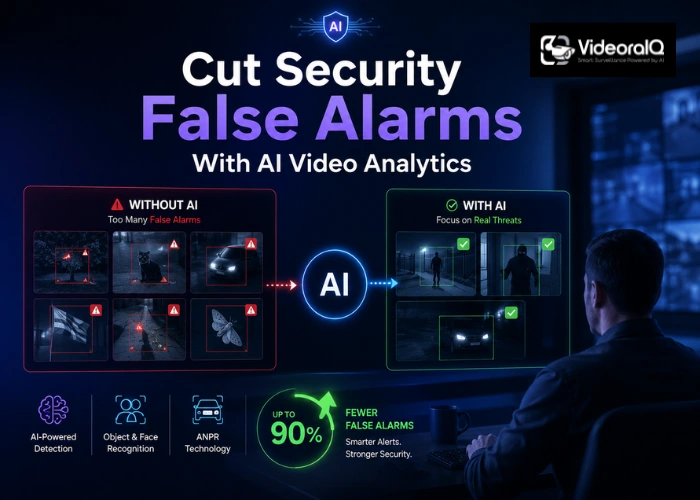
Picture a monitoring centre running 80 cameras across a retail estate. Three hundred-plus alerts a night. Operators are cycling through each one. In eleven months, the genuine intrusion count is single digits; the rest are delivery headlights, wind-blown signage, and the resident fox that triggers the car park feed at 2 a.m. every Tuesday. That is not an edge case. It is the operational baseline for most pixel-based motion detection deployments today, and it is exactly why operators quietly stop trusting the queue long before anyone notices on a quarterly review. VideoraIQ addresses this by classifying what actually moved, person, vehicle, animal, or noise artefact, before any alert reaches your team.
Listen to the podcast!
Why False Alarms Are So Expensive
- Municipal fines and permit revocations
Many U.S. cities charge per unverified police dispatch the exact amount varies by ordinance and some revoke alarm permits after repeat offenses within a 12-month window. A single busy retail site can absorb thousands of dollars in fines before anyone notices the pattern on a quarterly finance report. This is often the first hard number that pushes decision-makers to look at AI video analytics as a fix. - Alarm blindness
When the overwhelming majority of alerts are noise, operators stop trusting the system. That is alarm blindness, and it is precisely the condition under which a real intrusion slips through unreviewed. The failure mode is not technology. Human attention is exhausted by noise. AI video analytics addresses this directly by filtering out false triggers before they ever reach a human reviewer. - Wasted labor
Every nuisance alert is a manual video review. At 30–60 seconds per verification across hundreds of nightly triggers, one monitoring station burns hours on nothing billable time charged to the client or headcount that should be elsewhere. SNS Insider’s AI Video Analytics forecast tracks surging enterprise investment in exactly this problem: organisations that already have the cameras are now adding the intelligence layer because labour costs on manual verification have become indefensible at scale. This is the core value proposition of AI video analytics, replacing manual triage with automated, accurate detection. - Slower response to real threats
Genuine events sit in a queue behind noise. Verified response times stretch past the window where intervention actually matters. The cost is not always measurable in dollars.
What AI Video Analytics Actually Does Differently
Legacy motion detection asks one dumb question: Did enough pixels change? Wind, weather, and passing headlights all answer yes. A computer-vision model asks a smarter one: What object caused the change, and is it behaving in a way I care about?
Multiple independent surveillance industry analyses put AI video analytics-powered false alarm reduction at up to 90%, a figure corroborated across the industry and consistently cited in practitioner reviews. The mechanism is object classification, not motion thresholding. The difference matters architecturally.
Object classification
Instead of raw motion, the system detects and labels objects persons, cars, trucks, bicycles, and animals – with a confidence score on each detection. You configure the rule: alert only on humans between 8 PM and 6 AM. The swaying tree, the delivery van idling at the Curb, and the raccoon exploring the dumpster all go silent.
Rules that match real risk
Good AI video analytics encode intent, not just presence. The rule types that drive the most reduction:
- Tripwire/line crossing fire only when a person crosses a fence line in a specific direction. Not both directions. Not vehicles. Not weather artefacts. In VideoraIQ, an operator draws virtual tripwires directly on the camera feed; a breach triggers a real-time alert with timestamped video proof.
- Intrusion zones: Draw a polygon around a sensitive area; everything outside it is ignored regardless of movement. A zone breach brings an instant alert with a video clip, location tag, and timestamp.
- Unauthorised access: Defines which zones are off-limits and who is permitted. The moment someone attempts entry without authorisation, the system fires a live video link to the relevant operator. Behaviour, not mere presence, is the signal.
- Vehicle access (ANPR): The number plate recognition engine logs every entry and exit automatically and checks each plate against a blacklist at the gate. No human watches a feed to catch an unauthorised vehicle; the match happens at ingestion.
Fire and smoke visual AI video analytics ahead of heat sensors
One false-alarm category that rarely gets discussed is the inverse problem: delayed detection of genuine threats. VideoraIQ’s Fire & Smoke Detection identifies fire signatures visually. VideoraIQ reports, based on internal testing, that it identifies smoke and flames 40 to 60 seconds before traditional heat sensors trigger. That lead time matters operationally: the moment smoke or flames appear on camera, the safety team receives a live feed rather than waiting for a heat threshold to trip. The underlying mechanism of visual pattern recognition on combustion signatures, rather than ambient temperature, polling runs faster by design than a thermal trip sensor.
Read More!
Who Can Benefit from AI Video Analytics?
How AI Video Analytics Detects Fire And Intrusions?
Face Authentication for the Highest-Trust Zones
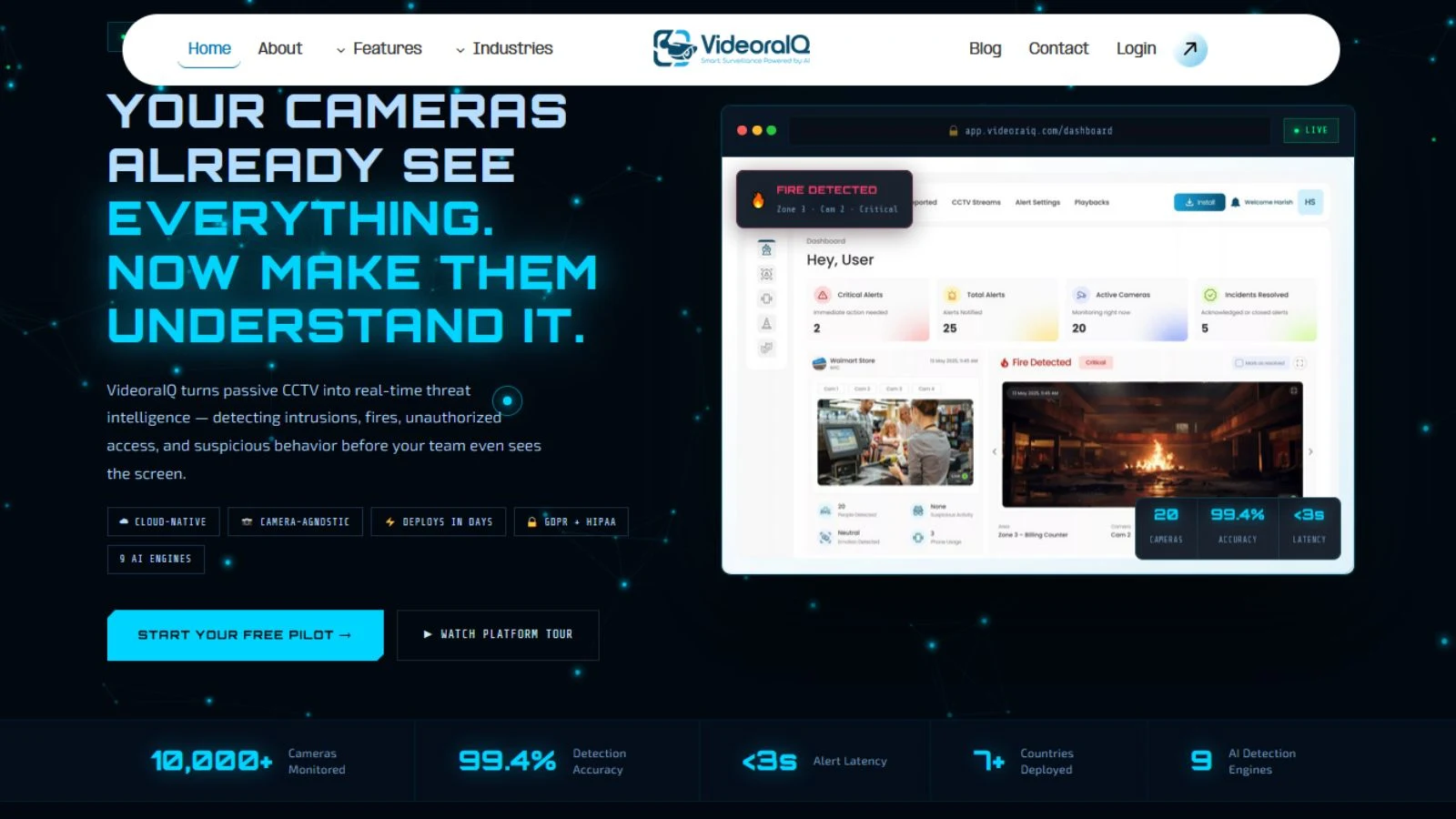
For controlled entrances, object classification is only the first filter. VideoraIQ adds face recognition on top; enrolled staff pass through without triggering anything. An unrecognised face at a secure door escalates instantly to a live operator.
The face recognition engine matches live camera feeds against watchlists and flags unknown visitors in restricted zones. VideoraIQ reports 99.4% detection accuracy and alert latency under three seconds in its own platform testing figures the company publishes on its product pages. Independent benchmarks such as NIST’s Face Recognition Vendor Test (FRVT) remain the gold standard for external validation; if that level of assurance matters for your procurement process, request VideoraIQ’s methodology alongside those external benchmarks. What operators need in practice is not a footnoted accuracy figure but the operational distinction: not “someone is at the door” but “an unauthorized someone is at the door,” surfaced fast enough to act on.
A Step-by-Step Rollout That Works
Step 1 Baseline your current noise:
Pull a week of alerts and count how many were genuinely actionable. If the ratio is low, you have a concrete reduction target to beat and a number that resonates with whoever approves the budget.
Step 2 Prioritize your worst cameras:
Start with the 3–5 feeds generating the most junk. It is almost always outdoor perimeter, parking lots, and anything aimed at a road or tree line. Fix the worst offenders first; the ROI story writes itself.
Step 3 Layer analytics onto existing streams:
VideoraIQ ingests standard RTSP/ONVIF feeds, so existing hardware stays in place. If you are unsure whether your current cameras qualify, the guide on AI video analytics add-ons for existing cameras covers compatibility in detail.
Step 4 Define zones and schedules per camera:
Mask out public sidewalks and roadways. Set separate rules for business hours versus after-hours. Pick which object classes matter where a back fence needs human detection; a vehicle bay needs human and plate recognition both.
Step 5 Tune confidence thresholds:
Run in monitor-only mode for a few nights. Review what was missed and what fired incorrectly, then adjust sensitivity before routing anything to live operators. Skipping this step is the single most common mistake in new deployments it destroys operator trust on day one, and trust lost early is slow to rebuild regardless of how the technology eventually performs.
Step 6 Route by severity:
A tripwire breach combined with an unrecognised face goes straight to a live operator. A low-confidence classification logs for asynchronous review. Treating all alerts identically recreates the noise problem you just solved.
Step 7 Measure and report:
Compare the week-two actionable-alert rate against your baseline. Translate the difference into fines avoided, review hours saved, and response-latency improvement. That is what finance actually listens to.
Ready to run that baseline? Start a free VideoraIQ trial and pull your week-one numbers. The gap between what you think your alert ratio is and what it actually is tends to be the most persuasive slide in any internal business case.
Mistakes That Keep False Alarms High
- Cameras aimed at moving backgrounds. Even strong models struggle with a feed dominated by a busy highway or wind-driven foliage across the entire frame. Reframe or zone it out the model can only work with what you give it.
- Leaving default sensitivity everywhere. A loading dock and a front lobby need different rules. One global threshold guarantees noise somewhere, usually the place you least want it.
- Skipping the monitor-only phase. Routing untuned alerts to operators on day one poisons the well fast. Operators who lose confidence in week one rarely reverse that judgment no matter how well the system performs later.
- Ignoring lighting. IR glare and headlight wash cause false detections even on good models. Pair analytics with adequate low-light cameras on critical lines, or add thermal on high-priority perimeters. No software compensates for a physically degraded image.
Where This Fits Against Traditional VMS
Platforms like Genetec, Milestone, and Avigilon are built to record and manage video. Their core value is storage, retrieval, and integration, not real-time event intelligence. Many deployments bolt analytics on as a secondary layer, which means the motion-detection logic still runs first and the AI video analytics layer inherits its noise rather than replacing it.
A purpose-built video-intelligence platform is architected the other way around: classification happens at ingestion, before any alert is queued. Operators review classified events not raw motion triggers. That architectural distinction, not a feature checklist, is what drives false alarm reduction at scale. The question to press in any vendor demo is not camera count or storage capacity it is where in the pipeline classification actually happens. For a deeper look at the mechanics, how intelligent AI video analytics differs from legacy approaches is worth reading before you sit down with any vendor.
The SNS Insider global AI Video Analytics forecast through 2035 tracks rapid expansion across enterprise, banking, telecom, and healthcare sectors that have already invested heavily in cameras and are now discovering the camera alone is not enough. The infrastructure is in place. The intelligence layer is what is being added.
See It on Your Own Cameras
The fastest way to believe a false alarm reduction figure is to watch it happen on your own feed. VideoraIQ connects to your existing ONVIF/RTSP cameras and adds object classification, intrusion zones, face authentication, fire and smoke detection, and ANPR. Verified events stream to operators in real time. The platform is already monitoring more than 10,000 cameras across seven-plus countries, built to GDPR and HIPAA compliance standards.
Bring your noisiest camera to the demo. We baseline it live and show you exactly how many of tonight’s alerts your team can safely stop reviewing.
Start your free VideoraIQ trial and measure the reduction yourself.