

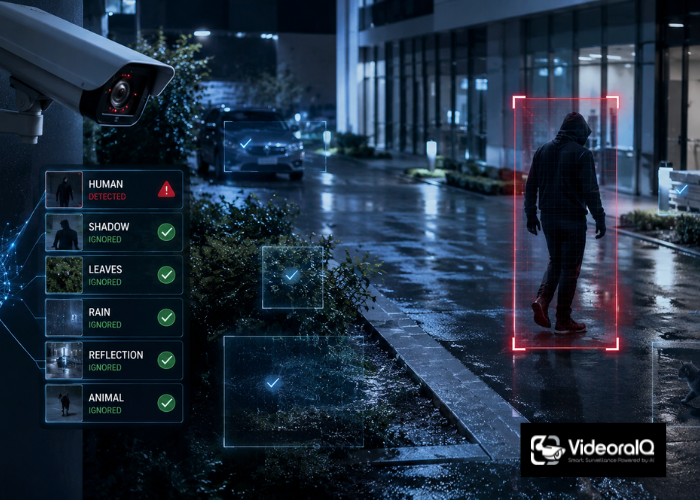
Your operators are not missing real threats because they lack cameras. They are missing them because they have stopped trusting the alerts. False alarm fatigue, not camera coverage, is the single biggest operational failure in enterprise surveillance today, and it is entirely self-inflicted.
The fix is not better hardware. It is replacing pixel-change triggers with object-level reasoning that understands what actually moved. That discipline is what VideoraIQ‘s computer-vision platform is built around, and this piece covers how it works in practice, which detection layers deliver the reduction, and what you must validate before committing to a deployment.
Listen to the podcast!
Why Pixel-Change Detection Was Always Going to Fail at Scale
Legacy VMS motion detection counts pixels. When there is enough change between frames, the system fires. It has no model of the scene, no concept of what moved, and no way to distinguish a person scaling a fence from a cloud shadow crossing the same ground. Those triggers are structurally indistinguishable to a counting algorithm.
The consequences compound fast. Operators monitoring multiple screens over long shifts stop treating alerts as meaningful signals because, statistically, they usually aren’t. The workarounds make things worse. Raising sensitivity thresholds reduces false positives but raises missed events. Shrinking detection zones creates coverage gaps. Adding time schedules creates predictable blind windows. You cannot tune your way out of a system that does not understand the scene.
Multiple independent analyses put false alarm reduction from AI-based object classification at up to 90% versus conventional motion triggers. That is not a marginal improvement; it is the difference between a queue operator’s trust and one they have learnt to ignore.
The Architecture Behind the Number

The core shift is from pixel counting to object recognition. A computer-vision model classifies each moving region per frame as a person, vehicle, animal, or environmental artefact and tracks that object across time. Wildlife, rain on a lens, headlights, and sensor noise fall outside the object classes that require a response. That single step eliminates the largest categories of nuisance triggers without touching detection sensitivity for real events.
Behavioural rules sit on top of classification and define intent. A forklift moving through a warehouse generates nothing. A person crossing a virtual tripwire on a perimeter fence at 02:14 generates a verified, timestamped alert with video proof attached. The distinction is specificity, not sensitivity, and specificity is what rebuilds operator trust.
For a deeper look at how these layers compose into a working system, VideoraIQ’s guide to intelligent video analytics covers the full detection pipeline from frame capture to alert dispatch.
Five Detection Layers and Why Each One Is Different
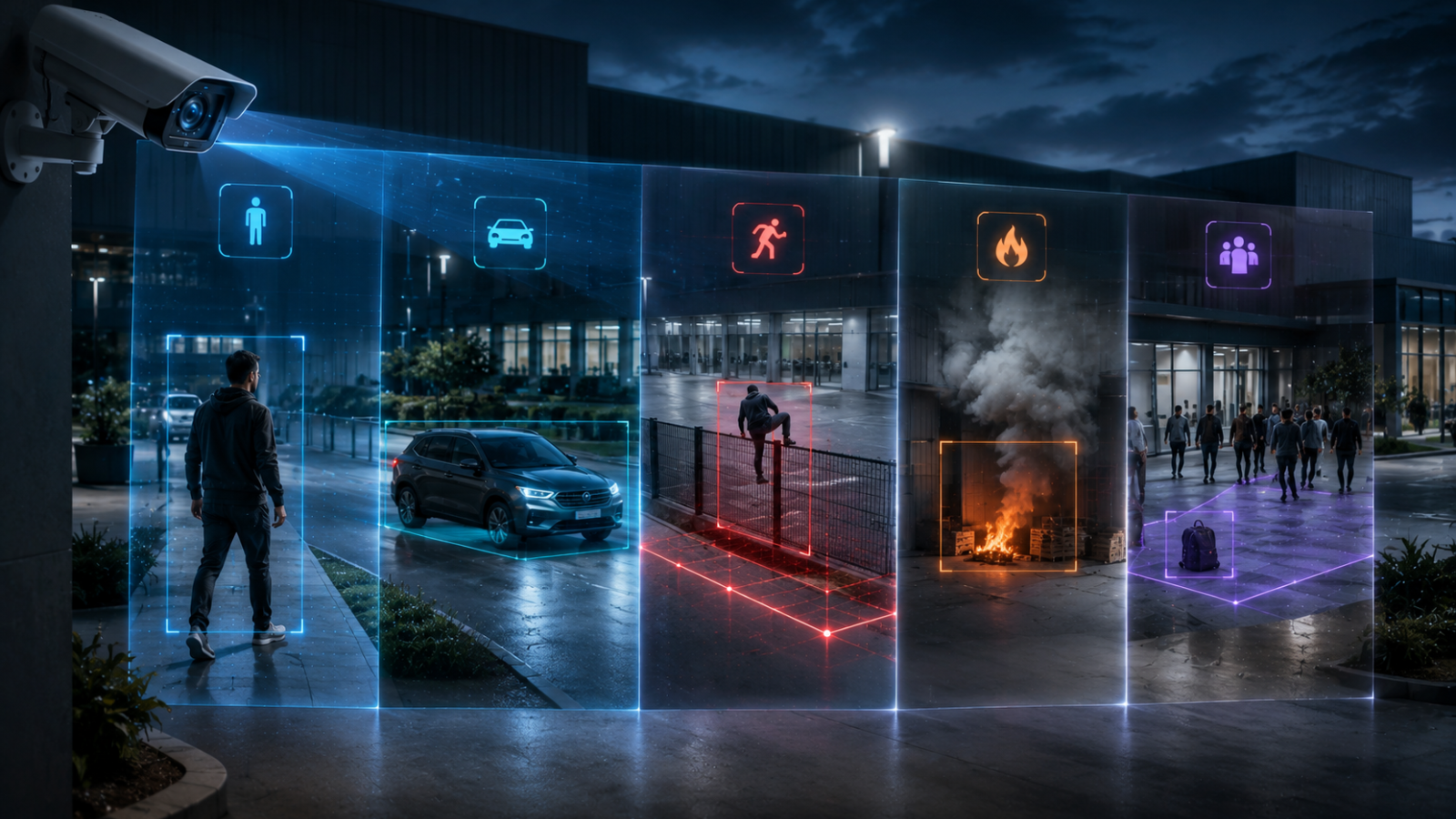
The mistake buyers make in evaluations is treating all behavioural detection as equivalent. These five layers operate on distinct trigger logic. Understanding the difference determines where each one belongs in your deployment.
Line-Cross Detection: Operator-Defined Tripwires
Operators draw virtual tripwires directly on a live camera feed. Direction matters; a person walking parallel to the line, or crossing at a permitted entry point, generates nothing. Only a crossing of that exact line, in the defined direction, fires an alert with a timestamped clip. This is the configuration that converts hundreds of nightly environmental triggers into a short, actionable queue. It also integrates with access control and automated lighting, so responses happen without operator intervention when the rule is clear enough.
Unauthorized Access: Zone Logic, Not Perimeter Logic
Where line-cross detection watches boundaries, unauthorised access watches interiors. Operators define polygon zones for server rooms, cashier stations, and warehouse storage bays, and the system fires only when a person enters that polygon outside authorised conditions. The alert carries a live video link, not a clip request that arrives minutes later. Floor managers get notified the instant a cashier station goes unmanned. That operational difference, live feed versus retroactive review determines whether you can actually intervene.
Intrusion Detection: Context in One Packet
Every zone breach bundles the video clip, location tag, and timestamp into a single alert. The operator has full context before touching a radio – no secondary camera lookup, no feed-switching to reconstruct what happened. VideoraIQ monitors more than 10,000 cameras across enterprise, banking, telecom, and healthcare environments, with every alert structured this way from the moment of detection.
Face Recognition: Scope Limiting Prevents Alert Explosion
Running facial matching across every camera indiscriminately is the fastest way to recreate the false-alarm problem you started with, just with faces instead of pixels. VideoraIQ’s Face recognition engine flags unknown visitors only in restricted zones, not in open public areas. Watchlist matching runs in real time. Access logs are generated automatically. The operator sees a flag only when the match or non-match is operationally significant.
Fire and Smoke Detection: A Category Apart
This one deserves separate treatment because the stakes are different. Visual AI identifies fire signatures 40–60 seconds ahead of traditional heat sensors that speed comes from the same frame-by-frame inference architecture, applied to a life-safety context where sensor placement creates inherent coverage gaps. The safety team receives a live feed the moment smoke or flame is visually detected, not after a heat threshold is crossed. In a manufacturing facility, that window is not marginal. It is the difference between evacuation and escalation.
The Three Numbers You Need and One Trap
Evaluating analytics on false-alarm reduction alone is a trap. A vendor quoting a large reduction figure without publishing a recall number may simply be under-triggering, missing real events while appearing to perform well. Insist on three metrics together:
- False alarm reduction: The headline figure. AI object classification reduces false alarms by up to 90% versus conventional triggers. Validate this against your own site’s baseline, not a vendor benchmark run on ideal footage.
- Detection accuracy (recall): VideoraIQ publishes 99.4% detection accuracy across its monitored fleet. That figure is from VideoraIQ’s own platform data and should be verified in your pilot against your camera mix and lighting conditions. The point stands regardless of source: recall and false-alarm reduction must be measured together, or neither number is meaningful.
- Alert latency: For live intervention, the detection-to-alert window is a hard requirement. VideoraIQ reports alert latency under 3 seconds. Cloud-only round trips in competing platforms can add enough delay to make live responses impractical at scale.
Any pilot who does not measure all three has not answered the question.
Read more:
What Is A Fire Alarm System? (Fire Detection System Explained)
AI Video Analytics: Cut CCTV False Alarms 90% (2026)
Where False Alarm Reduction Pays Off Fastest
Manufacturing and Industrial Plants
Large floors, outdoor yards, and loading bays produce constant motion from machinery, forklifts, dust, and steam that fire conventional motion detectors continuously. The practical deployment pattern is layered, not monolithic.
Line-cross tripwires go across loading bay access points to catch unauthorised vehicle entry. Unauthorised access rules cover machinery exclusion zones. ANPR logs every delivery vehicle’s plate against an approved vendor list at the gate. The result: alerts arrive only when a behaviourally defined condition is violated, not when a forklift crosses the same frame for the hundredth time.
In the cashier absence use case, floor managers are alerted the instant a station goes unmanned applies the same zone-trigger logic to staffing compliance rather than perimeter security. Same architecture, different operational context.
Banking and Financial Premises
Banking combines high-value targets with strict compliance requirements. ANPR logs vehicle entry and exit automatically against a blacklist at every gate. Face Recognition flags watchlist matches in restricted zones. Both reduce investigator workload without expanding the alert queue.
VideoraIQ’s GDPR and HIPAA compliance framework matters here specifically. Analytics that introduce privacy liability create more operational risk than they eliminate, and in a regulated environment, the compliance posture is not optional.
Healthcare and Public Safety
Healthcare sites need zone-specific access control without blanketing the facility in alerts. Sensitive zone definitions around medication storage and records rooms generate alerts only where and when entry is unauthorised; volumes stay manageable because the rules are spatially bounded.
Public safety deployments add vehicle-flow analysis that distinguishes a stalled vehicle from normal traffic, rather than alerting on every movement across a busy intersection feed. VideoraIQ is deployed in 7+ countries, with latency and bandwidth architectures adapted to each region’s infrastructure constraints a rigid cloud-only model cannot serve both a European banking campus and a Southeast Asian manufacturing complex.
Edge vs. Central Processing: A Practical Decision Framework
Running detection at the edge on a local gateway or at the camera keeps alert latency tight and maintains operation during WAN outages. Only verified event clips travel the network; 24/7 raw streams stay local. Central aggregation handles cross-site search, reporting, and model updates.
Most serious deployments run hybrid. Edge inference for real-time alerting, central processing for analytics and fleet management. The fire and smoke detection case makes the trade-off concrete: the 40–60-second advantage over heat sensors disappears if inference has to round-trip to a remote data centre before generating an alert. Speed comes from keeping inference close to the camera.
For a broader look at how CCTV analytics software fits into existing infrastructure, the architecture choices are covered in more depth there.
What to Validate Before You Deploy
Run a scoped pilot on your five to ten worst-offending cameras. Log one full week of the current false alarm volume per camera; that is your previous number. Deploy and configure one or more camera behavioural rules per view based on what actually matters at that location, run for two weeks with real operator feedback, then measure reduction against recall. No single-axis benchmark replaces this.
Four things to verify before signing:
- Integration: RTSP and ONVIF compatibility with your existing VMS avoids a rip-and-replace. Confirm it works with your current camera mix.
- Low-light accuracy: Most nuisance events and real intrusions happen at night. Daytime benchmarks are not the relevant test.
- Compliance posture: Confirm GDPR or HIPAA alignment before any biometric data is processed in your region.
- Latency source: Understand exactly where in the pipeline frame capture, inference, classification, and dispatch latency is introduced and where it can be controlled.
The 10 key features to evaluate in a video analytics platform are a useful checklist for structuring that vendor conversation.
The Actual Problem Is Trust, Not Volume
Alert volume is a symptom. The real problem is that operators stop trusting the queue, and once that happens, the camera infrastructure you invested in becomes passive recording rather than active protection. Object classification, behavioral rules, and zone-specific logic rebuild that trust by ensuring alerts carry meaning before they reach a human.
That is not a technical claim. It is an operational one. The cameras were always there. The question is whether the alerts they generate are worth acting on.
Start your free VideoraIQ trial and pilot the platform on your highest-noise cameras; measure the false alarm drop against your own baseline, with recall intact, before any broader commitment.