

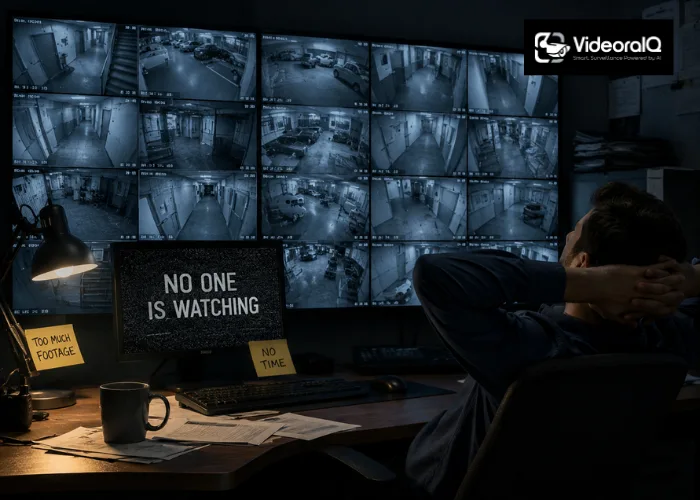
Industry research shows that 64% of retail security managers only pull CCTV footage after an incident has already occurred—a theft, an injury, a complaint. Only 12% perform regular reviews more than once a week. Those numbers describe retail, but the pattern holds everywhere: cameras run 24/7, and only a small fraction of recorded footage is ever reviewed before something goes wrong. Think about what that means for a 200-camera campus. Your team is realistically watching a fraction of what happens and hoping the rest stays quiet.
This is exactly the problem VideoraIQ‘s AI video surveillance platform is built to solve—not replace cameras, but make every frame actionable. The pitch is simple. Execution is where buyers routinely go wrong.
Listen to the podcast!
The Monitoring Gap Nobody Budgets For
Security directors tend to measure investment in hardware: camera count, resolution, and storage capacity. Those numbers look good in procurement reports. They say nothing about whether a threat at camera 147 will surface to an operator before the window to respond closes.
Alert latency is the metric that actually matters in live operations. Sub-3-second alert delivery is the operational standard that separates reactive logging from genuine intervention capability. A delay at a vehicle gate means the vehicle may already be inside the perimeter before any operator can act. You have footage. You have no response capability.
Most legacy systems were never designed around that constraint. They log. They record. They surface alerts when the system feels like it—often in batches, often after a manual refresh. The monitoring gap is not a camera problem. It is an architecture problem.
Why Single-Engine Deployments Compound the Problem

The market default has been to solve one detection problem at a time. A face recognition module here, an ANPR system there, and a separate fire detection appliance somewhere else. Each produces its own alert queue. Each has its own event timeline. When an incident touches two systems—a vehicle tailgating behind a watchlisted individual, for instance—the security team gets mismatched flags from two separate dashboards and manually correlates them while the situation develops.
That manual correlation step is not a workflow feature. It is a gap in your response chain.
VideoraIQ runs multiple AI detection engines simultaneously across the same camera feeds—face recognition, ANPR, fire and smoke detection, line-cross, intrusion detection, and unauthorised access—without requiring separate hardware or separate alert queues per engine. One feed. One unified alert. One timestamp the team can act on.
What 99.4% Accuracy Actually Costs You If You Get It Wrong
Accuracy figures deserve scrutiny because the math cuts both ways. At 99.4% detection accuracy with alert latency under three seconds, most genuine threats surface fast and cleanly. Drop meaningfully below that on a large deployment and the calculus flips: false-positive volume climbs fast enough that operators stop reviewing attached footage. Real events get buried. You have recreated the monitoring gap algorithmically.
False alarm fatigue is “the single biggest operational failure in enterprise surveillance today.” That is VideoraIQ’s own operational finding—and it is the correct diagnosis. AI-based object classification reduces false alarms by up to 90% versus conventional motion triggers. Below a reliable accuracy threshold, a system trains its own operators to ignore it. That is the failure mode procurement rarely models.
The false-positive cost also carries a compliance tail. Under GDPR Article 9, biometric data used for identification is special-category data. A false-positive match resulting in someone being stopped or denied access creates demonstrable harm tied to a data-processing event. A noisy system is not just operationally annoying—it is a liability surface. VideoraIQ is GDPR and HIPAA compliant, which matters not just for regulated industries but for any deployment handling biometric or vehicle data under regional privacy law.
The Detection Engines That Close the Blind Spot
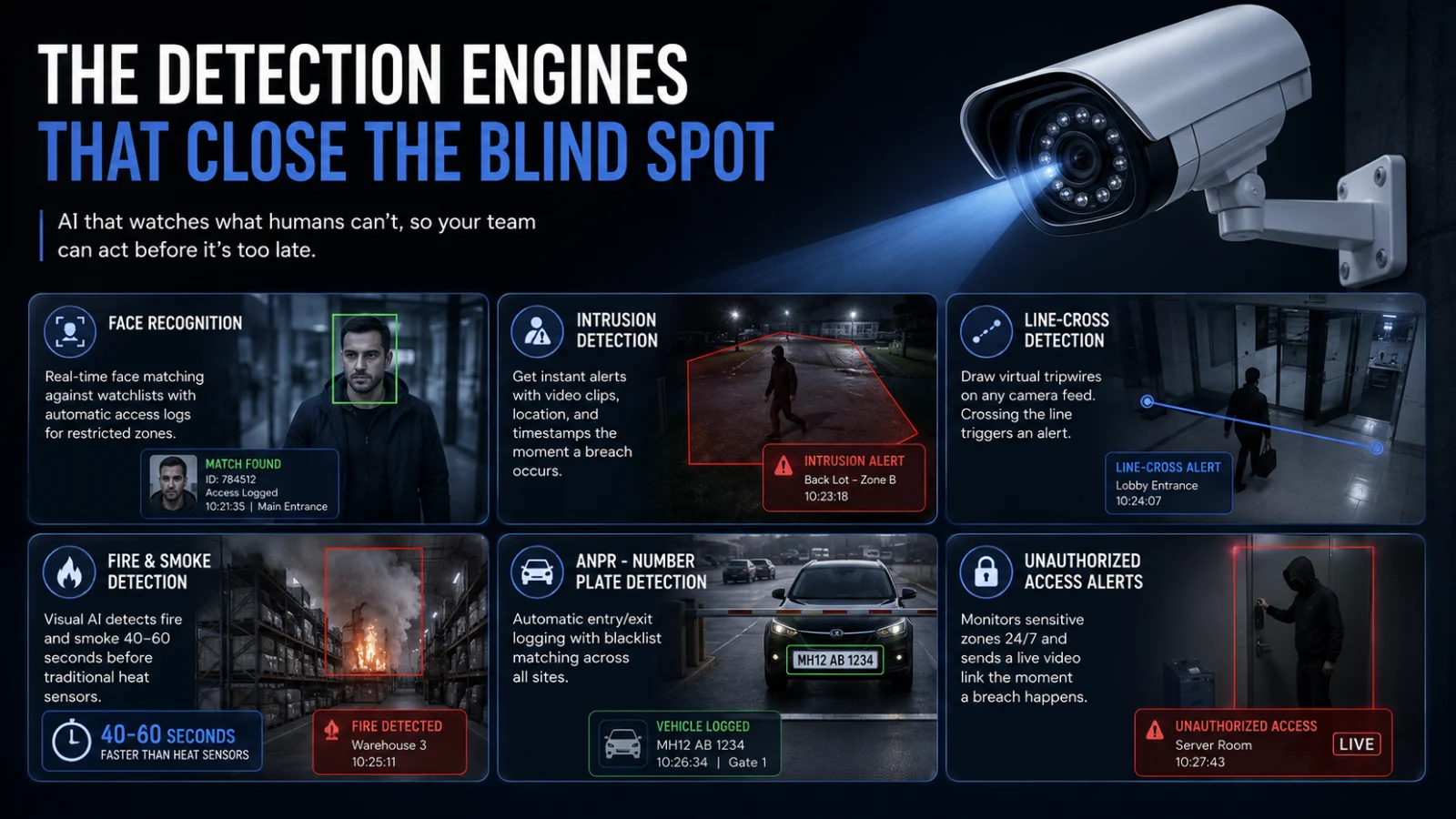
Closing the gap requires detection that works without a human watching. Here is how the core engines operate in practice.
Face Recognition
Faces are matched in real time against watchlists the moment they appear in frame, and automatic access logs are generated without an operator confirmation step. That matters in post-incident forensics: manual access logging creates audit trail gaps that are hard to defend in a compliance review. VideoraIQ scopes face recognition to restricted zones rather than open public areas—a deliberate design choice that prevents alert volume from exploding across high-footfall spaces.
Intrusion Detection
When a restricted zone breach occurs, the security team receives an alert with an attached video clip, a location tag, and a timestamp—automatically. No one needs to be watching that camera at that moment. The system is.
Line-Cross Detection
Operators draw virtual tripwires directly on a camera feed. Any crossing triggers an alert. This is useful precisely because the geometry can change: a loading dock that is unrestricted during shift hours but sensitive at night gets a different tripwire configuration for each window. The operator sets it; the system enforces it.
Fire and Smoke Detection
This one has a hard number worth stating plainly: visual AI identifies fire and smoke 40–60 seconds before traditional heat sensors. In a manufacturing environment with flammable materials, 40 seconds is the difference between a contained incident and an evacuation. Heat sensors respond to temperature change. The AI responds to what it sees—which happens earlier.
ANPR and Unauthorised Access
Every vehicle entry and exit is logged automatically with blacklist matching across all sites. No gate operator needed to record or cross-reference. Separately, the Unauthorised Access engine monitors sensitive zones continuously, delivering a live video link the moment a breach occurs—not a clip request that arrives minutes later, when intervention is already impossible.
Compatibility: The Reason Pilots Succeed or Stall
The deployment question buyers underestimate is infrastructure compatibility. VideoraIQ’s analytics layer sits on top of existing IP camera hardware, which changes the pilot economics entirely—no rip-and-replace project required before you can test what you are actually buying.
The right pilot methodology: start with a defined subset of cameras at high-traffic entry points before committing to a full rollout. Test during peak hours, in low-light conditions, and through watchlist update cycles. Two metrics matter—false-positive rate and mean time from event to operator receipt. Both are measurable within the first weeks of operation. If false positives are high on a small camera set, extrapolate that noise to the full deployment, and you will understand why it matters to test before you scale.
VideoraIQ monitors over 10,000 cameras across deployments in seven or more countries, spanning public safety and manufacturing environments. The platform’s CCTV video analytics infrastructure is built to operate at that scale without degrading alert quality—which is the only claim about scale that actually matters at procurement time.
The Straightforward Buyer Checklist
- Set a high accuracy bar and hold to it. VideoraIQ publishes 99.4% detection accuracy across its monitored fleet. Treat that as the reference point. A system that falls materially short generates enough false positives to make operators stop trusting alerts entirely.
- Measure alert latency before you sign anything. Under 3 seconds is the operational standard. Ask to see it demonstrated on your own camera feeds, not a vendor demo environment.
- Run the pilot on your worst-case camera positions. Not the ones you want to succeed—the ones with poor lighting, high pedestrian density, and awkward angles. If the system holds up there, you know what you are buying.
- Audit your storage and retention setup first. AI analytics surface more actionable events, which means footage you now actually want to keep. Review your CCTV storage architecture before deployment, not after.
- Check compliance scope at the outset. Biometric and vehicle data trigger obligations under GDPR, HIPAA, and increasingly the EU AI Act. A platform that is not compliant on day one will require costly remediation later.
The monitoring gap is not a horror story. It is a fixable architectural problem. Every unmonitored feed can be handed to an AI detection engine. It does not fatigue, take breaks, or batch alerts at shift end. The question is whether the system you choose is accurate enough not to recreate the gap in a different form.
Start your free VideoraIQ trial and find out how many of your cameras are actually working for you.