

A 200-camera corporate campus running face recognition at 95–97% accuracy generates hundreds of false-positive alerts every single day. Not dozens. Hundreds. Security buyers rarely run that arithmetic before signing a contract, and by the time the noise becomes unworkable, they’ve already committed the budget.
This is the specific mistake I see most often when organisations shortlist video intelligence platforms: they evaluate accuracy as a headline percentage and skip the operational stress test entirely. The percentage looks fine on a spec sheet. The alert volume looks catastrophic at 2 AM when your team is drowning in pings that go nowhere.
Here is the framework that actually protects you.
Listen to this podcast!
Why the Accuracy Percentage Is the Wrong Starting Point
The maths are brutal once you apply them. A platform claiming 97% accuracy misfires on 3% of every face-match attempt. On a busy multi-camera site that compounds into hundreds of actionable-looking pings before a single real threat appears — that is the arithmetic a 200-camera campus at 95–97% accuracy actually produces. Stack it across a multi-site deployment and you have not built a security operation; you have built a noise machine.
The recommended minimum threshold for 24/7 SOC teams is ≥99% detection accuracy. Below that, the false-positive volume swamps the team before a real threat has time to escalate. That one percentage point between 97% and 99% is not a marginal improvement — it is the difference between a workable operation and a broken one.
The industry-wide consequences of getting this wrong are well documented. According to the SANS 2025 Detection and Response Survey, 73% of security teams cite false positives as their number one detection challenge. Alert fatigue is a top concern for 76% of organisations, and between 46% and 83% of SOC alerts turn out to be false. More noise creates more cover for the threats that actually matter.
That context matters when you are evaluating a face recognition platform, because every vendor demo runs in ideal conditions: good lighting, cooperative subjects, a curated watchlist. Your site will not look like that demo. Your pilot should.
The Three Conditions Your Pilot Must Cover
Before scaling to a multi-hundred-camera deployment, start with approximately 20 cameras. If false positives exceed a handful per shift at that scale, the extrapolated noise across 200 cameras is unworkable — run that extrapolation explicitly before you commit.
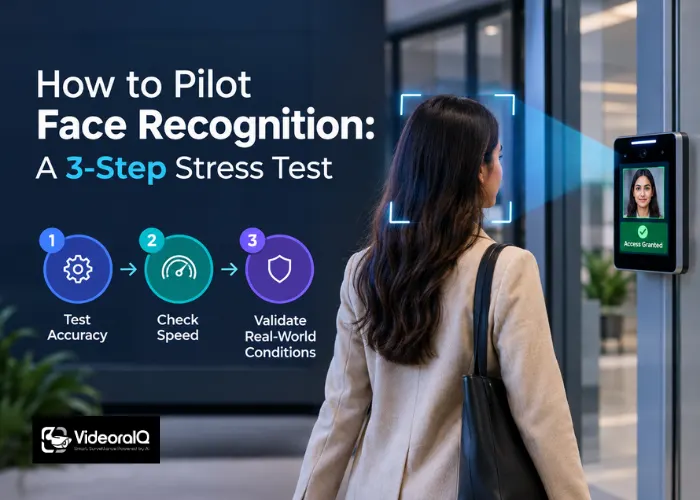
For those 20 cameras, run the system through three specific conditions:
1. High-Traffic Entry Points at Peak Hours
This is where most pilots start and stop. It is necessary but not sufficient. You want to see how the system performs when the volume of face-match attempts is highest and the margin for error is lowest. A crowded lobby at 8:30 AM is not a stress test — it is baseline. If the platform struggles here, disqualify it immediately. If it clears this condition cleanly, move on.
2. Low-Light and Adverse Weather at Perimeter Lines
Perimeter cameras at night, in rain, or with glare from vehicle headlights produce the images that break systems trained on clean indoor data. Most vendors will not suggest you test here. You should insist.
This is also the condition where demographic variation in false positive rates becomes operationally significant. NIST research has documented that top-performing face recognition systems can produce dramatically higher false positive rates across certain demographic groups — and that variation shows up most starkly in degraded imaging conditions. Run this condition for at least one full overnight shift. The results will tell you more than any daytime demonstration.
3. Watchlist Update Speed Measured Mid-Shift
This is the condition almost no buyer thinks to test. A watchlist that takes 20 minutes to propagate across all cameras after a new entry is added is a liability, not a feature. If your security team adds a person of interest at 11 PM and the update does not reach perimeter cameras until 11:20 PM, you have a gap. Test this explicitly: add a test entry to the watchlist mid-shift and measure how long it takes for every camera in the pilot to reflect the change.
The Two KPIs That Actually Matter
During the pilot, track exactly two things. Not system uptime. Not integration scores. These two:
False positive rate — the percentage of alerts that require no action. This is your operational noise floor. Everything the team investigates that turns out to be nothing is time and attention pulled away from the real events.
Mean time from event to operator receipt — how long elapses between a triggering event and a security team member receiving an actionable alert. Sub-3-second alert delivery is the gold standard for live response in high-throughput environments like airports and transit stations. Sub-5-second is the minimum acceptable threshold — and a 15-second delay at a vehicle gate means the vehicle is already inside the perimeter before any operator can act.
Pay close attention to what the alert actually contains when it arrives. A bare notification — “face match detected” with no supporting context — forces the operator to pull footage manually before they can make any decision. An alert that arrives with an attached video clip, a location tag, and a timestamp cuts that decision time dramatically. These are not equivalent products even if both claim the same accuracy figure.
What to Do With the Pilot Results
If false positives exceed a handful per shift on 20 cameras, do not rationalise it. The extrapolation is simple and the outcome is already determined: that system, at full deployment scale, will produce a volume of noise your team cannot manage. The answer is not to tune the sensitivity settings post-deployment. The answer is to choose a different platform during the pilot.
Compliance is a parallel check, not an afterthought. Face recognition data sits at the intersection of multiple regulatory frameworks — GDPR, HIPAA, CCPA, and BIPA depending on your jurisdiction and sector. Confirm during the pilot that the platform’s data handling, retention policies, and audit logging actually satisfy the frameworks that apply to your organisation, not just the ones the vendor lists in its marketing materials.
One more thing worth verifying: whether the platform you are piloting runs face recognition as a standalone module or as part of an integrated detection layer. Sites running separate face recognition and ANPR platforms produce duplicate alerts and mismatched event timelines, which forces guards to manually correlate events while a vehicle has already cleared a barrier. The coordination overhead compounds the alert fatigue problem rather than solving it.
Read More!
Face Recognition Compliance: Deploy Without Legal Risk
Face Recognition False Positives: Your Hidden GDPR Bill
A Note on Scale

VideoraIQ states a 99.4% detection accuracy across its deployments, alert delivery in under 3 seconds, and coverage across more than 10,000 cameras in 7 or more countries. Those are the company’s own stated figures — and they illustrate the right benchmarks to hold any platform against during a pilot. Whether you evaluate VideoraIQ or a competitor, the stress test conditions above will tell you whether those headline numbers hold in your specific environment, under your specific conditions, with your specific watchlists.
85% of CCTV footage is never reviewed by human teams. The value of a face recognition platform is not that it records everything — it is that it surfaces the right events, fast enough to act on, without generating so much noise that the real signals get lost. The pilot is how you verify that promise before you are locked in.
Run the three conditions. Track the two KPIs. Extrapolate the false positive rate to full scale before you sign anything. That sequence has saved more than one security team from a very expensive mistake.
Start your free VideoraIQ trial and run the stress test on your own cameras — the pilot framework above is exactly the structure we recommend for every new deployment evaluation.