

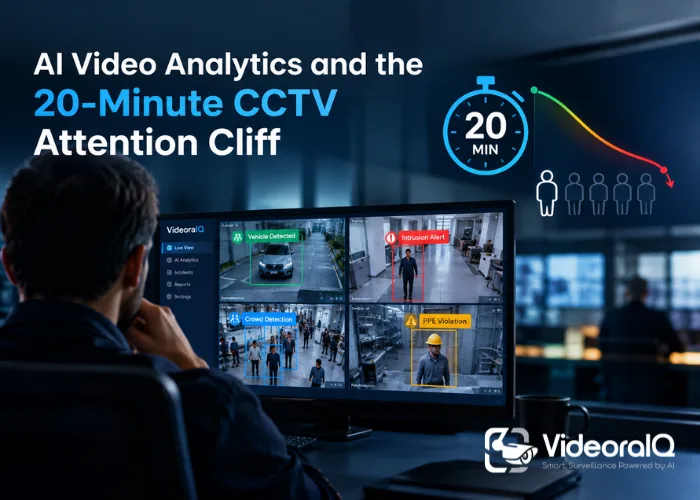
Every security rota I have ever seen is built on a quiet fiction. A trained operator, seated in front of a wall of monitors, is expected to notice a threat at hour seven with the same sharpness they had at minute one. The research says otherwise. Human operators hit measurable attention fatigue within 20 minutes of monitoring live feeds. Shifts are eight hours. Nobody in procurement talks about what happens in the gap.
That gap is where incidents live.
Listen to this podcast!
What “monitoring” actually means at scale
The numbers are uncomfortable to read in sequence. The average operator is simultaneously watching between 20 and 60 feeds at once. Eighty-five percent of CCTV footage is never reviewed at all. Sixty-one percent of security teams have ignored an alert that later turned out to be critical. These are not edge-case failures at badly-run facilities. They are structural outcomes of a model that asks humans to do something humans cannot sustain: focused visual attention across dozens of simultaneous streams for hours at a time.
Cognitive science has known this for decades. Sustained attention tasks degrade sharply after roughly 20 minutes, and the degradation is not visible to the person experiencing it. The operator does not feel less alert. They feel fine. The missed event in the corner of camera 34 at the 47-minute mark does not announce itself.
The standard industry response — more cameras, bigger screens, stricter procedures — makes the problem worse, not better. Each additional feed is another stream competing for the same finite attentional resource. Procedures create paperwork; they do not restore concentration.
The design error hiding in plain sight
Here is what I keep seeing in security procurement decisions: buyers evaluate camera resolution, storage capacity, and frame rate. They benchmark VMS licensing costs. They seldom ask what the system demands of the person sitting in front of it eight hours later.
Legacy VMS motion detection, as documented in the AI false-alarm problem, fires when pixel change between frames exceeds a threshold — no model of the scene, no understanding of context. Cloud shadows and a person scaling a fence are structurally indistinguishable to the algorithm. So operators learn to ignore alerts. That learned ignore reflex is not laziness; it is the only rational adaptation to a system generating constant noise. Then a real event fires. The reflex holds.
The 2025 Unit 42 Global Incident Response Report, drawing on 700 real-world investigations across 49 countries, named alert fatigue as a critical vulnerability that sophisticated attackers are actively exploiting. It is not a personnel problem. It is an architecture problem.
Rethinking the model: event-driven versus attention-dependent

The right frame is not “how do we make operators more attentive?” The right frame is “how do we remove the dependency on sustained human attention for first detection?”
This is what AI video analytics actually changes — not picture quality, not storage efficiency, but the fundamental operating model. Instead of a human scanning feeds hoping to notice something, the system detects specific conditions and surfaces only confirmed events. The operator becomes a responder and decision-maker, not a watcher. That is a job a human can do well for eight hours.
VideoraIQ structures this around event-specific modules rather than generic motion sensing. Intrusion Detection fires only when a person enters a defined polygon zone — a server room, a cashier station, a warehouse storage bay — not on every person passing the corridor outside it. Line-Cross Detection lets an operator draw virtual tripwires directly on a live camera feed, with direction configured so a person walking parallel to the line or crossing at a permitted entry point generates no alert. Unauthorised access flags sensitive zones with live video alerts. Face Recognition matches against watchlists in real time and generates automatic access logs, removing the need for an operator to recognize individuals manually.
Each of these replaces a sustained-attention task with a confirmation task. The operator does not need to watch a zone for hours. They need to respond when the system tells them something happened there — with an attached video clip, location tag, and timestamp already in hand.
The latency question nobody asks at the right moment
Alert speed matters more than most buyers realise, and they usually realise it too late. Anything over five seconds is too slow for an active threat. The window between a breach and an opportunity to intercept it is measured in seconds, not minutes.
A system that takes 30 seconds to surface an alert is not a real-time system, regardless of what the spec sheet says. Batch processing on the server side, extra routing hops, buffered delivery — each adds seconds that compound into a response window that has already closed.
VideoraIQ claims an alert delivery target of under three seconds from detection, across a monitored fleet of more than 10,000 cameras across 7+ countries. Those are first-party claims and should be tested against your own infrastructure in a proof of concept, but the threshold itself is right. If a vendor cannot tell you their alert latency in seconds — not “near real-time” or “low latency” — treat it as a red flag.
What the transition actually looks like operationally
Moving from attention-dependent to event-driven monitoring is not a single cutover. The teams that do it well usually follow a sequence.
- Audit which tasks currently require sustained watching. Zone monitoring for restricted areas, cashier station occupancy, vehicle entry and exit — list every task where the current answer is “someone watches that feed.” These are your highest-value replacement candidates.
- Define the trigger conditions precisely before configuring anything. Intrusion detection scoped to a vague “back area” will fire on maintenance staff and generate the noise problem you are trying to solve. A defined polygon around a specific server room door does not. The same discipline applies to Line-Cross Detection: direction matters, and entry-point exclusions matter.
- Run recall checks, not just precision checks. A vendor quoting a large false-alarm reduction number without publishing a detection rate may simply be under-triggering — missing real events while appearing to perform well. Multiple independent analyses put false alarm reduction from AI-based object classification at up to 90% versus conventional motion triggers. That figure is only useful if detection rate holds up alongside it.
- Restructure operator workflow around response, not surveillance. If your operators are still expected to watch feeds continuously after the system is deployed, you have not changed the model. The shift design should reflect the new reality: operators handle confirmed alerts, investigate clips, coordinate response. The system watches the feeds.
- Audit evidence quality early. Investigations stall when evidence lacks clean timestamps, camera IDs, or location tags. Each of those is a documented operational failure, not an edge case. Verify that alerts arrive with all three before you are in a situation where it matters.
The compliance dimension
There is a secondary problem that operational teams often miss until an audit surfaces it. When an operator manually raises detection thresholds to quiet a noisy system — a common coping mechanism — missed events become compliance gaps, those gaps become audit findings, and those findings become fines. The entire chain starts with a system that was never designed to be quiet in the right way. False negatives from over-raised thresholds are not a performance metric footnote; they are a regulatory liability.
GDPR and HIPAA compliance on the platform side matters too, particularly for deployments involving face recognition. VideoraIQ claims both certifications. If your vendor cannot confirm compliance status for your jurisdiction, the scoping conversation about face recognition should not proceed.
Read More:
What Is AI Video Analytics? A Complete Guide For Businesses
How AI Video Analytics Detects Fire And Intrusions?
Where this leaves security buyers in 2026
Europe accounted for 27.2% of the global video content analytics market in 2025, valued at USD 1.15 billion, with a projected CAGR of 19.8%, according to Straits Research. Adoption is accelerating, which means procurement decisions made now will shape operational models for years. The buyers who will regret those decisions are not the ones who chose wrong cameras. They are the ones who bought AI analytics and kept the attention-dependent operating model underneath it.
The 20-minute cliff does not move because you install new software. It moves when the software takes over the task that was breaking operators in the first place.
If your current setup still expects a human to catch a threat by watching the right camera at the right second, the architecture has not changed — only the resolution has.
See how alert fatigue is actively exploited by attackers, or read the full breakdown of how AI analytics cuts CCTV false alarms — both cover the operational failure modes in detail.
Start your free VideoraIQ trial and replace attention-dependent monitoring with event-driven security — before the next shift begins.