

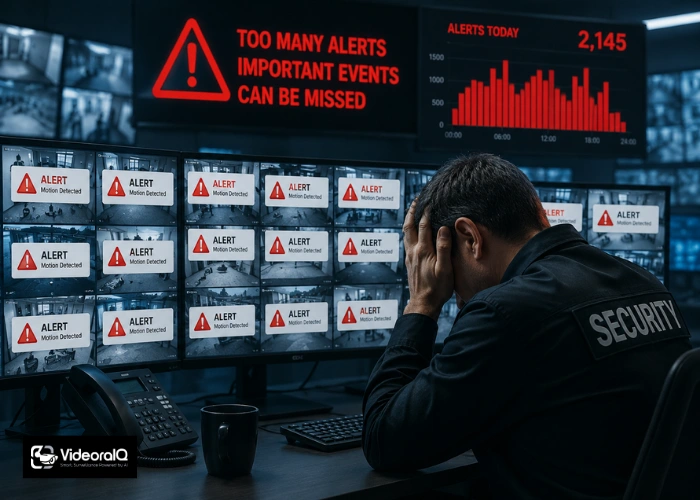
Sixty-one per cent of security teams have ignored an alert that later turned out to be critical. Not because they were careless. Because they were buried.
The AI SOC Market Landscape 2025 found that 40% of alerts are never investigated, while the average organisation fields 960 alerts daily from roughly 28 different tools. That research is framed around cybersecurity, but the failure mode it describes – teams so overwhelmed by volume that they stop trusting their own alert queues – applies with even sharper force to physical surveillance operations.
Here is the uncomfortable truth most vendors won’t say out loud: deploying more cameras without solving the alert quality problem does not make a site safer. It accelerates the fatigue that was already degrading your team.
Listen to the podcast!
The Attention Problem Is Already Baked In
Before a single alert fires, your operators are already fighting biology. Human operators hit attention fatigue within 20 minutes of monitoring live feeds, and most are simultaneously watching between 20 and 60 feeds at once. Against that baseline, 85% of CCTV footage is never reviewed at all.
That last number deserves to sit for a moment. Not because it is shocking; anyone who has worked a control room shift knows it, but because it exposes the fundamental lie of camera count as a security metric. The camera exists. The footage exists. The threat may well have been captured. Nobody saw it in time.
Add a poorly configured analytics layer, and you accelerate the problem. Legacy detection systems tuned too sensitively fire on shadows, headlights, and pigeons. Operators learn quickly that most alerts are noise. The 2025 Unit 42 Global Incident Response Report drew on 700 real-world investigations across 49 countries and named alert fatigue as a critical vulnerability that sophisticated attackers are actively exploiting. Not by evading detection, but by generating enough noise that real signals get ignored. Physical security is no different.
Context Is the Cure, Not Lower Volume

When alert fatigue hits, the instinct is to raise thresholds and reduce alert volume. That instinct is wrong. You are not solving the problem; you are converting false positives into false negatives. As our own analysis of surveillance deployments has documented, false negatives become compliance gaps, which turn into audit findings and fines.
The actual fix is context. An alert that arrives as a bare notification number means almost nothing to an operator already juggling 20–60 live feeds simultaneously. The same alert, delivered as a short video clip with a precise location tag and an exact timestamp, is a different object entirely. It is actionable. The operator does not need to locate the relevant camera, scrub backward through footage, or make a judgement call in the dark. The decision is already 80% made.
This is the workflow that matters: the moment a threat is detected, the security team receives the attached video clip, location tag, and timestamp. Not a log entry. Not a notification badge. The evidence, pre-packaged, is delivered in under three seconds. Anything over five seconds is too slow for an active threat by the time a sluggish system surfaces the alert, the window for intervention has often closed.
VideoraIQ is built around this principle. The platform monitors more than 10,000 cameras across 7+ countries. Every detection module – Face Recognition, Intrusion Detection, Fire & Smoke Detection, Number Plate Recognition, Line-Cross Detection, and Unauthorised Access – delivers its alert with a clip, a location tag, and a timestamp within that sub-3-second window, at 99.4% detection accuracy.
Where SOC Teams Go Wrong Operationally
There is a day-to-day failure mode that appears repeatedly in surveillance operations and that nobody likes to name explicitly: SOCs triaging “possible” events without context, then either overreacting or underreacting. Both outcomes are expensive.
Overreaction means shutting down zones, scrambling response teams, or pulling a floor manager off shift for something that turns out to be benign. Underreaction means filing the alert as unverified and moving on, then discovering three days later, during a compliance review, that a restricted zone was breached and the record is incomplete. Neither mistake is the operator’s fault. Both are the system’s fault.
A platform shutdown or terminal sweep can cost six figures in a single hour when you factor in staff overtime and lost throughput. Investigations stall when evidence lacks clean timestamps, camera IDs, or location tags; each of these is a documented operational failure, not an edge case.
The fix at the detection layer is precision over volume. Virtual tripwires are drawn on camera feeds via Line-Cross Detection alert only when a defined boundary is crossed, not when someone walks near it. Intrusion detection flags a restricted zone breach; it does not fire on every person who passes the corridor outside. The operator receives an alert that is true, relevant, and immediately verifiable. That is what resets trust in an alert queue.
The Burnout Dimension
The human cost is real and measurable. Between 63% and 76% of SOC analysts report experiencing burnout, with a 2025 SANS survey finding 70% of analysts actively considering leaving the profession. Physical security operators rarely appear in these statistics; their burnout tends to get classified as general staff turnover, but the mechanism is identical. Sustained high-volume, low-context alerting degrades performance, erodes trust in the system, and eventually loses the people who know the site best.
Retention is a security metric. A control room that cycles through operators every eight months never accumulates the site knowledge that catches the anomaly a camera configuration cannot anticipate.
Read More!
AI Video Analytics: Why Bundled VMS Modules Fail
AI Fire Detection in Manufacturing: The False Alarm Problem
A Practical Framework for Reducing Alert Fatigue Without Raising Risk
Based on what actually works in real deployments, here is where to start:
- Baseline before you tune: Capture your false-positive rate and average operator response time before changing anything. You cannot measure improvement without a starting point. This is a named pilot metric that should be tracked from day one.
- Attach evidence to every alert, without exception: If an alert arrives without a clip, a location, and a timestamp, it is incomplete. Configure your detection platform to treat these as mandatory fields, not optional metadata.
- Use zone logic to filter by relevance, not just presence: Intrusion detection and line-cross alerts should be tuned per zone inclusion, exclusion, and line-cross logic configured to the actual risk profile of that space, without requiring coding to adjust.
- Run detection types in parallel, not sequence: Fire & Smoke, face watchlist matching, ANPR blacklist checks, and intrusion alerts should operate simultaneously. Sequential processing means a fire event is queued behind a vehicle log. That is not how threats present.
- Pilot at a controlled scale first: A 10–20 camera pilot in one zone or cluster gives you real operator feedback before the configuration propagates across a 500- or 2,000-camera estate.
The Compliance Angle That Gets Missed
Fire & Smoke Detection deserves specific mention here because it illustrates what precision-over-volume looks like in practice. VideoraIQ’s visual AI identifies fire and smoke 40–60 seconds ahead of traditional heat sensors. In a manufacturing environment or a public venue, that margin is not a nice-to-have. It is the difference between an evacuation that executes cleanly and one that does not.
The platform is also GDPR and HIPAA compliant, which matters because alert records and video clips are themselves sensitive data. An alert system that creates compliance exposure while trying to address security risk is solving the wrong problem.
Alert fatigue is not a technology problem. It is a design problem. The cameras, the compute, and the detection accuracy are largely solved. What breaks operations is the gap between what the system detects and what it communicates. How much context arrives with each alert, how fast, and how verifiable. Get that right and operators stop ignoring their queues. Get it wrong, and no camera count in the world closes the gap.
If you want to see how context-first alerting works across a real multi-site deployment, start your free VideoraIQ trial and configure your first detection zones in under an afternoon.