

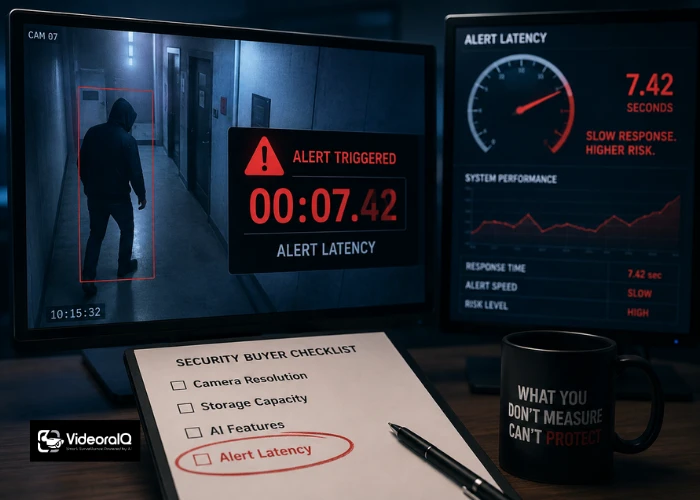
Buyers spend weeks comparing detection accuracy figures and camera-per-license pricing, then sign a contract with a platform whose alerts arrive twelve seconds after the event. By that point, the person is already through the door.
Alert latency, the gap between the moment a camera sees something and the moment an operator can act is the single most operationally important metric in video analytics procurement. It is also the one most consistently absent from vendor comparison sheets. After a decade watching enterprise security deployments succeed and fail, I’ve come to think this omission is the industry’s most expensive bad habit.
Listen to this podcast!
Latency Tiers Are Not Optional Reading
Not every use case demands the same speed. Published latency benchmarks draw a clear operational line: sub-second response is required for weapon detection, fall detection, and access control workloads where the intervention window is measured in moments. The 1–3 second tier covers intrusion alerts and fire detection, where edge or cloud processing can both work. Seconds-to-minutes is acceptable for multi-site forensic search and shift reporting, where cloud-only processing is fine.
This matters because many platforms are engineered for the third tier and marketed against the first two. A system optimised for overnight reporting queries will batch-process alerts to save compute costs. That design choice is invisible in a product demo and catastrophic in a live incident.
Enterprise deployment guidance for 2025–2026 is unambiguous: sub-100 ms response for life-safety access control is only achievable at the edge; cloud processing alone cannot satisfy that threshold. If a vendor’s architecture diagram shows video travelling to a cloud server before an alert fires, ask them what their p95 latency is under load. Then ask to see the test methodology.
What Three Seconds Actually Buys You

VideoraIQ publishes an alert latency figure of under three seconds, based on its own platform testing. In the context of the latency tiers above, that positions the platform squarely in the intrusion and fire detection tier, where real-time response is operationally meaningful, but the sub-100ms edge requirement doesn’t apply.
Three seconds is fast enough to matter for most enterprise security scenarios. Consider fire and smoke detection. VideoraIQ’s Fire & Smoke Detection identifies smoke and flames 40–60 seconds before traditional heat sensors trigger. Add three seconds of alert latency and you still have a roughly 40-second head start over a conventional sprinkler-trigger system. That window is the difference between evacuation and exposure.
Now reverse the maths. A competing platform with a 15-second alert pipeline and the same visual detection capability delivers a 25-second head start at best. Not wrong, but noticeably worse, and in a manufacturing environment where fire can spread through dry materials quickly, that gap compounds.
Accuracy Without Latency Is a Forensic Tool, Not a Security Tool
The industry has a habit of leading with accuracy numbers. Analysts set the bar for safety-critical detection at above 85% true positive rate, with fewer than three false positives per camera per day before operators stop trusting the system. VideoraIQ’s published detection accuracy of 99.4% clears that threshold comfortably.
Accuracy figures are measured at detection time. They say nothing about what happens in the seconds between detection and operator awareness. A platform that correctly identifies a restricted zone breach 99% of the time but takes 20 seconds to surface that alert to a security console has not solved the security problem it has documented it.
This distinction maps directly to operational reality. In VideoraIQ’s intrusion detection layer, operators receive a single alert packet containing the video clip, location tag, and timestamp; no secondary camera lookup, no feed-switching before acting. The alert itself is actionable. That design removes the informal latency that accumulates when operators must manually locate and scrub to the relevant feed after receiving a bare notification.
Informal latency the time an operator spends finding the right camera, rewinding to the moment of detection, and confirming the alert is not theoretical overhead. Industry figures put manual video review at 30–60 seconds per alert verification. Multiply that across a busy night shift and the real response gap dwarfs whatever the vendor’s specification sheet claims.
The False Positive Trap Compounds Latency’s Damage
Low latency on a high-noise system is actively harmful. A monitoring centre running 80 cameras across a retail estate generated 300+ alerts per night. Genuine intrusions over eleven months numbered in single digits. The rest were delivery headlights, wind-blown signage, and a fox triggering the car park feed at 2 a.m. every Tuesday. Each nuisance alert costs 30–60 seconds of manual video review; across hundreds of nightly triggers, one monitoring station burns hours on nothing.
When latency is low but false positive rates are high, operators learn quickly that most alerts are noise. Response times creep up. The three-second platform effectively becomes a fifteen-second platform through behavioural adaptation. This is not a hypothetical. It is what happens in every high-noise deployment I have seen.
The combination that actually works is low latency paired with high precision. Industry benchmarks set the acceptable threshold at fewer than three false positives per camera per day for SOC-monitored alerts. Above that, trust erodes. Below it, operators respond to what the system surfaces and the latency figure you negotiated in procurement starts to mean something again.
How to Evaluate Latency Before You Buy
Vendor-supplied latency figures are a starting point, not a verdict. Here is what to test during a proof of concept.
1. Measure End-to-End, Not Compute-Only
Ask vendors to define what their latency figure actually measures. Some report inference time how long the model takes to classify a frame. That is not end-to-end latency. End-to-end latency runs from the camera sensor capturing the event to the alert appearing on the operator console. Insist on that definition and time it yourself with a stopwatch during the PoC.
2. Test Under Load
The p95 benchmark for live alerts is under 1.5 seconds; under 5 seconds is acceptable for forensic use cases. Ask vendors for p95, not average. Averages hide the spikes that occur when multiple cameras trigger simultaneously, exactly the scenario that matters during an actual incident.
3. Count the Alert Packet Contents
An alert that delivers a clip, location tag, and timestamp in one packet requires no operator follow-up before action. An alert that delivers a camera ID and a timestamp requires the operator to locate the feed, pull up the recording, and scrub to the event. Time both. The second workflow adds informal latency that your specification sheet will never capture.
4. Map Use Cases to Latency Tiers
Before the PoC, pull a week of alerts and count how many were genuinely actionable. That baseline sets a concrete reduction target and tells you which latency tier your real workload actually sits in. Access control to a server room requires different characteristics than overnight perimeter monitoring. A platform that performs well across all tiers is genuinely capable; one that performs well only at the forensic tier is a reporting tool wearing a security tool’s badge.
Read More!
Face Recognition False Positives: Your Hidden GDPR Bill
Unattended Baggage Detection: 2026 Airport Guide
The Market Is Moving, But Slowly
The global AI-powered video analytics market was valued at $5.63 billion in 2025 and is projected to reach $23.03 billion by 2034, driven by the convergence of AI, deep learning, and edge computing. More compute at the edge means lower achievable latency for more organisations. The infrastructure argument for accepting slow alerts is weakening every year.
What is not changing: procurement teams that evaluate platforms on accuracy and camera count alone will keep buying systems that perform well on paper and slowly in practice. The latency question is easy to ask. Most buyers simply haven’t been told to ask it.
For a broader look at what separates capable platforms from capable-sounding ones, our analysis of why bundled VMS modules fail in enterprise deployments covers the architectural trade-offs in detail. And if fire detection latency is a specific concern for your environment, the breakdown of AI visual fire detection versus sensor-based systems covers the 40–60 second advantage in full.
Latency is not a footnote. It is the mechanism by which everything else your platform promises either reaches an operator in time to matter or arrives as an accurate, well-tagged, perfectly timestamped record of something you could not stop. See how VideoraIQ’s sub-3-second alert pipeline performs against your current system, and this time, bring a stopwatch.