

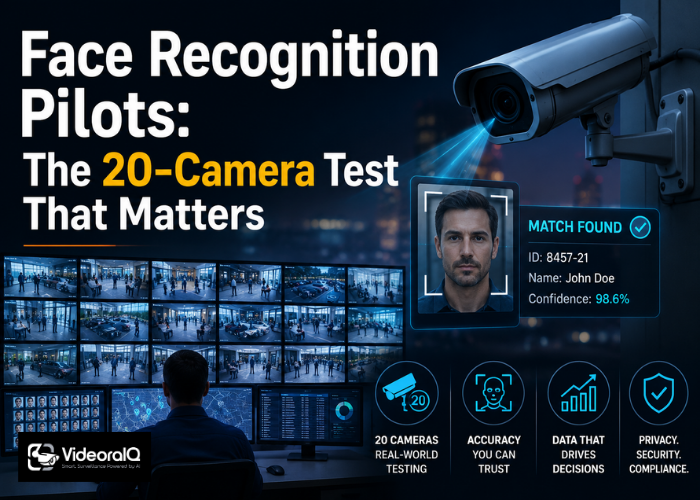
Every vendor demo looks flawless. The lighting is controlled, the watchlist has six faces, and the camera is three metres from the subject. Sign the contract, deploy across a 200-camera estate, and something different happens entirely.
I’ve watched this play out enough times to say plainly: the demo is not the product. What separates a face recognition deployment that works from one that quietly becomes shelfware is how hard you pushed the system before you committed. Most procurement teams don’t push hard enough, and they measure the wrong things when they do.
This is a framework for running a pilot that actually tells you the truth.
Listen to this podcast!
Why the Math Works Against You at Scale
Start with a number that sounds reassuring: 95–97% face recognition accuracy. That’s roughly what many enterprise-grade systems advertise, and in isolation it sounds fine. It isn’t.
At 95–97% accuracy on a 200-camera corporate campus processing thousands of recognition events per day, false-positive alerts can reach hundreds per day on a single estate. Every one of those false alerts lands in an operator’s queue. Every one demands a manual review. Stack that across a full shift and you haven’t built a security tool — you’ve built a noise machine.
The research supports this at a sobering scale. South Wales police testing a facial recognition system saw 91% of matches labelled as false positives — 2,451 incorrect identifications against 234 correct ones. That’s a real deployment, not a lab. And according to independent benchmarking published as of January 2025, even the best-performing commercial systems achieve false negative rates of just 0.13% — roughly one missed match per 800 attempts. The gap between vendor headline accuracy and production performance is real, consistent, and consequential.
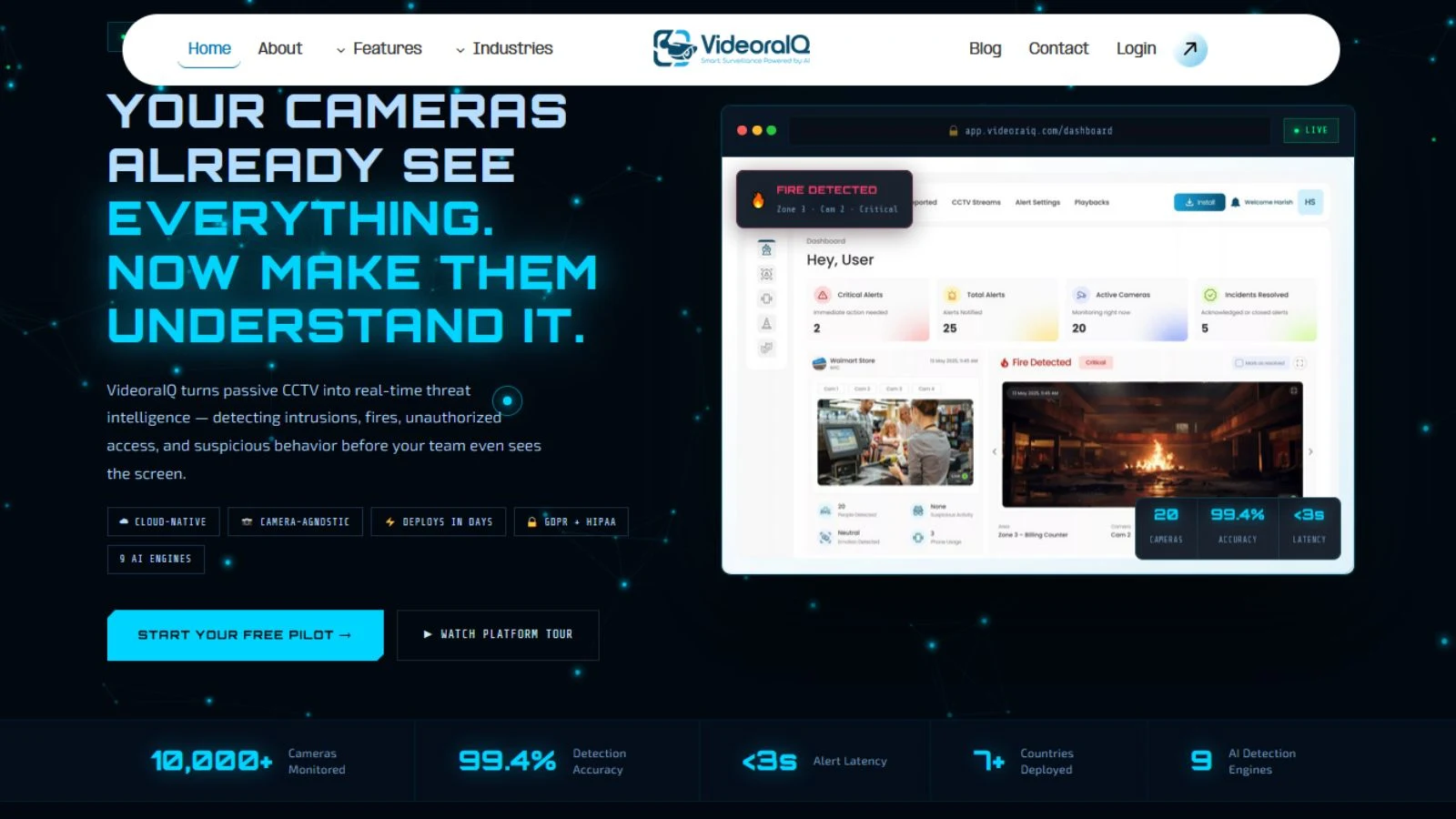
VideoraIQ publishes a stated detection accuracy of 99.4%, and the reason that number matters operationally is explained bluntly in their own documentation: the recommended threshold for 24/7 SOC teams is ≥99%; anything below “swamps the team with false pings”. Two percentage points of accuracy don’t sound like much. In production, across thousands of daily events, they’re the difference between a workable operation and a fatigued team that starts ignoring alerts.
The Three Metrics That Actually Matter
Most pilots measure the wrong thing. They count detections, check that known faces are matched, and call it done. Here are the three metrics that tell you whether a deployment will hold up under real operational conditions.
1. False Positive Rate Per Shift, Extrapolated
Run your pilot on approximately 20 cameras — a mix of high-traffic and low-traffic feeds, ideally including at least one entry/exit point and one interior zone. Track false positive alerts per eight-hour shift for at least two weeks. If false positives exceed a handful per shift on 20 cameras, the extrapolated noise on 200 cameras is, as the VideoraIQ pilot methodology frames it, simply “unworkable.” The math is not complicated. Do it before you scale.
2. Mean Time from Event to Operator Receipt
This is the metric almost nobody measures in a pilot, and it’s the one that determines whether your security team can actually respond before a situation escalates. Sub-3-second alert delivery is the gold standard for live response; sub-5-second is the minimum acceptable threshold. Anything slower isn’t a minor inconvenience — it’s a structural gap in your coverage.
The vehicle gate scenario makes this concrete. A 15-second alert delay at a vehicle gate means a blacklisted vehicle is already inside the perimeter before any operator can act. The alert arrives, the damage is done. During your pilot, time every alert from event to receipt. Not average time — worst-case time, because the worst case is when it matters most.
And check what the alert actually contains. A bare notification is operationally useless. The alert payload should arrive with an attached video clip, a location tag, and a timestamp — everything a guard needs to decide without a second round-trip to find the footage. That’s how the VideoraIQ alert workflow is built, and it’s the right bar to hold any competing platform to.
3. Watchlist Propagation Latency
This is the failure mode that almost no procurement checklist mentions. Add a new face to the watchlist mid-shift — simulating a scenario where a threat is identified during an active operational period. Measure precisely how long it takes before live cameras are matching against that entry.
A system that takes several minutes to propagate a watchlist update isn’t providing real-time protection. It’s providing historical protection, which is a different product. Watchlist staleness is a distinct failure mode from accuracy, and it won’t surface in a standard vendor demo where the watchlist was loaded the day before.
What the Pilot Environment Should Look Like
Keep it honest. Use your real camera infrastructure — VideoraIQ is compatible with 200+ brands of existing IP cameras, so you shouldn’t need to swap hardware. Pull in feeds that represent your actual operational mix: one high-volume pedestrian entrance, one vehicle gate, at least one interior zone monitored for restricted access. Run it across multiple shifts, not just business hours. Threat events don’t schedule themselves for 10 AM on a Tuesday.
If you’re evaluating face recognition alongside vehicle number plate recognition — which is common in any campus or manufacturing environment — run both simultaneously on the same feeds. Sites running separate face recognition and ANPR platforms produce duplicate alerts and mismatched event timelines, forcing guards to manually correlate events while a vehicle clears the barrier. That’s a burden you don’t want to discover at scale.
Also pay attention to what else is running on the same feeds. A platform that runs nine AI detection engines simultaneously — covering face recognition, ANPR, fire and smoke, line-cross, intrusion, and more — produces a unified event timeline rather than siloed alerts from separate systems. During your pilot, check whether alerts from different detection types can be correlated against a single incident timeline. If they can’t, you’re buying fragmentation.
Read More!
The GDPR Trap in Face Recognition Procurement
Red Flags That Should End a Pilot Early
Three conditions warrant stopping and reconsidering before you reach the end of the pilot window:
- False positives exceeding a handful per shift on 20 cameras. The extrapolation to a full deployment makes the number unmanageable.
- Mean alert delivery time consistently above five seconds. Below that threshold, live response is theoretically possible. Above it, you’re doing post-event review, not prevention.
- Watchlist propagation taking more than a minute. In a fast-moving access control event, that delay is operationally equivalent to no update at all.
These aren’t high bars. They’re the minimums. The stakes at the ceiling are concrete: Ananya Mehta, Head of Facilities at a 200-camera corporate campus, noted that a single 2 AM intruder event caught by VideoraIQ “justified the entire platform cost.” That outcome only happens when the system fires accurately and fast enough for someone to actually respond.
One More Thing: Compliance Is Not Optional
If your deployment spans European facilities, build GDPR compliance verification into the pilot — specifically the special-category data provisions under (EU) 2016/679 that apply to biometric data. The same applies to HIPAA, CCPA, and BIPA depending on your jurisdiction. A platform that can’t produce an audit trail of when biometric data was processed, retained, or deleted is a legal liability, not just an operational one. Verify that the system generates and stores the necessary access logs automatically — and confirm those logs meet the requirements of every jurisdiction where your cameras are deployed.
The global AI-powered video analytics market was valued at $5.63 billion in 2025 and is projected to reach $23.03 billion by 2034. There is no shortage of vendors entering this space, and most of them will give you a compelling demo. The 20-camera pilot is how you find out which one holds up when the lights go down and the watchlist changes mid-shift.
Don’t sign before you run it.
Run the 20-camera pilot framework on VideoraIQ — a platform built to clear every threshold above, with 99.4% detection accuracy, sub-3-second alert delivery, and nine AI engines running simultaneously on your existing cameras.