

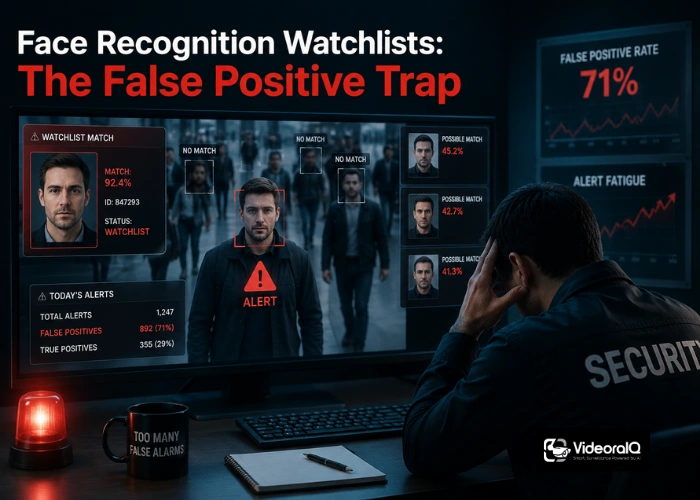
The procurement deck shows a headline accuracy figure. What it hides is the false positive rate — and at the scale of an enterprise deployment, even a fraction of a per cent translates to a volume of false alerts that can overwhelm an operator team. That team was supposed to be watching for real threats. Nobody models that cost before signing.
I have spent years watching enterprise security teams buy on accuracy percentage and then quietly decommission face recognition modules inside eighteen months because the alert queue became unmanageable. The problem is almost never the technology’s ceiling — it’s the gap between a headline figure and the operational reality of running a live watchlist across dozens of sites. That gap has a name: false positives. Their cost is almost always invisible until it isn’t.
Listen to the podcast!
Why Accuracy Percentages Are the Wrong Numbers to Buy On
The face recognition market reached nearly $9 billion in 2025 and is projected to exceed $30 billion by 2034. Every vendor in that market leads with accuracy. It’s the number that travels well in a slide. What it conceals is the false positive rate — the proportion of alerts where the system flags a face that does not belong to the watchlisted individual.
NIST benchmarking data, cited by the Bipartisan Policy Center, shows that even high-performing algorithms produce false positive errors around 0.3% of the time under controlled conditions. That sounds negligible. Scale it to a deployment spanning thousands of cameras processing millions of face templates per day, and the arithmetic turns brutal. At 0.3%, the false positive volume becomes a full-time job for an operator team.
The downstream cost compounds fast. Research on the operational cost of false positive fatigue documents how alert overload directly degrades detection capability: operators start dismissing alerts without reviewing attached footage, response times slow, and genuine incidents get buried in noise. IBM’s Cost of a Data Breach Report 2025 put the global average breach cost at $4.44 million — a number that reflects, in part, how delayed containment compounds initial exposure.
The last two percentage points of accuracy matter more than the first ninety-seven. I explored that arithmetic in more depth at why a small accuracy gap falls short in production — the core argument is that the operational difference between similar-sounding accuracy figures is not linear when alert volume is high.
What a Live Watchlist Actually Looks Like in Operation

VideoraIQ‘s Face Recognition module runs real-time matching against operator-defined watchlists and generates automatic access logs the moment a match occurs. The alert goes to the security team with a video clip, location tag, and timestamp — not a raw notification that someone needs to then manually pull footage to investigate. That workflow distinction matters operationally: the difference between an alert that arrives with evidence attached and one that requires a manual lookup is measured in minutes of response time.
The platform’s published detection accuracy sits at 99.4%, with alert latency under three seconds. It monitors more than 10,000 cameras across seven or more countries. Those numbers carry real operational weight. They only hold up if the false positive rate stays low enough that operators trust and act on every alert they receive.
The access log automation is worth pausing on. In most legacy watchlist deployments, logging is a manual step — an operator confirms a match, then records it. Gaps happen. Audit trails drift. When VideoraIQ generates the log automatically at match time, that record is timestamped, location-tagged, and consistent regardless of how busy the shift is. For compliance purposes under GDPR and HIPAA — both of which the platform supports — that audit completeness is not optional.
The Pilot Test That Exposes False Positive Risk Early
Most enterprise buyers run a proof-of-concept on a handful of cameras in a low-traffic area. That test tells you almost nothing about false positive behaviour at an operational scale. The environment that matters is your busiest, most demographically diverse camera zone during peak hours — a main entrance, a production floor during shift change, a transport interchange.
The minimum meaningful pilot is covered in detail at the 20-camera test that actually matters, but the core principle is this: measure alert volume before you measure match rate. Count how many alerts fire per hour, how many require no action because they’re false positives, and how long it takes an operator to review each one. That math tells you whether the system is operationally viable in your environment — a different question from whether it works in a lab.
Three metrics every buyer should capture during a pilot:
- False positive rate per camera hour — not overall system accuracy. This is what determines operator workload.
- Alert-to-resolution time — from the moment an alert fires to the moment an operator either confirms or dismisses it. If this number rises over the pilot period, alert fatigue is already setting in.
- Watchlist match latency — how quickly after a face enters frame does the match fire? A three-second window is the threshold below which a security team can actually intercept a subject before they move out of camera coverage.
Where Compliance Makes the False Positive Problem Worse
GDPR and HIPAA compliance requirements do not simplify the false positive problem — they intensify it. Under GDPR Article 9, biometric data used for identification purposes is special category data. A false positive match that results in someone being stopped, questioned, or denied access creates a demonstrable harm tied to a data processing event. The compliance exposure from a systematic false positive pattern is not theoretical.
This is one reason the audit log generated automatically by face recognition matters as much for risk management as for operations. When every match — including false positives — is timestamped and location-tagged, a compliance review can actually reconstruct what happened and when. Without that trail, a complaint becomes difficult to investigate and harder to defend.
The compliance landscape for face recognition is worth reviewing before any watchlist goes live. Regulatory rules vary sharply across jurisdictions. What’s permissible in one country may require additional safeguards in another — and that variation is a live operational concern across the seven-plus countries where VideoraIQ is deployed, not a footnote for legal to handle post-procurement.
What Reduces False Positives in Practice
Three operational factors move the needle more than any single accuracy specification.
- Watchlist hygiene: A bloated watchlist with low-quality enrollment images is the fastest path to false positive overload. Every entry should have multiple images captured under different lighting conditions and angles. Where the subject is known to alter appearance with and without accessories. Stale entries of individuals no longer relevant to active monitoring should be removed on a scheduled cadence, not ad hoc.
- Camera placement and image quality: Match accuracy is bounded by the quality of the frame the camera produces. A face recognition algorithm matching against a motion-blurred or low-resolution image will produce more false positives regardless of how good the underlying model is. Camera positioning angle, focal length, and lighting are a prerequisite, not an afterthought.
- Threshold calibration per environment: Match confidence thresholds should not be set identically across a high-security restricted zone and a general entrance. A higher confidence threshold in a public-facing area reduces false positives at the cost of some true positive sensitivity. In a restricted zone where the cost of a missed match is higher, a lower threshold may be appropriate — with the understanding that operator review volume increases accordingly. This is a policy decision, not a technical one. It belongs with the security team, not the vendor.
Read More!
Face Recognition and License Plate Reading for Retail
The GDPR Trap in Face Recognition Procurement
The Operational Reality
The AI-powered video analytics market is growing at 16.8% annually and will reach $23 billion by 2034. A significant share of that growth is watchlist-based face recognition. Most deployments in that market will underperform not because the technology fails, but because buyers optimised for the wrong metric at procurement and discovered the operational consequences later.
The false positive trap is avoidable. It requires measuring alert volume in the pilot, not just match rate. It requires watchlist discipline and honest threshold calibration. And it requires a platform that delivers evidence: video clip, location, timestamp alongside every alert, so operators don’t have to choose between reviewing the one in front of them and watching the next one arrive.
That is what separates a face recognition watchlist that functions as an operational tool from one that becomes a noise source the team learns to ignore.
If you’re evaluating watchlist-based face recognition for a live deployment, start your VideoraIQ trial and run the pilot against your busiest camera zone. The false positive rate you see in week one is the one you’ll be managing in year two.