
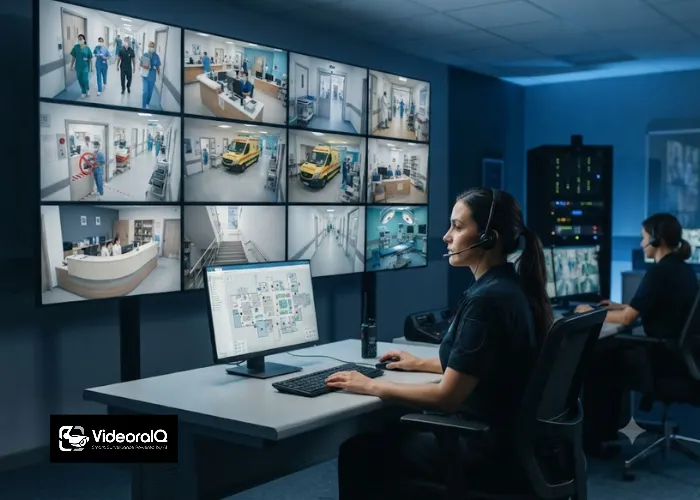
Healthcare facilities face a unique set of security challenges that most other environments simply don’t. Patients are vulnerable, staff work under pressure, medications are regulated substances, and the 24-hour operating environment creates constant access control demands across dozens of entry points. Hospital security cameras sit at the centre of every effective healthcare security strategy, deterring threats before they occur, documenting incidents when they do, and providing the real-time visibility that allows security teams to respond rather than react. In 2026, the role of hospital security cameras has expanded dramatically beyond simple recording. When paired with AI-powered analytics, they become active, intelligent systems capable of detecting threats, protecting patients, and supporting compliance across every department. This guide covers ten specific ways they make that difference.
1. Deterring Unauthorised Access at Entry Points
The most immediate benefit of hospital security cameras is deterrence at entry points. Visible cameras at entrances, emergency departments, pharmacy doors, and restricted corridors signal to anyone considering unauthorised access that their presence is being recorded.
This deterrent effect is particularly important in healthcare, where controlled substances, expensive medical equipment, and vulnerable patients all create an incentive for unauthorised entry. Studies consistently show that visible surveillance reduces opportunistic security incidents, making well-placed hospital security cameras one of the most cost-effective security investments a facility can make before any incident occurs.
2. Protecting Pharmacy and Medication Storage Areas
Pharmaceutical theft from both internal and external actors is one of the most significant security risks in any healthcare facility. Camera coverage of pharmacy dispensaries, medication storage rooms, and controlled substance cabinets creates an audit trail for every access event.
When integrated with access control systems, cameras can verify that the person accessing a restricted medication area matches the credential used to open it. Any discrepancy triggers an immediate alert. This combination of visual verification and access logging is now considered a best practice for pharmaceutical security in accredited healthcare facilities.
3. Hospital Security Monitoring Cameras for Staff Safety
Healthcare workers experience workplace violence at rates significantly higher than most other professions. Emergency department staff, mental health workers, and overnight security personnel are particularly vulnerable to assaults from patients or visitors in distress.
Hospital security monitoring cameras in corridors, waiting areas, emergency departments, and stairwells provide both a deterrent and a rapid response tool. When an incident occurs, security staff can see exactly where it is happening and deploy the right response immediately. Post-incident, footage provides the clear evidence needed for incident reports, investigations, and, where necessary, legal proceedings.
4. Monitoring Infant and Paediatric Wards
Infant abduction, while rare, represents one of the most serious security scenarios any hospital can face. Camera coverage of neonatal units, paediatric wards, and all exits from maternity areas is now a standard security requirement in accredited hospitals worldwide.
Beyond abduction prevention, camera coverage in paediatric areas helps monitor patient condition remotely, observe visitor behaviour, and ensure that access is limited to authorised family members and staff. The combination of camera coverage and access control in these areas creates a layered security model that dramatically reduces risk while supporting family access.
5. Security Cameras in Hospital Rooms: Balancing Safety and Privacy
The question of security cameras in hospital rooms requires careful consideration of both security requirements and patient privacy rights. In most jurisdictions, patient room cameras are not standard practice; patients have a legal and ethical right to privacy during treatment.
However, cameras are commonly and appropriately used in corridors outside patient rooms, nursing stations, and shared areas that don’t constitute private treatment spaces. For specific high-risk situations, such as patients with a history of self-harm or elopement risk, individual risk assessments and formal consent processes exist. The key principle is that security must support patient dignity, not compromise it.
6. Are There Security Cameras in Hospital Patient Rooms?
This is one of the most commonly asked questions by patients and families. Are there security cameras in hospital patient rooms? The short answer is: in most standard ward settings, no. Patient rooms are considered private spaces where recording without consent raises significant ethical and legal concerns.
Where cameras do exist in clinical areas, they are typically in nursing stations, corridors, shared waiting areas, and non-clinical zones. Some specialist settings such as certain ICU or mental health environments, may use monitoring under strict clinical and consent protocols. Patients should always feel able to ask their care team what surveillance exists in any area they occupy.
7. Protecting Against Infant Elopement and Patient Wandering
Beyond infant security, camera coverage plays a critical role in preventing patient elopement, particularly for patients with dementia, cognitive impairment, or mental health conditions who may attempt to leave the facility unsafely.
AI-powered cameras can detect unusual movement patterns near exit points at unexpected hours, triggering immediate alerts to nursing staff before a patient reaches an unsecured door. This proactive detection capability, responding to behaviour in real time rather than discovering a patient has left after the fact, significantly improves both safety outcomes and the facility’s duty-of-care compliance.
8. Supporting Incident Investigation and Legal Defence
When a clinical incident, complaint, or legal claim arises, camera footage provides objective, timestamped evidence of exactly what occurred and in what sequence. This evidence is invaluable for internal investigations, regulatory reviews, and legal defence.
In healthcare, where the consequences of disputed clinical events can be severe for both patients and facilities, having clear footage from well-positioned hospital security cameras often resolves disputes faster, more fairly, and at significantly lower legal cost than investigations relying on witness statements alone. Many facilities have found that camera coverage reduces their liability exposure measurably.
9. Managing Visitor Access and Behaviour
Hospitals must balance open access for patients, families, and support networks with security measures that protect patients, staff, and the care environment. Managing visitor flow who enters, when, and where they go is a significant operational challenge.
Camera coverage of reception areas, visitor check-in points, and public corridors gives security teams real-time visibility over visitor movement without requiring physical security presence everywhere simultaneously. Combined with visitor management systems, cameras help enforce visiting policies, identify repeat or restricted visitors, and ensure that access to sensitive areas remains controlled.
10. Fire, Smoke, and Emergency Detection
Hospital security cameras, when integrated with AI analytics, do more than manage human threats. AI-powered video systems can detect fire and smoke signatures 40 to 60 seconds faster than traditional heat sensors, providing a critical window for evacuation and suppression before a fire spreads.
In healthcare facilities where patient mobility is limited and evacuation is complex, those extra seconds matter enormously. AI-driven camera systems that detect fire visually rather than waiting for heat thresholds to trigger traditional sensors give emergency teams the earliest possible warning directly improving patient safety outcomes in the most serious emergency scenarios.
How VideoraIQ Makes Hospital Security Cameras Genuinely Intelligent
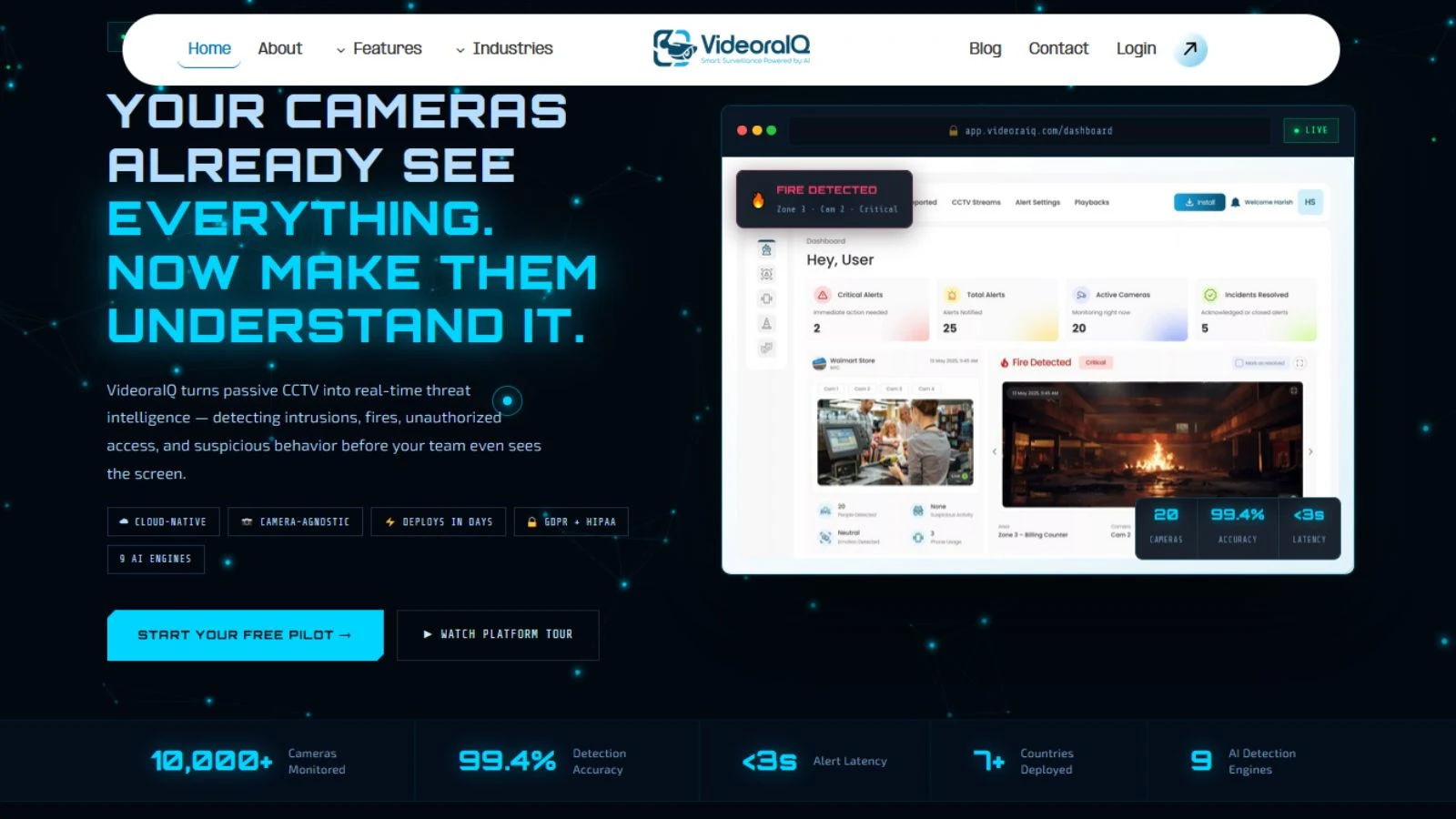
Installing cameras is the foundation. Making them intelligent is what transforms a passive recording system into an active, real-time security operation. VideoraIQ is a cloud-native AI video intelligence platform trusted by security teams across 7+ countries, monitoring 10,000+ cameras for organisations including Microsoft, Tata, ICICI Bank, and Wipro, and it is purpose-built for exactly the kind of complex, multi-zone security environments that healthcare facilities represent.
Here’s what VideoraIQ adds to your hospital security camera deployment:
- Face Recognition (Engine 01) – Real-time watchlist matching at entry points, unknown visitor flagging in restricted zones, and automatic access logs, eliminating manual ID checks at high-traffic entrances.
- Intrusion Detection (Engine 02) – Instant alert with video clip, location tag, and timestamp the moment anyone enters a restricted zone without authorisation, delivered in under 3 seconds.
- Fire & Smoke Detection (Engine 03) – Visual AI detects fire signatures 40–60 seconds before traditional heat sensors, with a live camera link sent to your emergency team immediately.
- Unauthorised Access Alerts (Engine 07) – Define sensitive zones pharmacy, ICU, paediatric ward, medication storage and receive instant alerts the moment access is attempted without valid credentials.
- Line-Cross Detection (Engine 06) – Invisible virtual boundaries defined anywhere on your camera feed; instant alerts fire the moment any boundary is crossed.
- Unattended Object Detection (Engine 08) – Continuous monitoring of waiting areas, corridors, and public zones with immediate alerts when any item is left beyond a defined threshold.
- Number Plate Recognition / ANPR (Engine 05) – Automatic vehicle logging at facility entrances, restricted parking areas, and emergency bay access points.
- Camera-Agnostic Integration – Works with Hikvision, Dahua, Axis, Bosch, and 200+ camera brands via RTSP. No hardware replacement required.
- Cloud-Native, Zero-On-Premise Servers – Scales from a single clinic to a multi-site hospital network without local compute infrastructure.
- GDPR & HIPAA Compliant – End-to-end encryption, role-based access controls, and full audit trails built in from day one.
- 99.4% Detection Accuracy, Under 5% False Alarm Rate – Alerts that security teams act on, not noise they learn to ignore.
- Live in Under 72 Hours – Full deployment and onboarding in days, not months. Free pilot available on your existing cameras.
Conclusion
Hospital security cameras are not a single solution; they are a security foundation that, when combined with AI-powered analytics, transforms how healthcare facilities detect, respond to, and prevent threats across every zone. From pharmacy protection and infant security to fire detection and staff safety, the right hospital security cameras compound their value every day they operate.
Frequently Asked Questions
Q1. Where should hospital security cameras be placed?
Key areas include all entry and exit points, pharmacy and medication storage, paediatric and neonatal wards, nursing stations, corridors, emergency departments, stairwells, car parks, and public waiting areas. Patient rooms are generally excluded for privacy reasons.
Q2. Are there security cameras in hospital patient rooms?
In most standard settings, no. Patient rooms are private spaces. Cameras are typically limited to corridors, nursing stations, and public areas. Some specialist clinical environments may use monitoring under strict consent and clinical governance protocols.
Q3. Does VideoraIQ work with existing hospital security cameras?
Yes. VideoraIQ integrates with 200+ camera brands including Hikvision, Dahua, Axis, and Bosch via RTSP with no hardware replacement required and full deployment in under 72 hours.
Q4. Is AI-powered hospital security monitoring HIPAA compliant?
VideoraIQ is HIPAA and GDPR compliant, with end-to-end encryption, role-based access controls, and full audit trails built in from day one of deployment.