

How predictive technology, connected hardware, and intelligent video monitoring are redefining workplace protection.
Risk does not look the way it did a decade ago. As 2026 brings deeper AI integration, volatile climate patterns, and increasingly connected “smart” facilities, the old toolkit of hard hats, painted floor lines, and passive signage simply cannot keep pace. Those measures still matter, but on their own, they react to incidents rather than prevent them.
The real shift is philosophical. Modern safety systems are proactive, predictive, and tightly woven into digital infrastructure. They sense conditions before they become hazards, learn from patterns, and coordinate a response across an entire site automatically.
This guide walks through the landscape: the framework types that define today’s protections, the business returns that justify the investment, a practical roadmap for implementation, and the advanced data monitoring that ties everything together.
Demystifying Workplace Protection: What Is a Security Monitoring System?
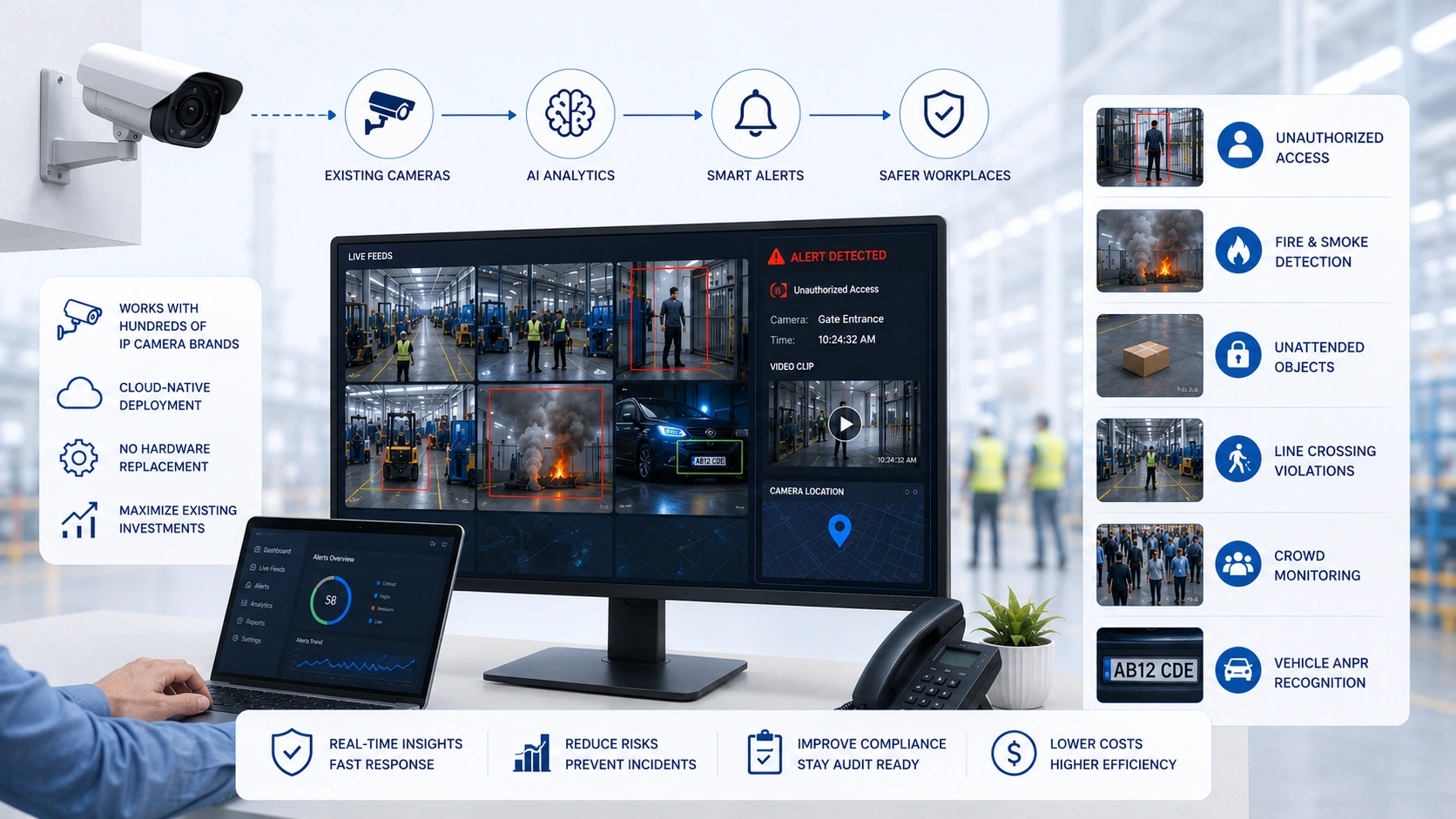
So, what is a security monitoring system in 2026? At its simplest, it is the connected layer of hardware, software, and human oversight that continuously watches a facility for threats to people, property, and operations and acts on what it sees.
The definition has evolved dramatically. A generation ago, “security” meant locked gates, a guard at the door, and a wall of grainy monitors nobody watched closely. Today it means an interconnected digital mesh: distributed sensors feeding a central platform that interprets data in real time.
Just as important is the safety-security convergence. Industrial and operational safety, protecting workers from physical hazards, and corporate facility security, protecting assets from intrusion, were once separate departments with separate budgets. They are now fusing into a single ecosystem because the same sensor network that detects an unauthorized entry can also flag a gas leak or a worker who has fallen.
Underneath it all sit a few core infrastructure pillars: environmental and motion sensors, real-time telemetry, automated access logs, and the central “nervous system” network that links them. Understanding these pillars is the foundation for everything that follows.
Planning to upgrade your security setup? Read our complete guide: Smart Security Cameras: Everything You Need to Know Before You Buy.
Upgrading Visual Defense: The Role of a Modern Security Camera Monitoring System
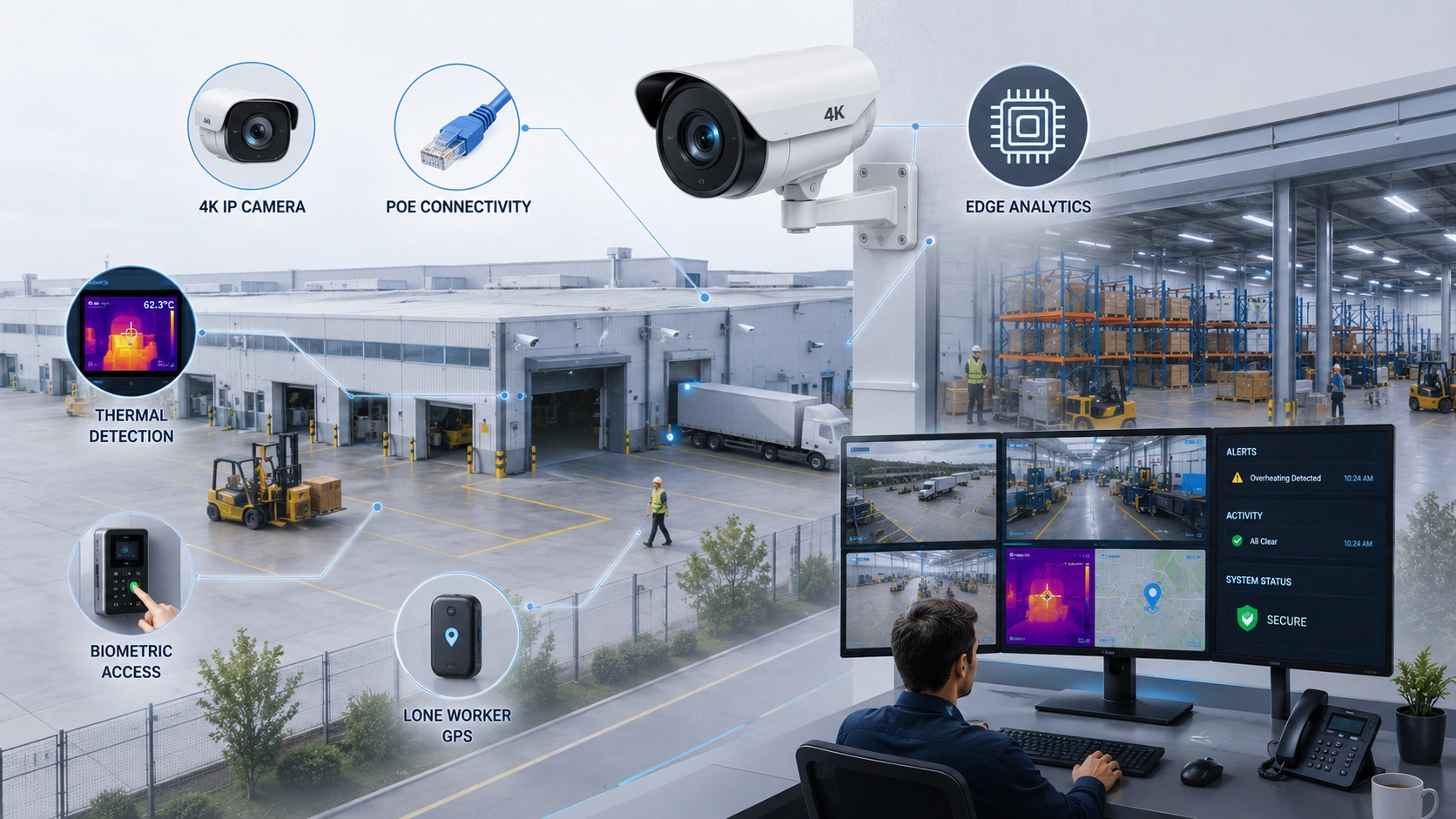
Cameras remain the backbone of physical protection, but a modern security camera monitoring system bears little resemblance to legacy CCTV. In 2026, the standard has moved to high-resolution 4K IP cameras, Power-over-Ethernet (PoE) meshes that simplify wiring, and edge-computing lenses that process footage on the device itself rather than shipping every frame to a server.
Hardware alone, though, is only as effective as its placement. Strategic deployment means mapping coverage across high-consequence zones, loading docks and warehouses where forklifts and pedestrians mix, server racks and data closets, electrical nodes, chemical storage, and the blind spots where incidents tend to go unrecorded. A camera in the wrong place is an expense; a camera in the right place is both evidence and early warning.
The category has also expanded well beyond the visible spectrum. Specialized hardware now includes thermal cameras that read heat signatures for early fire and equipment-overheating alerts, often minutes before flames or smoke appear. Biometric access scanners verify identity at sensitive thresholds, and GPS-enabled lone-worker devices keep tabs on staff operating in isolated or hazardous areas. Together, this hardware turns the perimeter into an active, sensing surface rather than a passive record of what already went wrong.
Transforming Raw Video into Predictive Insights: Deploying a Security Video Monitoring System
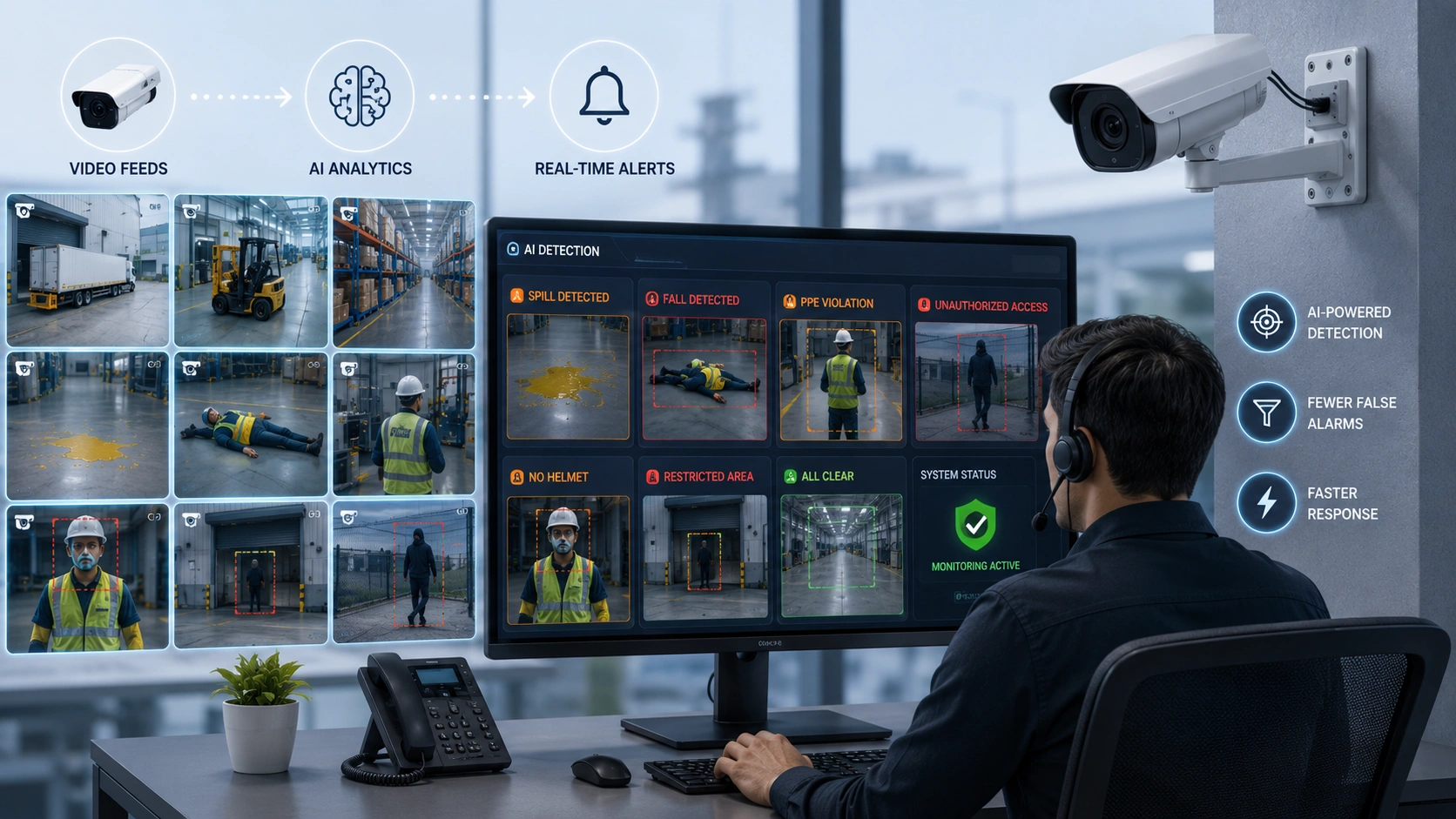
Capturing footage is the easy part. Making sense of it at scale is where a true security video monitoring system earns its keep. The decisive ingredient is the AI software layer, computer vision models that convert passive feeds into proactive safety guards.
Instead of asking a person to stare at dozens of screens, the software watches every feed simultaneously and flags only what matters. Real-time hazard detection can automatically identify a spill or slip-and-trip risk on a walkway, a worker who has fallen and is not moving, missing or improper personal protective equipment (PPE), and unauthorized entries into restricted zones. The system raises an alert the instant a rule is broken, not hours later during an incident review.
Crucially, this also solves one of the oldest problems in surveillance: monitoring fatigue. Human attention degrades after roughly twenty minutes of watching uneventful video, and a steady drip of false alarms only accelerates the burnout. Intelligent software filters out routine background motion, wind-blown debris, passing shadows, and animals, so that when an alert does arrive, security personnel can trust it. Fewer false positives mean faster, more confident responses to the events that genuinely threaten safety.
Maximizing Facility Safety Through 24/7 Security System Monitoring
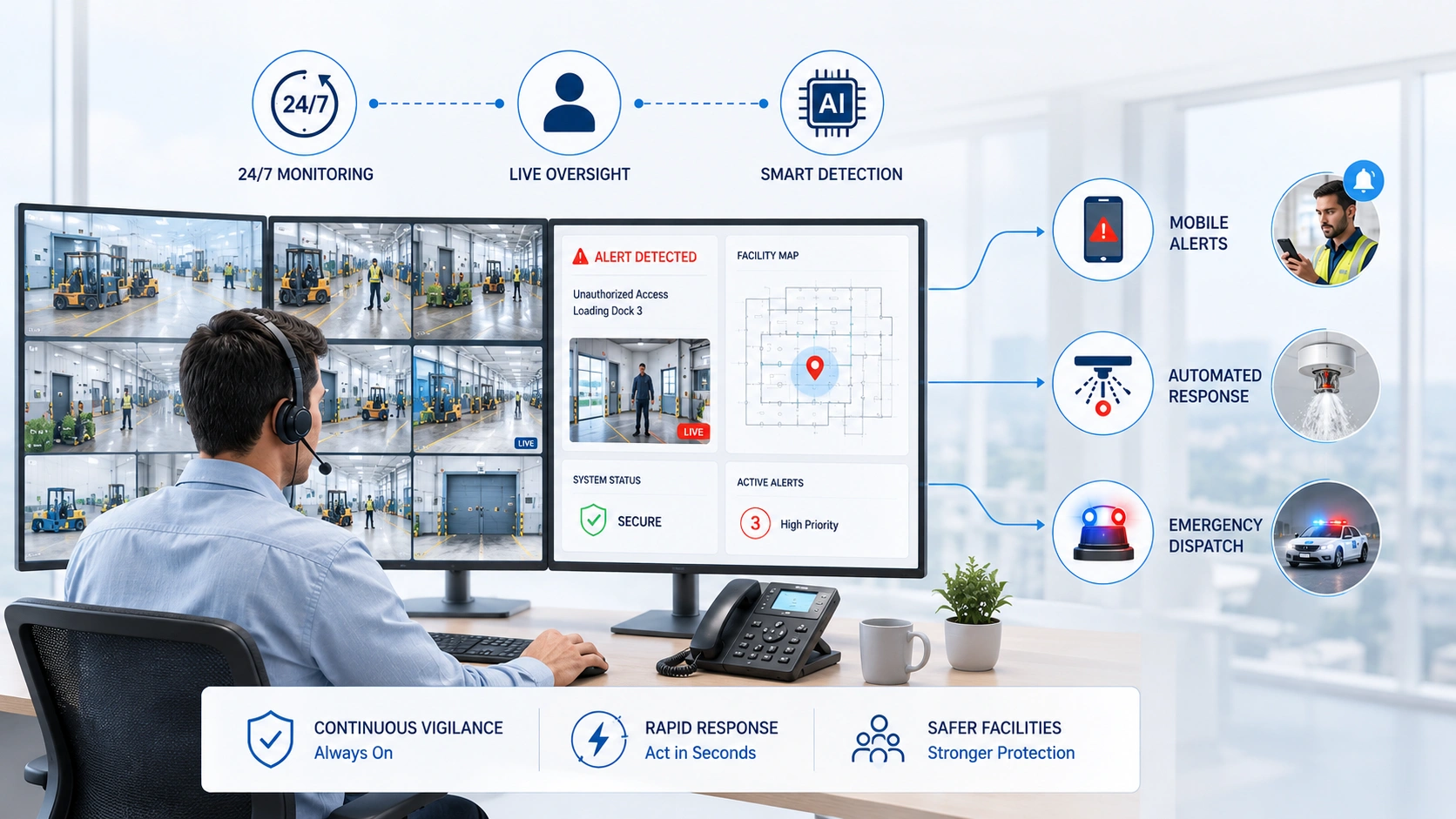
Detection only protects a facility if someone, or something, is watching at the moment it matters. That is the role of continuous security system monitoring: always-on vigilance that manages live telemetry feed loops around the clock, including nights, weekends, and holidays when sites are most vulnerable.
Organizations typically choose between two models. Managed services route feeds to an external provider’s professionals who watch on your behalf, spreading cost across many clients and delivering 24/7 coverage without internal staffing. An internal Security Operations Center (SOC), by contrast, keeps monitoring on-site for tighter control, faster context, and sensitive environments where data cannot leave the building. Many larger operations blend the two.
The payoff is rapid-response interlocking. A modern monitoring hub does not just sound an alarm; it relays the alert to the right people and systems at once: field managers receive a mobile notification, automated fire suppression engages, and, where warranted, the platform can loop in local emergency dispatch. Compressing the gap between detection and response is often the difference between a near-miss and a catastrophe.
The Financial and Legal Benefits of Comprehensive Safety Systems
Beyond protecting people, integrated safety systems make hard financial sense. On the compliance side, they help organizations meet strict 2026 baselines under OSHA, ISO 45001, and local regulations, with documentation, audit trails, and verifiable controls that prevent costly citations and shutdowns.
Then there is the safety dividend. The returns show up across the balance sheet, as the table below illustrates.
| Return Area | How the Saving Is Realized |
| Lower insurance premiums | Well-monitored, audited sites present measurably lower risk to insurers. |
| Reduced machinery downtime | Early fault and overheating detection prevents unplanned stoppages. |
| Fewer compensation claims | Hazards are caught and corrected before they cause injury. |
For most facilities, prevention is dramatically cheaper than a single serious incident , which is what turns safety from a cost center into a measurable investment.
Best Practices for Implementing an Integrated Safety System
Deployment works best as a clear sequence rather than a scramble of disconnected purchases. Four phases keep the rollout grounded:
- Risk-assessment mapping: identify your real exposure before buying anything.
- Technology integration connects new tools with existing infrastructure into one platform.
- Multi-lingual training and competency verification ensure the whole workforce can actually use the system.
- Iterative auditing closes the loop with leading metrics such as near-miss logs, uptime statistics, and response times.
Future-Proofing Your Workspace with Smart Safety Systems
The throughline of 2026 is unmistakable: protection has shifted from hardware you install to intelligence you operate. The most resilient organizations treat safety as a predictive culture, not a checklist to satisfy once a year. Build the connected foundation now, and your workspace will be ready for whatever risk looks like next.
If you’re looking for a deeper understanding of how commercial surveillance systems improve business security, read our complete guide: What Are Commercial Surveillance Systems? A Complete Business Guide.
Turning Existing CCTV Into Intelligent Safety Systems with VideoraIQ
For many organizations, the biggest obstacle to improving workplace safety is not a lack of cameras. It is the inability to turn thousands of hours of video into actionable intelligence. Traditional CCTV systems record incidents, but they rarely identify risks while there is still time to respond.
This is where AI-powered platforms like VideoraIQ add another layer of protection. Rather than replacing an existing surveillance infrastructure, VideoraIQ works with hundreds of IP camera brands, transforming passive camera networks into intelligent safety systems that continuously analyze live video feeds.
Instead of relying on security personnel to monitor dozens of screens simultaneously, the platform uses multiple AI detection engines to identify high-risk events in real time. These include unauthorized access, perimeter breaches, fire and smoke detection, unattended objects, line-crossing violations, facial recognition, vehicle number plate recognition (ANPR), crowd monitoring, and other operational risks. When an incident occurs, the system automatically delivers an alert with the camera location, timestamp, and supporting video clip, enabling faster and more informed responses.
Another advantage is deployment flexibility. Since the platform is camera-agnostic and cloud-native, businesses can integrate AI monitoring into their existing surveillance infrastructure without replacing hardware or building expensive on-premises server environments. This allows organizations to modernize their security operations while protecting previous investments in CCTV equipment.
Beyond physical security, intelligent video analytics also support workplace safety initiatives. Automated detection of restricted-area access, hazardous situations, crowd congestion, and early fire indicators helps safety teams identify issues before they escalate into serious incidents. The result is a unified safety ecosystem where cameras do more than record events. They actively contribute to risk prevention, compliance, and operational efficiency.
As organizations continue investing in connected safety systems, platforms that combine AI, real-time monitoring, and intelligent video analytics will play an increasingly important role in building safer, smarter, and more resilient workplaces.
Conclusion
Modern workplaces can no longer rely on isolated alarms, standalone cameras, or reactive safety procedures. As facilities become more connected and operational risks grow more complex, the value of integrated safety systems lies in their ability to detect threats early, coordinate responses automatically, and provide continuous visibility across people, assets, and operations.
Whether you’re implementing a security camera monitoring system, deploying an AI-powered security video monitoring system, or investing in 24/7 security system monitoring, the goal remains the same: prevent incidents before they escalate. Organizations that combine intelligent monitoring with strong safety policies, employee training, and regular risk assessments are better positioned to reduce downtime, improve compliance, protect their workforce, and strengthen long-term business resilience.
The most effective safety systems are no longer just protective tools. They are strategic business assets that transform real-time data into faster decisions, safer workplaces, and measurable operational improvements. By investing in the right technologies today, businesses can build a safer, smarter, and more future-ready environment for employees, customers, and critical infrastructure.
Frequently Asked Questions (FAQ)
Q1: What is a security monitoring system?
A: A security monitoring system is an integrated network of hardware (sensors, locks) and software that continuously tracks real-time data to protect a facility from unauthorized access, accidents, and environmental threats. In 2026, these platforms integrate directly with broader safety systems to automatically lock down machinery or trigger alarms during an emergency.
Q2: What is the difference between a security camera and a security video monitoring system?
A: A security camera monitoring system refers to the physical hardware (4K IP cameras, thermal lenses, and wiring meshes) installed on-site. A security video monitoring system refers to the intelligent software layer (like AI and computer vision platforms) that analyzes those camera feeds in real time to automatically detect hazards, missing PPE, or perimeter breaches.
Q3: Why is 24/7 security system monitoring necessary for businesses?
A: Continuous security system monitoring ensures your facility is protected during off-hours, weekends, and holidays when most incidents occur. It provides immediate, automated responses interlocking with emergency services and creates immutable digital audit trails required for OSHA and ISO 45001 compliance.
Q4: How does AI improve modern safety systems?
A: Modern AI eliminates monitoring fatigue by filtering out background noise like shadows, weather, or animals. It ensures your security team is only alerted to genuine, high-risk safety events, such as a fallen worker, an early-stage fire, or an unauthorized zone entry.