
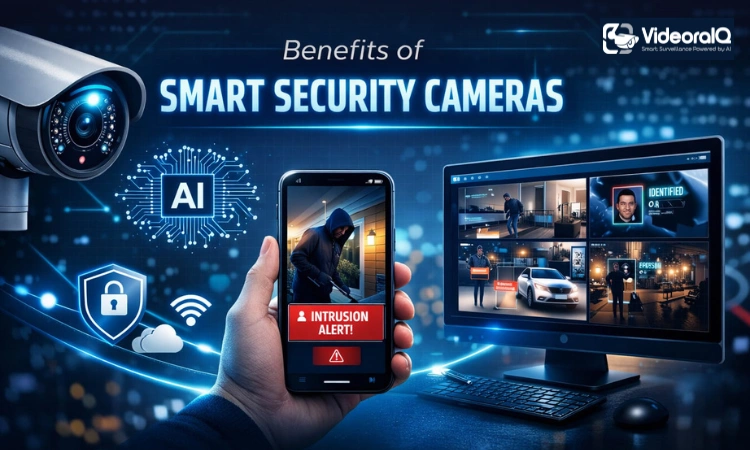
In today’s fast-moving world, smart security cameras are no longer a luxury — they are a necessity. Whether protecting homes, businesses, or public spaces, modern smart surveillance systems powered by AI are transforming how we prevent threats. Unlike traditional security cameras, today’s intelligent systems detect, analyze, and respond in real time.
These cameras are much more advanced than traditional surveillance cameras; they offer features like facial recognition, data analysis, and motion detection. It can be a small office, a large commercial complex, or a retail/general store; a trustworthy surveillance system is necessary for achieving operating success.
But what exactly makes these cameras so beneficial? Let us go through the benefits of smart security cameras and understand them better.
In a hurry? Listen to the blog instead!
What are Smart Security Cameras?
Smart security cameras are advanced surveillance cameras. They combine traditional video recording with modern technology like artificial intelligence, creating a robust and secure security system. This is essential in preventing theft, burglary, trespassing, and other criminal activities.
These cameras are part of a surveillance system that helps users in monitoring and surveilling their homes, assets, and businesses. They also have the ability to identify moving targets, which enables the device to record all the events happening within the permitted range.
Smart cameras can be controlled and updated through any device, like a phone, laptop, or tablet.
How are they different from traditional surveillance cameras?
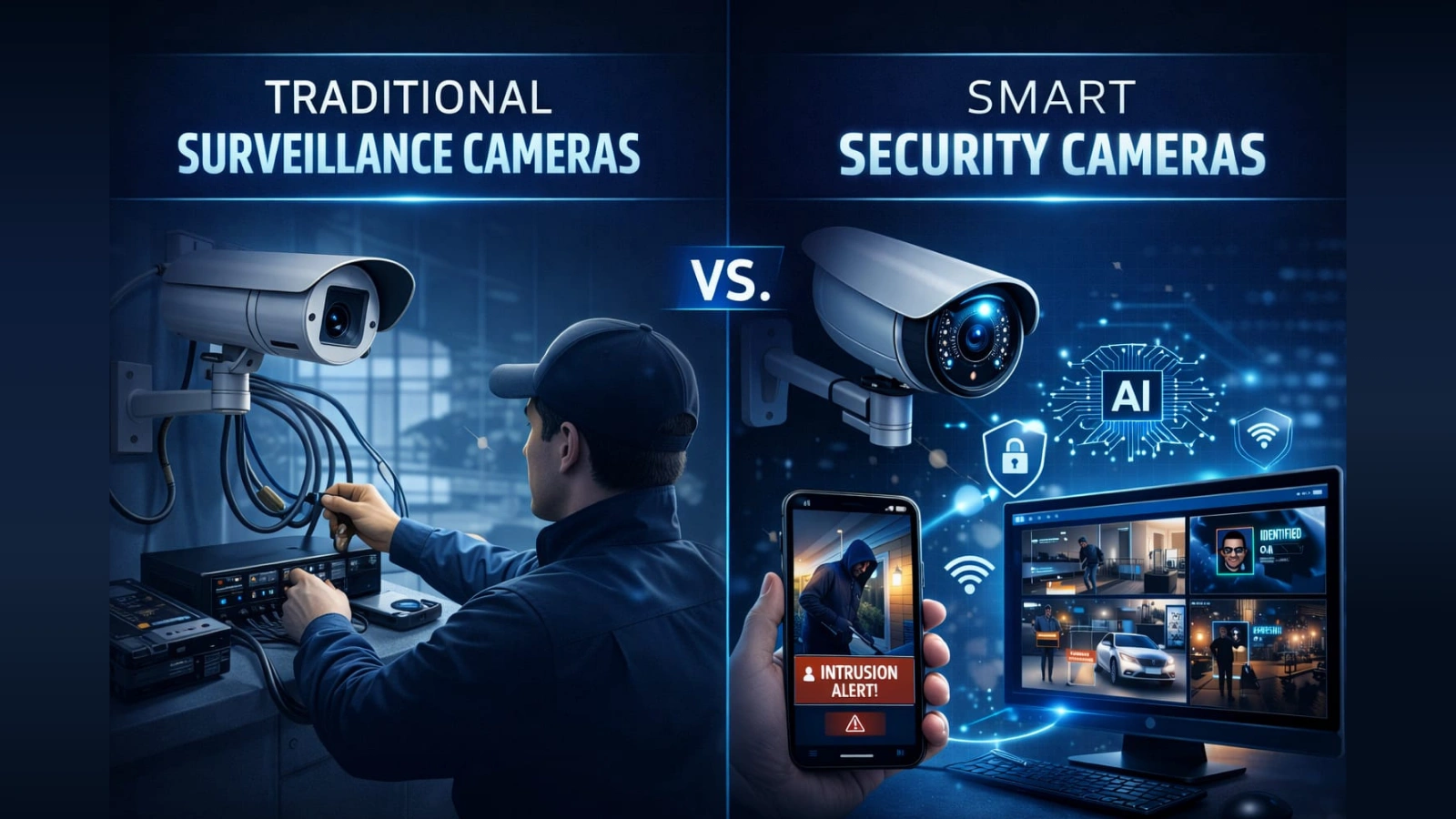
Let’s have a look at some key differences between traditional surveillance cameras and smart security cameras.
Method of recording
Traditional surveillance cameras are built in a way that they record the feed continuously 24/7, and the data is stored in a local hard drive. Whereas smart security cameras record or act when they detect any motion, they begin recording when there is any action in the camera’s field of view.
This keeps the clips more relevant, making it easier to review footage without having to sort through hours of recording.
Storage process
In the traditional camera, the footage is stored in a hard drive, which is good for long-term storage. But this comes with the risk of loss in case of damage to the recorder.
On the other hand, smart security cameras mostly store footage in the cloud, making sure it is backed up and secure. Though cloud storage usually comes with a subscription fee, monthly or yearly.
Options to communicate
Traditional surveillance cameras record footage without interaction. You cannot have two-way communication with these cameras.
But in smart security cameras, the feature is often present where you can talk to someone directly. This can be useful in deterring intruding attempts by alerting the intruder that they are being watched.
Process of installation
Traditional cameras typically require lots of cables running between the camera and the recorder; this can be difficult and time-consuming.
However, smart security cameras, especially wireless ones, are easily installable. They are usually powered by rechargeable batteries, saving the trouble of complicated wiring.
Power source
Traditional surveillance cameras depend on continuous power from the grid; a power cut or outage may stop the recording unless there is a backup power system.
On the other hand, smart cameras run primarily on batteries. This allows them to record even in the case of power outages, though batteries need to be charged regularly, which is a hassle.
Benefits of Smart Surveillance Cameras
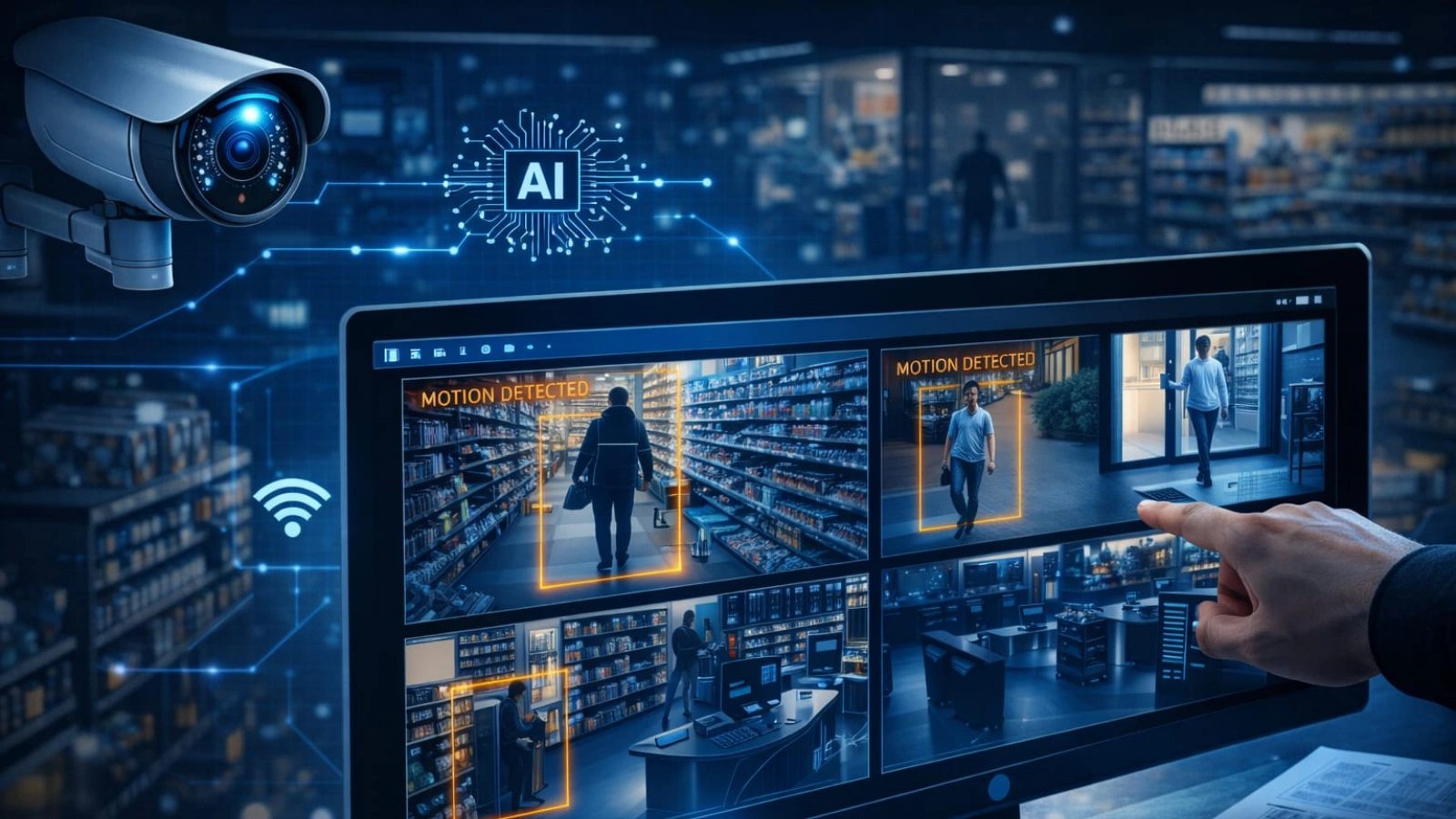
Security and Protection
Using a security camera system is one of the most effective methods for preventing criminal activities. A good security system is significantly helpful in minimizing the probability of theft, vandalism, or uninvited access.
Smart security cameras are an essential and powerful tool in preventing potential intruders by alerting them to unusual activity in real-time. In the case of a security breach or vandalism, smart security cameras are designed to provide high-resolution footage that can serve as important evidence.
AI tools and platforms like VideoraIQ provide great options and features that can be helpful in preventing threats. One such feature is Intrusion Detection; this feature provides real-time intrusion alerts and constant detection, preventing threats.
Facial Identification
Whether it be in business areas or smart home security cameras, these cameras are featured with facial recognition technology. Helpful in improving security in multiple environments, this feature enables the camera to recognize people by their faces. In some cases, this is better than other security methods like key cards or passwords, which are easily copyable or can be forgotten.
For example, smart security cameras are designed to only allow authorized dignitaries to enter the restricted areas, such as workplaces or secured areas. The camera uses facial mapping and analyzes the picture with the list of people allowed to enter. If the person is in the list, the door will open.
Automatic security process
Smart cameras can be used to automate many aspects of a security system. Instead of using manual security teams to monitor video streams and analyze the footage constantly, smart security cameras can analyze and perform these tasks independently. For example, these cameras have a feature that can send alerts immediately when they identify any threat or notice that the door is open unattended.
They also work in real time by notifying security personnel to enable them to assess situations and respond accordingly to them.
Some smart cameras also provide the feature where the security system locks the doors and other mechanisms when a threat appears. This automation helps eliminate the need for security staff. Hence, they can be a great asset and reduce the time and costs required for manual labor.
Can be integrated with home smart devices
Whether they be outdoor or indoor smart security cameras, these can be integrated seamlessly with ease, creating a secure and safe security system. They can be used to work with doorbells and locks to level up your home’s protection.
They also have features like lights being turned on when motion is detected; this adds an extra layer of protection. Also, they are compatible with voice control devices like Alexa or Google Assistant, which makes managing the system even more convenient.
Provides assurance and calmness
One of the most important benefits of smart security cameras is the assurance and peace of mind they provide. The assurance of your premises being protected while you are away feels invaluably reassuring.
When you get immediate alerts for unusual activity, you can take quick actions in case of emergencies, be it informing authorities or having check-ins.
Role of AI in Smart Security Cameras
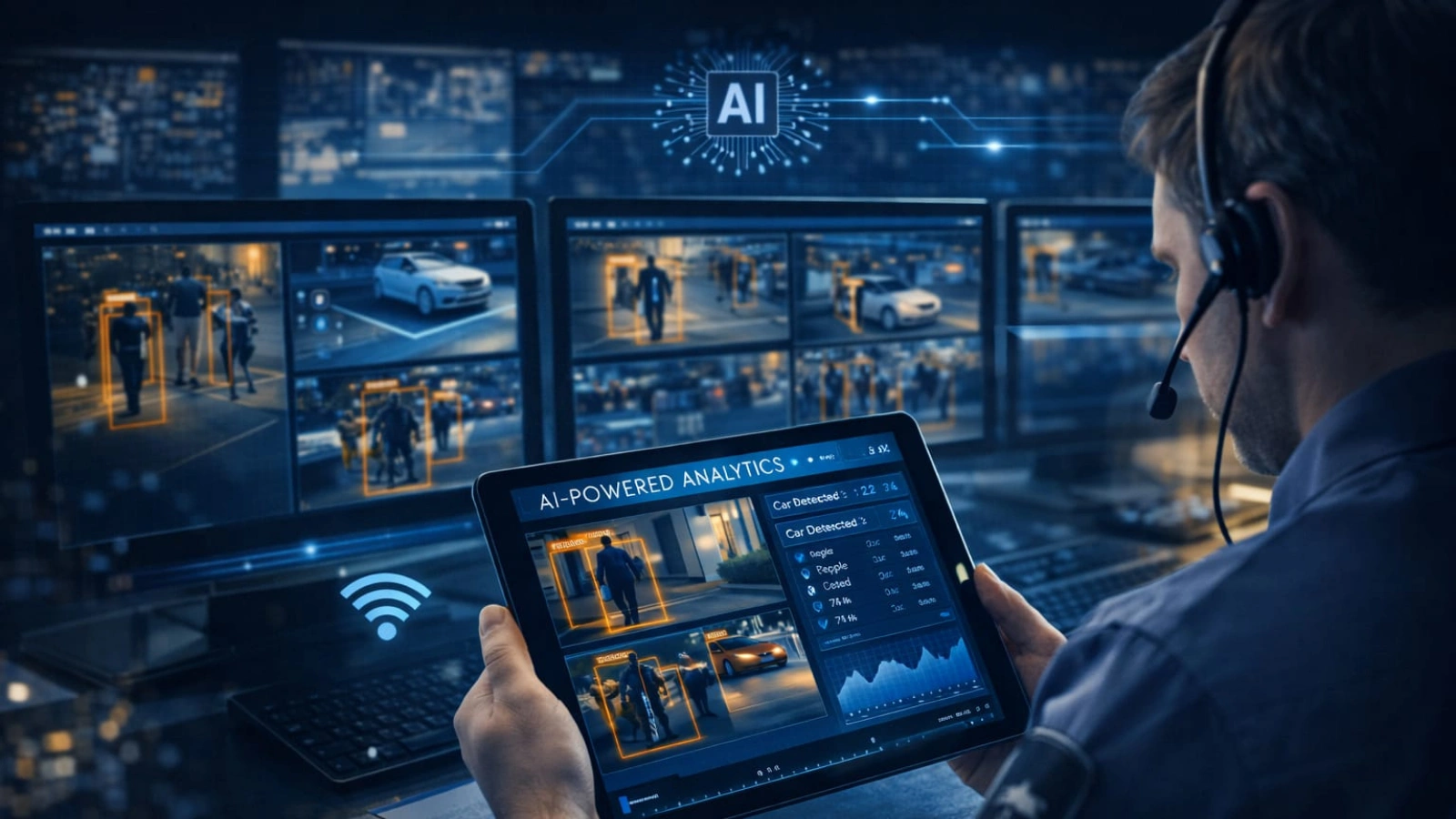
Artificial Intelligence (AI) has completely transformed the way of recording; it has turned these cameras from mere surveillance devices into an efficient and active security system. By using AI in surveillance, cameras can now read video footage in real-time, identify potential threats, and prevent mis happenings, making them more reliable and efficient.
Let us discuss a few factors and see the role of AI in smart security cameras.
Detection of persons and vehicles
AI features in cameras enable them to identify humans and vehicles surely, reducing the chances of false alarms caused by irrelevant movements of swaying trees.
Facial recognition
Some AI cameras are enabled with the feature of facial recognition, which can recognize the faces (employees or family members) fed into the data system, preventing unknown faces from entering the premises.
Defined perimeter
A specific area or some certain areas can be defined to the camera so that it only captures movement in that particular area, reducing the chances of unnecessary alerts and notifications.
Why choose VideoraIQ?
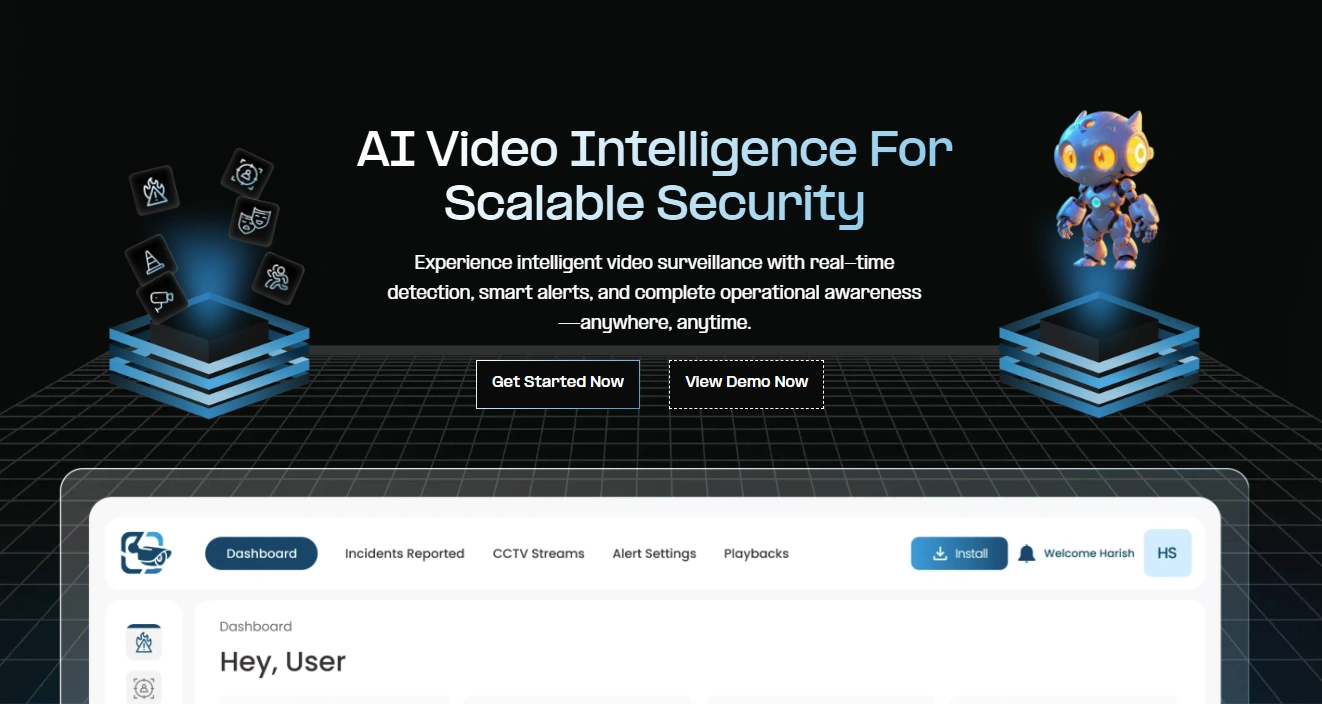
VideoraIQ is an AI-powered video analytics platform designed to upgrade both traditional and smart security cameras with intelligent threat detection capabilities. VideoraIQ is equipped for both traditional cameras and smart security cameras. It not only offers a lot of robust features but also is a very affordable option to secure your premises. Let us discuss the features of VideoraIQ:
Face Recognition
This feature of VideoraIQ uses cameras in identifying and differentiating familiar faces (employees or family members) and unknown faces. The face recognition feature is very helpful, especially in places of access control, only allowing authorized personnel while alerting to strangers.
Unauthorized Access Alerts
This feature of VideoraIQ in smart security cameras allows the user to get instantly notified when someone tries to enter restricted zones without access. This can be an ideal feature in preventing unauthorized access in sensitive zones like storage areas or private residences.
Line Cross Detection
Line Cross Detection allows businesses to secure high-risk areas like ATMs, warehouses, and restricted zones by triggering real-time alerts when virtual boundaries are crossed, reducing response time and preventing incidents before escalation.
It instantly alerts by notifying when any loitering is detected, helping to take quick actions and prevent security threats. It also creates invisible lines in any camera view and alerts triggers in case of any boundaries being crossed, allowing you to take action in real-time.
Smoke and fire detection
VideoraIQ provides a feature that detects the signs of fire and smoke using AI vision; it does not depend on heat or gas sensors for creating an alert. This feature has been trained on real-world fire data to distinguish smoke, fog, or steam, which in turn minimizes the risk of costly false alerts.
It can also continuously monitor multiple high-risk areas across different camera zones, day and night. The smoke and fire detection feature is also useful in syncing alerts across facilities, which helps centralized teams stay informed from a single dashboard.
Number plate detection
With VideoraIQ’s intelligent number plate recognition, standard CCTV cameras are transformed into smart security systems. The platform automatically detects and logs vehicle number plates in real time, enabling continuous monitoring across parking lots, entry gates, and other critical areas.
You can create custom blacklists to flag specific vehicles. Whenever a blacklisted plate is detected, VideoraIQ sends instant alerts—via push notification, email, or SMS—so security teams can respond immediately, even in low-visibility conditions.
The system also maintains a detailed historical record of all vehicle entries and exits, complete with accurate dates and timestamps. All data is accessible through an intuitive, easy-to-navigate dashboard designed for clarity, efficiency, and 24/7 performance.
Read more!
Why Vehicle Detection Cameras Are the Security Upgrade You Can’t Ignore? – VideoraIQ
Top 10 Home Security System Mistakes (And How To Avoid Them) – VideoraIQ
FAQs
Can cameras record without an internet connection?
It is possible for a camera to record without an internet connection. A lot of cameras only record locally, onto a micro-SD card or a hard drive.
Do smart security cameras record 24/7?
Smart security cameras mostly do not record 24/7 by default; they are mostly event-based, recording only when any sound, motion, or visual is detected. However, there are options to make them record 24/7, but they require a wired connection and a large capacity.
Can smart security cameras be used in low light?
Yes, smart security cameras do work in low light:
Infrared (IR) security cameras are one of the most common and widely used methods for night vision. Instead of relying on visible light, these cameras produce an infrared light that is invisible to the human eye but easily visible to the camera’s image sensor.
One more type is color night vision, which uses very sensitive sensors and very low-light technology. They have larger picture sensors that can take in more light and create color details very accurately, even in low light.
How long is camera footage stored in the cloud?
Typically, footage in a cloud is stored for 7-30 days, depending on the subscription plan.
How is VideoraIQ different from traditional surveillance cameras?
Traditional CCTV cameras record footage simply, whereas VideoraIQ features AI-powered video analytics that interpret activity in real-time, helping in detecting threats, intrusions, or incidents the moment they happen.