

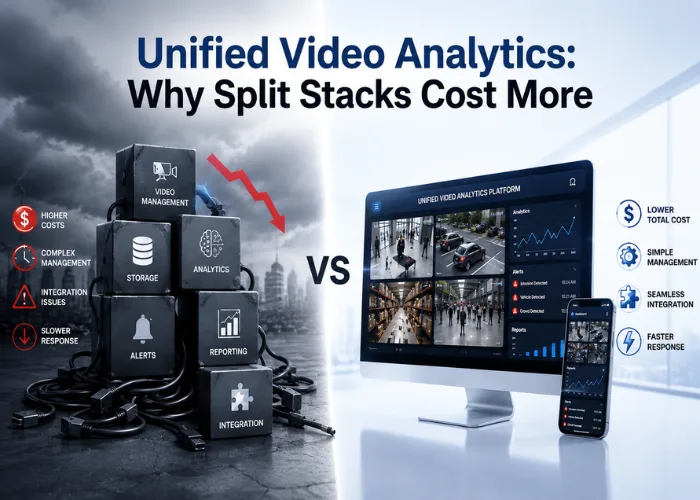
A vehicle clears a barrier in under 12 seconds. If your face recognition platform and your ANPR system are running on separate stacks, your guards are still manually cross-referencing two alert dashboards when that vehicle is already parked inside the perimeter. I have seen this exact scenario play out — not as an edge case, but as a routine daily failure in security operations centres that bought “best-of-breed” point solutions and assumed integration would sort itself out.
Listen to the podcast!
The Fragmented Stack Problem Nobody Talks About in the RFP Stage
Procurement teams evaluating surveillance AI tend to focus on detection accuracy — understandably. Accuracy matters enormously. But the conversation rarely reaches what happens operationally when accurate detections from two separate systems arrive on two separate consoles with timestamps that don’t align.
The failure mode is well-documented in VideoraIQ’s analysis of split-stack deployments: running separate face recognition and ANPR platforms produces duplicate alerts and mismatched event timelines. Guards spend the critical first seconds of an incident correlating data manually rather than acting on it. By the time the picture resolves, the vehicle — or the person — has moved.
This is not a software quality problem. It is an architectural problem. Two platforms mean two event streams, two alert formats, two timing references, and two sets of audit logs that will never quite match when you need them to in a post-incident review. The promise of “API integration” glosses over the latency, the mapping of entity IDs across systems, and the ongoing maintenance burden every time either vendor ships a schema change.
What “Simultaneous” Actually Means for an Operator
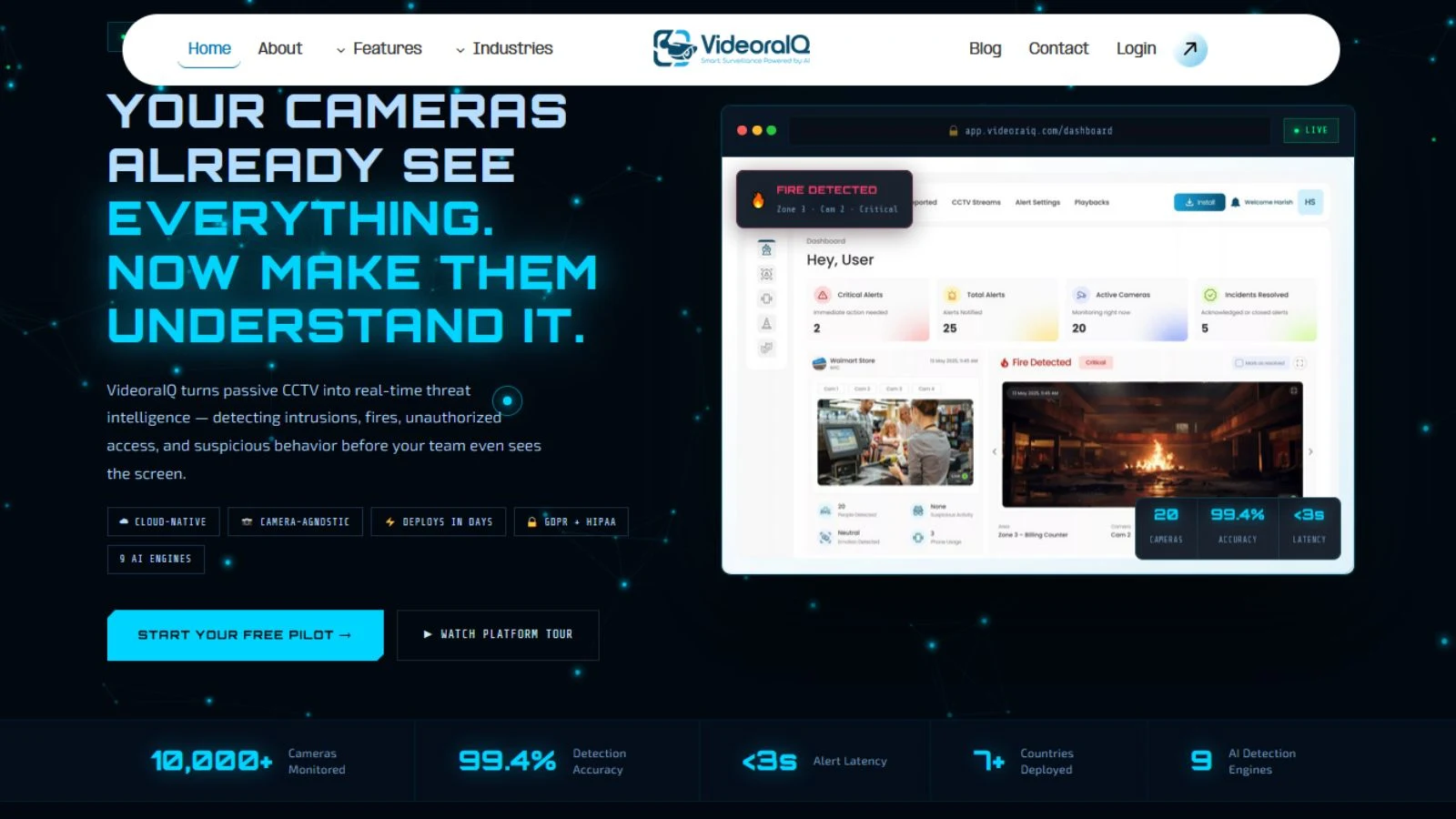
VideoraIQ runs nine AI detection engines simultaneously across the same camera feeds: face recognition, ANPR, intrusion detection, line-cross, fire and smoke, unauthorised access, and more. Every engine runs on the same timestamp. Every event feeds a single, correlated timeline. That architectural choice sounds like a product brochure claim until you think through what it means at the moment of an incident.
When a vehicle triggers ANPR blacklist matching on entry, the face recognition engine has already been processing the driver’s face from the same feed, at the same timestamp. The alert the operator receives is one notification: plate, face match status, location tag, video clip, timestamp — delivered as a single package, not a bare ping. There is no second console to check. There is no mental reconciliation required.
Compare that to the fragmented stack scenario. ANPR fires first — it tends to be faster on a clean plate read. Face recognition fires later, from a different system, with a different timestamp. The guard receives two partial alerts that may or may not describe the same event. Automated correlation fails. Manual reconciliation begins. The 15-second alert delay that lets a vehicle clear a gate before any operator can act is bad enough as a single-system latency problem. It is worse when it is a multi-system synchronisation problem wearing a latency problem’s clothes.
The Accuracy Threshold That Changes the Fragmented-Stack Calculus
Face recognition accuracy has improved dramatically across the industry. The Security Industry Association reports that false positive rates have dropped to 0.2% — down from 4% four years prior. NIST 2024 benchmark data shows top performers achieving false negative identification rates below 0.15% at a false positive identification rate of 0.001.
These numbers matter — but they assume a single, well-integrated system. When you run face recognition and ANPR as separate platforms, a correlated false positive becomes a doubled false positive: two systems firing incorrectly on the same event, each generating its own alert, each requiring individual dismissal. The operator burden doesn’t add; it multiplies.
At 95–97% accuracy on a 200-camera deployment, a single-system operator is already swamped with hundreds of false-positive alerts per day. The recommended threshold for 24/7 SOC environments is ≥99%—anything below that makes sustained human oversight operationally impossible. Now imagine two systems each running below that threshold, each feeding separate alert queues. The case for a unified architecture isn’t philosophical. It’s arithmetic.
VideoraIQ’s published detection accuracy of 99.4% across live deployments, with alert latency under 3 seconds, is only useful if the alert arrives as actionable intelligence rather than a fragment requiring manual correlation. Accuracy is table stakes. The architecture that delivers that accuracy to an operator in a usable form is the differentiator.
Watchlist Staleness: The Fragmented Stack’s Silent Risk
There is a second failure mode that fragmented stacks make dramatically worse: watchlist staleness. Buyers test accuracy at procurement, using a static watchlist. They rarely test how quickly a new entry added mid-shift propagates to live camera matching.
In a split-stack environment, adding a new high-risk individual to a watchlist requires updating two separate systems — potentially with different formats, different propagation timelines, and different operator workflows. The window between “added to the watchlist” and “actively matched on camera” is a genuine security gap. Watchlist staleness is a distinct failure mode equal in risk to a missed match — and the larger the deployment and the more fragmented the stack, the longer that window stays open.
A unified platform with a single watchlist propagated to all detection engines simultaneously closes that gap by design. It is not a feature to tick in an RFP. It is a structural advantage that only exists when the engines share the same data layer.
Compliance Complexity Doubles When Vendors Do
Biometric and vehicle data collected for security purposes is regulated — GDPR, HIPAA, CCPA, BIPA — and the compliance burden is not trivial. VideoraIQ’s platform is built to GDPR and HIPAA standards across a unified data layer. When you run separate platforms from separate vendors, you have two data processors, two sets of data processing agreements, two audit trails, and two incident response obligations under breach notification rules.
That is not an abstract concern. Regulators do not accept “our ANPR vendor didn’t notify us” as a mitigation. The compliance case for unified platforms is as strong as the operational one, and it is almost never surfaced during procurement.
Read More!
AI Video Analytics for Manufacturing Plants
A Framework for Evaluating Any Unified Platform Claim
Not every vendor that claims unified detection actually delivers it. Some bolt separate modules onto a shared UI without shared event correlation. Three questions cut through the marketing:
- Are events from different detection engines correlated on a single timeline by the platform, or does correlation happen only in a reporting layer after the fact? If it’s the latter, you still have a fragmented stack — it just has a prettier dashboard.
- When a watchlist entry is added, how long before all detection engines are matching against it on live feeds? Get a specific, testable answer. Run that test during a pilot.
- What does the alert payload actually contain? A notification that sends you to a console to find the clip and location tag is not the same as an alert that delivers the clip, location tag, and timestamp as one package. The difference in operator response time is measurable.
Pilot methodology matters here. The recommended approach is to start with around 20 cameras, track false positive rate and mean time from event to operator receipt, and stress-test watchlist update propagation mid-shift. Three conditions to cover: high-traffic entry points during peak hours, low light or adverse weather, and watchlist update speed during an active shift. If the numbers hold at 20 cameras, the architecture scales. If they don’t, you learn that before you’ve committed to 200.
The Integration Tax Is Paid Every Shift
The case against fragmented security AI stacks is not that the individual components are bad. It’s that the integration tax — the manual correlation, the alert duplication, the watchlist synchronisation lag, the doubled compliance overhead — is paid every shift, by every operator, invisibly. It shows up as operator fatigue, as response time that exceeds the window where intervention is possible, and as post-incident review sessions where nobody can reconstruct a clean timeline because two systems told two different stories.
With 85% of CCTV footage never reviewed by human operators, the footage itself is not the bottleneck. The bottleneck is turning detection into action in time for action to matter. A unified architecture that monitors over 10,000 cameras across deployments in seven or more countries with sub-3-second alert delivery earns that latency number by removing the inter-system handoffs where time is lost.
Buyers who evaluate face recognition and ANPR as separate line items in separate vendor relationships will spend years paying the integration tax they didn’t budget for. The smarter question at procurement is not “which face recognition vendor is most accurate?” It is: “what happens between detection and the moment an operator can act — and how many systems are in that chain?”
Fewer is better. One is best.
Start your free VideoraIQ trial and see what nine detection engines on a single unified timeline looks like in your environment.