

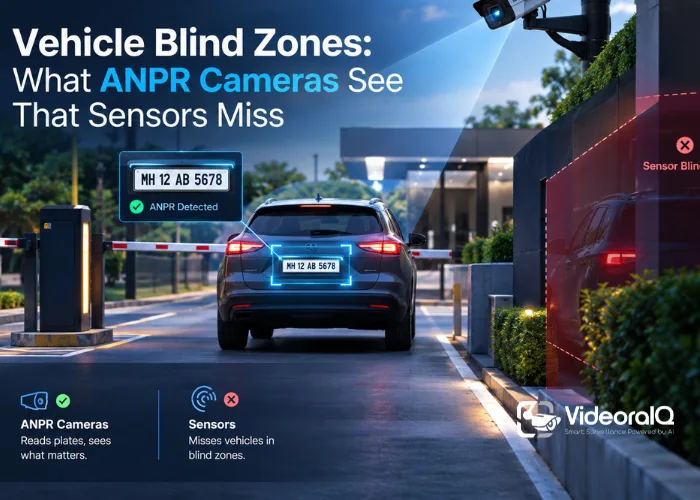
Forward blind zones on six of the best-selling passenger vehicles in the United States have grown substantially over the past 25 years, according to a June 2025 IIHS measurement study. That is a road-safety story, yes. But it is also a facility-security story that most security managers have not read yet.
The blind zone debate has been almost entirely about what the driver cannot see. Regulators are responding in kind — the NHTSA has confirmed that blind spot warnings and pedestrian detection will be added to crash-safety ratings starting with 2026 models. In-vehicle sensors are finally getting their regulatory moment.
But those sensors cannot help you. Not at your loading dock and your perimeter gate and at the entrance to a manufacturing floor where a forklift and an unmarked contractor van share the same narrow apron at shift change. In-vehicle technology is designed for open roads. Your facility is a controlled environment, and controlled environments need fixed infrastructure that watches the vehicle—not technology inside the vehicle that watches the road.
Listen to the podcast!
The Facility Blind Zone Is Different
In-vehicle blind spot monitoring reduces lane-change crashes by 14% when fitted and active. That is meaningful on a motorway. On a private campus, it means almost nothing. Contractors disable alerts. Older fleet vehicles carry no sensors at all. Visitors arrive in personal cars with unknown configurations.
And the threat you are actually managing is entirely invisible to any in-vehicle sensor. A blacklisted plate. A credential mismatch. A van lingering in a restricted zone after a clean arrival—none of that registers on technology mounted inside the vehicle itself.
Fixed camera infrastructure does not care what the vehicle is equipped with. It watches the vehicle from the outside, continuously, at every point of entry and across every defined perimeter line. That is the structural difference. It is also why organizations running serious physical-security programs have largely stopped treating ANPR as an optional add-on and started treating it as the primary data layer for vehicle movement.
What a Modern ANPR Deployment Actually Does
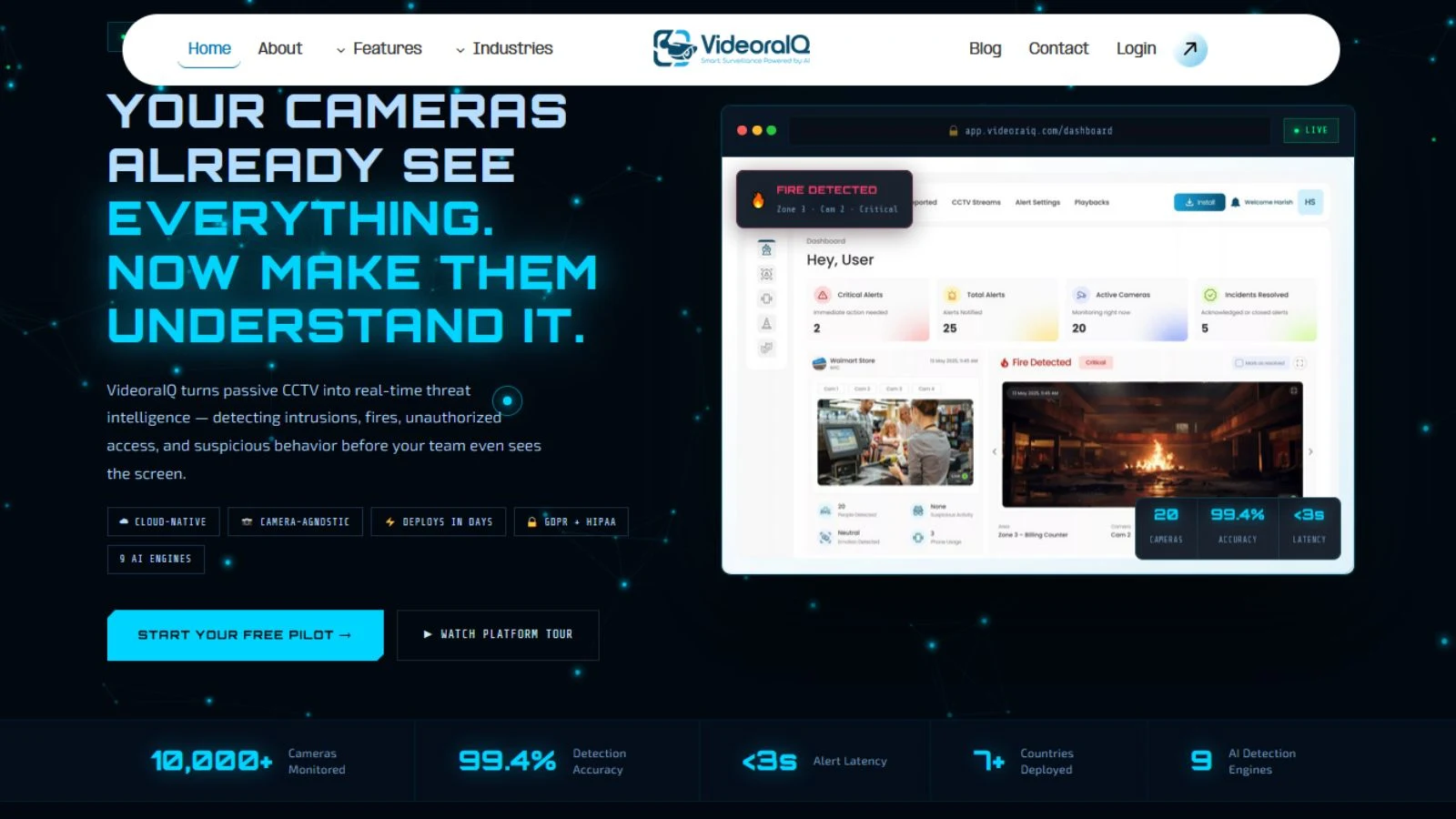
VideoraIQ‘s Number Plate Recognition module logs every vehicle entry and exit automatically, with blacklist matching running in real time across all monitored sites. The platform claims alert latency of under three seconds from plate read to operator notification. That matters: a blacklisted vehicle can clear a gate and disappear into a car park in under thirty seconds if the alert arrives late.
The blacklist matching piece is where most deployments quietly fail. As our post on ANPR blacklist matching across multiple sites details, a blacklist entry added at Site A at 09:00 will not trigger an alert at Site B at 10:30 under a nightly batch-sync architecture. That is still the default for most on-premises deployments extended to a second site without re-architecting the data layer. The vehicle drives in. The system has the plate on record. The alert never fires. This is not a configuration edge case; it is a fundamental consequence of treating sites as isolated data silos.
Real-time, cross-site blacklist matching closes that gap. It is the architectural requirement that separates a genuine vehicle-intelligence layer from a glorified gate log.
Where Line-Cross and Intrusion Detection Take Over
ANPR handles entry and exit. It does not handle what happens in between. A vehicle admitted legitimately at 08:00 can park, wait, and move to a restricted zone at 11:00. The entry log shows a clean arrival. Nothing else flags unless the camera network is watching the perimeter of that restricted zone too.
This is where Line-Cross Detection and Intrusion Detection extend the coverage. Operators draw virtual tripwires directly on the camera feed — a boundary around a loading dock, a restricted equipment bay, a zone that vehicles are not permitted to enter after a certain time. Any crossing fires an alert with an attached video clip, location tag, and timestamp, reaching the security team within the platform’s claimed three-second window.
For manufacturing environments specifically, this combination — ANPR at the perimeter, Line-Cross on internal zones — creates an audit trail that covers the full vehicle journey through the site, not just the gate event. Compliance audits become retrievable by plate and timestamp rather than dependent on officer memory or incomplete paper logs.
The Market Is Moving, But Deployment Maturity Is Lagging
The global AI-powered video analytics market was valued at $5.63 billion in 2025 and is projected to reach $23.03 billion by 2034, a compound annual growth rate of 16.8%. That trajectory is driven by the convergence of AI, deep learning, and edge computing — the same stack that makes real-time plate reading at distance practical without dedicated hardware per lane.
Market growth does not mean deployment maturity, though. Most organisations buying into AI video analytics for the first time treat it as a camera upgrade rather than a data architecture decision. They deploy ANPR at the primary gate and stop. Internal vehicle movement goes unmonitored. Blacklists live in a spreadsheet that someone remembers to upload. The coverage gap between “vehicle arrived” and “vehicle departed safely” is never closed.
By 2025, cloud-based ANPR systems are expected to account for 37% of all deployments — a shift that makes real-time cross-site synchronisation technically straightforward. The barrier is no longer hardware. It is whether buyers ask the right question during procurement.
The Question Buyers Are Not Asking
When a facility manager evaluates an ANPR system, the standard questions are: What is the read accuracy? What is the hardware cost per lane? Does it integrate with our access control system?
Fine questions. The one that gets skipped: What happens to a blacklist update at 09:00 on a Tuesday when that plate appears at a different site at 10:30?
Ask it. Specifically. Ask the vendor to walk you through the data propagation path. Ask how long a blacklist addition takes to become active across all monitored sites. Ask what the alert latency is — not the theoretical maximum, but the measured figure under normal operating load. If the vendor cannot answer the propagation question with a specific architecture description, the system is almost certainly running batch sync. That is a gap you will not discover until after a vehicle you needed to stop drives through unchallenged.
VideoraIQ’s published platform specification claims 99.4% detection accuracy across more than 10,000 cameras in seven countries, with under-three-second alert latency for ANPR blacklist-match events. Those are the company’s own marketing claims, not independent benchmarks — but they set a concrete reference point for what to ask every other vendor to match, in writing, before you sign.
A Practical Deployment Checklist
Auditing an existing ANPR deployment? Specifying a new one? Run through these five questions before anything else:
- Propagation speed: How quickly does a new blacklist entry go live across every camera in every site? Real-time or batch? If batch, what is the sync interval?
- Alert latency: From plate read to operator notification — what is the measured figure, not the theoretical cap?
- Internal zone coverage: Do you have Line-Cross or Intrusion Detection configured for restricted zones inside the perimeter, or only at entry/exit points?
- Compliance configuration: Are GDPR and HIPAA settings—data retention periods, access controls, anonymisation rules—consistent across all sites, or does each site carry its own configuration?
- Audit trail depth: Can you retrieve the full movement history for a specific plate across all sites by date and time, without manual log reconciliation?
The fifth question catches more problems than any of the first four. Organisations that cannot answer it quickly almost always have fragmented data architectures. Fragmented architectures are where the real blind zones live — not in the camera field of view, but in the gap between what the system recorded and what can actually be retrieved and acted on.
You can read more about how vehicle detection cameras are deployed across residential, commercial, and government environments — and the specific analytics they unlock — in our detailed guide to vehicle detection camera deployments.
Read More!
ANPR Blacklist Matching: The Multi-Site Blind Spot
ANPR Site Survey: 5 Physical Checks Before You Install
Fixed Infrastructure Is the Only Reliable Answer
In-vehicle blind spot sensors are improving. Regulation is pushing manufacturers in the right direction. None of that changes what happens at your perimeter gate at 10:30 on a Tuesday when a flagged vehicle arrives at a site your ANPR system has not yet been told about yesterday’s blacklist update.
The blind zone that matters for facility security is not the one the driver cannot see. It is the one in your data architecture. Fixed camera infrastructure, real-time cross-site blacklist matching, and virtual tripwires on internal zones are the three layers that close it. Getting all three right — consistently, across every site, with a documented propagation path — is the standard serious security buyers should be holding vendors to.
If your current deployment does not meet that bar, explore what VideoraIQ’s video intelligence platform can do for your vehicle monitoring coverage — and bring the propagation question to the first conversation.