


Security operations centres that chase hundreds of nuisance alerts a day share one root cause: pixel-change motion detection. It cannot tell a trespasser from a swaying tree. Swap it for AI object classification, and false alarm volumes drop by up to 90%, not by dulling sensitivity but by adding a classification layer that legacy triggers completely lack. This article explains why traditional systems over-alert, what actually fixes it, and how to deploy the change across an existing camera fleet.
Listen to the podcast!
Why traditional motion detection floods you with noise
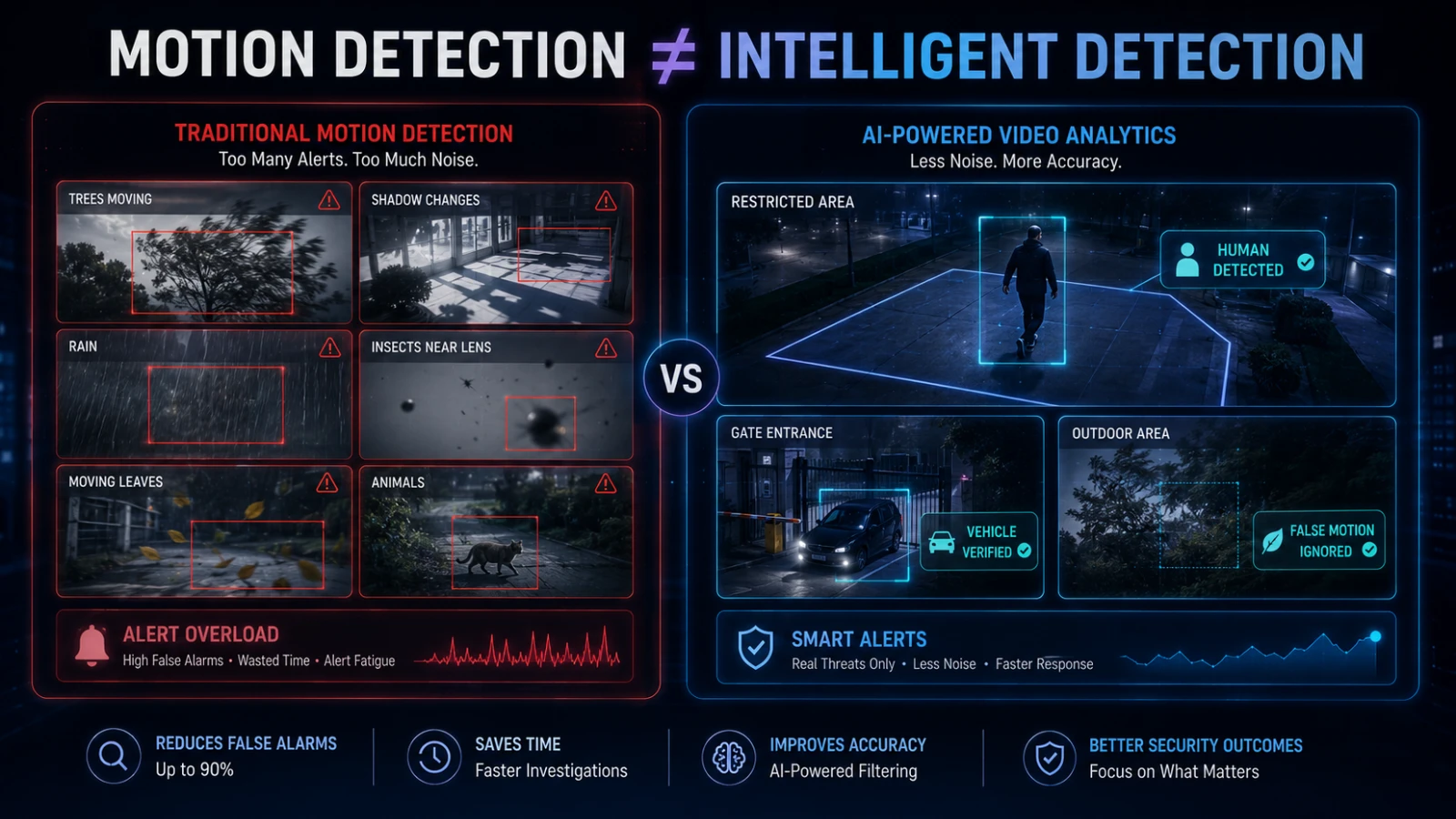
Most VMS and camera-side motion detection work on pixel change: if enough pixels in a zone shift between frames, it fires. That logic cannot tell the difference between a trespasser and a plastic bag, headlights sweeping a wall, rain on the lens, a cat, or a flag. In outdoor deployments, environmental triggers commonly account for the overwhelming majority of alerts.
The operational cost is real. When the bulk of alerts are junk, operators develop alarm fatigue and start dismissing events reflexively, exactly when a genuine breach slips through. Research into AI-enhanced video surveillance systems shows false alarm rates in legacy setups running above 90%, and every dismissed alert erodes trust in the entire system.
What actually reduces false alarms is classification, not sensitivity
The instinct is to lower camera sensitivity or shrink detection zones. That trades false negatives for false positives: you stop seeing the bag, but you also miss the intruder crouching at the fence line. The durable fix is a different question: not “did pixels move?” but “what moved, and does it matter?”
Modern computer-vision analytics answers that with layered logic:
- Object classification: Deep-learning models label each moving object as a person, vehicle, animal, or other, so a fox or a windblown branch never triggers a human intrusion rule.
- Rule and zone context: Line-Cross Detection lets operators draw virtual tripwires directly on a camera feed; an alert only fires when a person crosses a specific boundary in a defined direction for a minimum dwell time. No physical barrier is required.
- Attribute filtering: Size, speed, and aspect-ratio thresholds discard objects that are physically implausible for the threat you care about; a bird close to the lens looks large but moves wrong.
- Face authentication at access points: At doors, turnstiles, and gates, VideoraIQ‘s face recognition engine matches live feeds against an enrolled watchlist in real time, so an authorised person walking through never generates a security event. Unknown or flagged visitors are surfaced instantly.
Stacked together, these filters are what move a site from thousands of raw motion events to a handful of actionable alerts per day.
Name use cases where this pays off
- Perimeter and fence-line protection: Logistics yards, substations, and construction sites are plagued by animals and weather. A person-only line-crossing rule with a short loiter threshold eliminates wildlife and headlight sweeps while still catching someone scaling a fence. Operators go from triaging every gust of wind to reviewing only confirmed human crossings.
- Public spaces, abandoned items, and crowd flow: Airports, transit hubs, and event venues face a different false-alarm problem: motion is everywhere, but specific objects matter. VideoraIQ’s Unattended Baggage Detection identifies abandoned items in public spaces as a discrete event rather than a blur of movement, letting security teams act on a specific location and camera feed rather than a vague zone alert.
- Retail and banking cashier station monitoring: Shopfronts get triggered all night by passing traffic and reflections. But the more expensive problem happens during trading hours: an unmanned cashier station is a shrinkage and compliance risk that pixel motion simply cannot detect. VideoraIQ’s Cashier Absence Detection monitors for continuous staff presence at service counters and alerts floor managers the instant a station goes unmanned, turning a passive alert feed into an active operational tool.
- Access control and tailgating: At secure entrances, face recognition verifies each person against a watchlist, while people-counting logic flags tailgating two bodies passing on one credential. Legacy motion detection literally cannot see that threat. VideoraIQ’s unauthorised access feature lets security teams define sensitive zones and receive an instant alert with a live video link the moment a breach attempt occurs.
- Fire safety, where speed matters more than noise reduction: This is the less obvious use case but arguably the most critical. VideoraIQ’s Fire & Smoke Detection identifies visual fire signatures 40–60 seconds before traditional heat sensors trigger. In manufacturing environments where machinery, chemicals, and dense occupancy compound risk, lead time is the difference between a suppression response and a full evacuation.
How to roll it out on an existing camera fleet
You rarely need to rip and replace hardware. VideoraIQ’s platform is cloud-based and designed to work with existing IP cameras without requiring full infrastructure replacement — connect via ONVIF/RTSP, and the analytics layer runs over your current video surveillance streams.
- Baseline your current noise: Pull 7 days of alert logs and count how many events were actioned versus dismissed. This is the number you hold the project accountable to.
- Prioritise your worst offenders: Identify the 5–10 cameras generating the most false alerts — usually outdoor, wide-angle, or high-traffic views. Start there for the biggest visible win.
- Ingest streams into the analytics layer: No camera changes are needed if resolution and frame rate are adequate. 1080p at 12–15 fps is generally enough for reliable person detection.
- Configure classification rules per camera: Set object types, detection zones, minimum dwell time, and direction. Disable raw pixel-motion alerting once rules are live.
- Run a shadow period: Keep the old system running alongside the AI rules for 1–2 weeks. Compare confirmed detections to ensure you are not trading false positives for false negatives before you cut over.
- Enroll faces where needed: For access points, build the authorised watchlist and set escalation protocols for unknown or flagged individuals.
- Measure and iterate: Recount actions versus dismissals after 30 days. Adjust dwell times and zone boundaries on any camera still producing noise — the goal is a Video Surveillance setup that gets quieter and more accurate over time, not one that just accumulates more footage.
What to measure so the results hold up
Operations leaders should track a tighter set than a generic summary dashboard:
- False alarm rate: Nuisance alerts as a share of total alerts, before and after.
- Alerts per operator per shift: The direct driver of alarm fatigue and staffing cost.
- Mean time to verify: how long it takes to confirm or dismiss an event; cleaner alerts shorten this sharply.
- Detection recall on live tests: Schedule quarterly walk-tests to confirm real intrusions still fire. Never optimise false positives at the expense of this one.
A well-tuned outdoor deployment should approach the 90% false-alarm reduction benchmark within the first month, with no measurable loss in genuine-event detection, provided the shadow period was run properly.
Read More!
How to Choose Video Surveillance Analytics Software
How Cloud-Based Video Surveillance Unlocks Smarter Security?
Common pitfalls that undo the gains
- Camera placement fights the model. Faces too small in frame, extreme backlighting, or angles above roughly 30° degrade both classification and face matching. Fix the view before blaming the analytics.
- Over-restrictive zones. Drawing detection lines too tightly creates blind spots. Give the model room to see the approach, not just the boundary.
- Skipping the shadow period. Cutting over instantly means you discover a missed detection during a real incident, not a controlled test.
- Treating it as set-and-forget. Seasons shift lighting and foliage. Revisit tuning quarterly.
Turn a noisy camera fleet into actionable intelligence
False alarms are not a hardware problem. They are a classification problem, and that is solvable in software without touching a single camera. Across more than 10,000 cameras monitored in enterprise, banking, telecom, and healthcare video surveillance deployments spanning 7+ countries, VideoraIQ layers real-time object classification, virtual tripwire zone logic, face authentication, and fire detection over existing IP cameras, hitting 99.4% detection accuracy with alert latency under 3 seconds. This is the difference between passive video surveillance and a system that actually reduces noise instead of just recording it. If you want to see how much of your current alert volume is avoidable, start your free VideoraIQ trial and run a side-by-side on your five noisiest cameras. The gap becomes visible in the first week proof that modern Video Surveillance doesn’t have to mean drowning in false alerts.