


Airports and transit stations choosing face recognition and license plate reading in 2026 face a high-stakes decision. Two proven approaches dominate: VideoraIQ’s cloud-native, real-time model and Briefcam’s investigative depth. This comparison lays out speed, accuracy, deployment, and compliance tradeoffs. The goal is to help your team make a confident call for both live intercepts and post-incident investigation.
[Book a free 15‑min consult →]
What Airports and Transit Stations Actually Need From Face Recognition and License Plate Reading Software in 2026
Airport and metro security teams run on speed and scale. You may watch hundreds or even thousands of cameras. A missed alert can mean a missed intercept. With 85% of CCTV footage never reviewed, real-time AI is not optional. It is how you move from “footage after the fact” to action while a person or vehicle is still on-site.
First, you need alert latency under three seconds. Anything slower turns a live intercept into a radio call to a team that is now one concourse late. Second, the same platform should run both facial recognition and plate analytics (ANPR/LPR). That expectation now applies to curbside, garages, and airside access points.
Two separate systems double training, audits, and failure points. They also introduce policy drift as teams maintain two sets of rules. Third, your system must fit the cameras you already own.
- Core requirements at a glance:
- Sub‑3‑second alerting from entry to dispatch-ready payload
- Unified face recognition and ANPR in a single console
- Compatibility with heterogeneous, legacy IP cameras
- Policy-aligned governance for watchlists, storage, and exports
Airports rarely have a single vendor. You likely have gear from 200+ brands across terminals, garages, and access roads. That diversity is normal in aviation and transit.
Privacy and policy matter as much as speed. In the EU and beyond, you must meet GDPR standards for lawful use, retention, and audit trails. Local aviation authority rules add more checks on how you enroll watchlists, who can access outputs, and how long you store clips. Internal governance should match those external obligations.
Operational realities in 2026
Crowds and clutter raise the bar for accuracy. In dense halls, false hits drain response teams. You need low false alarm rates, especially for faces in motion and license plates at odd angles. The best systems maintain precision when passengers wear masks, hats, or sunglasses. They also handle motion blur and fast pans from PTZ cameras.
In addition, unattended baggage detection is not a “bonus.” It sits alongside biometric alerts as a core need for platforms and stations. The same applies to perimeter intrusion around airside fences and service roads. Smart alerts must cut through noise without hiding edge cases.
Finally, you need a deployment model that matches your risk posture. Cloud can cut IT overhead across many small sites. On-prem helps when you run an air-gapped network or face strict data rules.
- Deployment choices cheat sheet:
- Cloud: rapid rollout, centralized updates, OpEx-friendly; plan bandwidth and regional hosting
- On‑prem: air‑gapped control, data sovereignty, custom retention; requires CapEx and GPU sizing
- Hybrid: local processing with cloud coordination; balances control with ease of management
Airports swing both ways. Some need cloud reach and centralized control. Others demand boxes in a locked rack with no external dependencies.
Resilience also matters. Designs should degrade gracefully if a WAN link drops. Buffered analytics and queued alerts prevent oversights during network incidents. That resiliency is essential in weather events and peak holiday periods.
Integration and interoperability considerations in complex camera ecosystems
In a heterogeneous airport environment, analytics must work hand-in-glove with the video management systems you already operate. Think Genetec, Milestone, or Video Insight. Verify whether the platform ships with native connectors. If not, ensure reliable REST APIs and webhooks exist for forwarding alerts, fetching clips, and bookmarking events directly into case files without manual shuffling. Event schemas should be well documented and versioned.
Watchlist and data synchronization should be equally deliberate. Most airport SOCs juggle multiple lists, such as prohibited persons, stolen vehicles, contractor badges, or time-bound BOLOs. Look for import options like CSV or JSON. Scheduled SFTP jobs help at scale. Role-based approvals that require a second set of eyes before a list goes live reduce risk and build trust.
- Ask vendors up front:
- Which VMS connectors are native, certified, and version-aligned?
- Do APIs support bulk exports and replay for missed webhook deliveries?
- How are watchlists validated, approved, and expired automatically?
- What SLAs govern alert delivery, deduplication, and retries?
Identity and access management is another pillar because auditability depends on strong authentication and least-privilege roles. Platforms should support enterprise SSO using SAML or OIDC. They must allow you to map clear boundaries between security officers, investigators, and supervisors. That segmentation controls who can enroll faces or plates, who can view alerts, and who can export evidence. It also simplifies offboarding when staff changes.
Once an alert is generated, its value hinges on distribution. Confirm that it can flow into radios, dispatch software, Slack or Teams, email or SMS gateways, and, for airports, AODB or incident management tools. Tight distribution shortens the loop from detection to response. Dispatchers need a single pane of glass, not a maze of tabs.
Finally, evidence workflows must travel cleanly. Exported clips should carry hashes, timestamps, camera IDs, and operator notes in standard formats like MP4 and JSON. The network stack should respect real-life constraints across camera subnets, VLANs, and fragile inter-terminal links. That means buffering gracefully, retrying on packet loss, and compressing video intelligently without sacrificing facial features or plate legibility. ONVIF, RTSP, and secure transport (TLS) support round out the picture.
The 8 criteria this comparison uses for biometrics and license plate analytics
- Scale: hundreds to thousands of cameras per site or network
- Speed: sub-3-second alerts for live interception
- Unified AI: face recognition and ANPR in one platform
- Camera fit: works with heterogeneous, legacy CCTV fleets
- Compliance: GDPR alignment and audit-ready workflows
- Crowd performance: low false positives in dense scenes
- Co-requirements: unattended baggage and perimeter intrusion
- Deployment: cloud vs on‑prem tradeoffs for critical sites
Editorial context: High-security areas like airports, metros, and event venues have unique throughput and compliance needs. AI that works in a small office may fail on a platform at rush hour.
VideoraIQ Overview: Strengths and Weaknesses for Airport and Transit Deployments for Facial Recognition and ANPR
VideoraIQ is a cloud-native video intelligence platform with nine AI engines in one stack. It covers face recognition, license plate reading (ANPR), unattended baggage, intrusion, fire and smoke, object detection, line-cross, unauthorized access, and cashier absence. For airport teams, that breadth means one system can watch gates, baggage carousels, sterile corridors, and parking in parallel. You do not have to stitch together point tools or swivel between dashboards.
On performance, VideoraIQ reports 99.4% detection accuracy with alert delivery in under three seconds. In practice, that speed is the difference between a handheld search at the gate and a terminal-wide BOLO ten minutes later. Real-time alerts include video proof, a location tag, and a timestamp. That bundle helps shift leads pass cases fast and act with confidence.
Moreover, it works with existing cameras across 200+ brands. That matters in legacy airports where terminals were built years apart. With a cloud-based design, there is no on-prem server to buy or maintain. For multi-site transit networks, this lowers IT work and speeds rollout. Automatic updates also reduce version drift and patching gaps.
Key benefits for airport teams
Airport operations benefit from consolidating face recognition and license plate reading in one platform. This reduces tool sprawl and the cognitive load of switching dashboards during peak traffic windows. VideoraIQ’s sub‑3‑second alerts arrive with video snippets, precise camera location, and timestamps. That makes it faster for supervisors to validate and push actionable information to patrol via radio. Fewer clicks mean shorter response times.
The broad compatibility across heterogeneous fleets minimizes rip-and-replace projects. Teams can phase upgrades in line with existing capex cycles rather than rushing wholesale changeouts. Built-in heatmaps and analytics illuminate queue pinch points and seasonal flow patterns without investing in a separate BI stack. That insight helps planners fine-tune staffing and lane allocation.
- What this means on the floor:
- Faster verify-and-dispatch cycles when seconds matter
- One policy framework for both faces and plates
- Lower training overhead across shifts and contractors
- Data-driven staffing using heatmaps and dwell analysis
Zone-Based Monitoring further narrows alerting to the “must-know” areas. Examples include gates, baggage claims, and sterile corridors. Teams spend less time triaging noise and more time responding to the events that matter. The Enterprise tier supports unlimited cameras, custom AI models, and 90‑day cloud retention. Heatmaps and analytics help teams study passenger flow and plan rosters with data rather than hunches.
Zone-Based Monitoring lets you draw virtual perimeters around gates, claim belts, and parking zones. The goal is to reduce noise and focus alerts. That precision matters for shift leaders who manage competing priorities in real time.
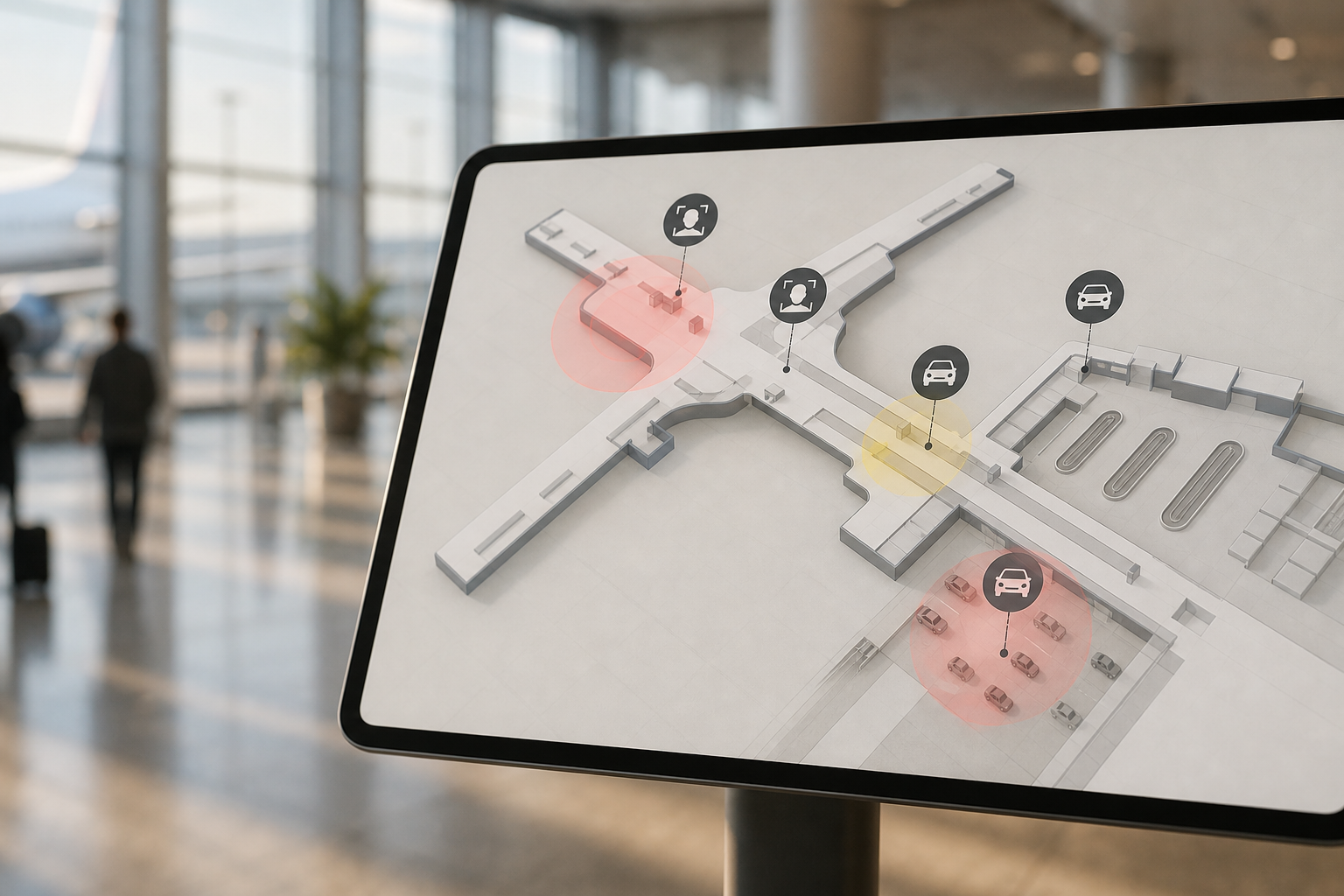
However, there are tradeoffs you should weigh. VideoraIQ is cloud-only. If your airport runs an air-gapped network or faces strict data sovereignty rules, that can be a blocker.
Also, while the face and plate engines are strong, the product’s primary market story is unattended baggage. You get biometric matching as part of a broader platform, not as the sole focus. That can mean less depth in large, complex face galleries than vendors built around face search alone.
As of now, there are no publicly documented airport-specific case studies. The platform monitors 10,000+ cameras and is deployed in 7+ countries. That footprint speaks to scale, yet aviation proof points are still emerging. Ask for references in transport or public safety to validate fit.
“Unattended bag alerts help us catch potential threats instantly in crowded platforms. It buys us time and improves passenger safety.” — Rakesh Mehra, Transit Operations Head
From a compliance view, VideoraIQ states GDPR and HIPAA alignment. That stance helps mixed-use sites like airport clinics and first-aid rooms. For pricing, the Starter tier (up to 20 cameras, 7‑day retention) is too small for airports. Your real entry is Professional (up to 200 cameras, all nine engines, 30‑day retention) or Enterprise for full-campus coverage. Ask about custom retention and regional data residency as part of due diligence.
Security posture deserves a note. Confirm encryption in transit and at rest. Verify key management, including CMEK options where required. These controls matter in regulated environments.
Implementation and integration notes for VideoraIQ
Deployment tends to be straightforward because the platform is cloud-native. This trims rack space, cabling, and the need for on-prem GPUs. You should confirm bandwidth assumptions and any lightweight gateway tooling required at the edge for constrained WAN links. A small relay can smooth spiky network conditions in older terminals.
Role-based access control and auditing are central to regulated environments. Validate that every action, including watchlist changes, alert acknowledgments, and exports, lands in an immutable log. Each entry should be stamped with operator identity and precise time. That design yields clean audit trails and defensible reports.
- Edge and bandwidth planning quick tips:
- Benchmark bitrates per camera profile; apply VBR caps for peak periods
- Cache thumbnails locally to cushion WAN drops; replay missed webhooks
- Stagger firmware and model updates to avoid synchronized spikes
- Pre-provision IAM roles and SSO mappings before go-live
If your operation spans multiple countries, scrutinize multilingual OCR and ANPR character set support. Include Arabic and Cyrillic in tests if relevant. Verify recognition against regional templates such as stacked motorcycle plates or specialty two-line formats. These checks maintain plate accuracy when vehicles cross jurisdictions.
Finally, line up incident management integrations via webhooks or pre-built connectors. Alerts should push into ticketing or dispatch in real time. That eliminates the “swivel-chair” from console to console and reduces missed intercepts. Also verify alert deduplication logic to prevent paging fatigue during bursts.
Cybersecurity integration helps too. SIEM forwarding of security events, API rate limiting, and MFA enforcement for admins add resilience. Ask for SOC 2 or ISO 27001 evidence to round out vendor assessment.
Where VideoraIQ fits best for facial recognition and LPR/ANPR
VideoraIQ is best matched to distributed transit networks that want a single cloud platform for biometrics and ANPR while also covering unattended baggage, fire or smoke, and other safety detections. Airports prioritizing sub‑3‑second real-time alerts and broad camera compatibility will find it aligns with the day-to-day tempo on concourses, curbsides, and garages. Teams that value heatmaps and zone rules can fine-tune alert scopes to match changing layouts or temporary closures. Operators who prefer predictable OpEx over CapEx-heavy server builds can scale quickly across terminals and satellite facilities without waiting on procurement cycles for hardware.
The platform also suits agencies that standardize on remote management. Cloud-first tooling reduces version drift across sites. It supports faster rollouts during expansions or terminal refurbishments.
Also Read!
Best Fire Smoke Detection Security Camera for Retail Stores and Chains in 2026
Best Intrusion Detection Security Camera for Retail Stores and Chains in 2026
Briefcam Overview: Strengths and Weaknesses for Airport and Transit Deployments for Biometrics and Plate Analytics
Briefcam, now part of Canon Group, is a mature video analytics platform known for forensic depth. Its VIDEO SYNOPSIS feature compresses hours of footage into a short, skim-able clip. That view is ideal for post-incident review in terminals and access roads. Investigators can search by appearance, color, size, direction, and speed. This is why public safety agencies and major transit authorities use it for case work and evidence builds.
For biometrics, Briefcam includes a strong face recognition engine with large gallery matching. License plate recognition is integrated, allowing you to filter by plate hits inside the same platform. These tools help teams stitch together a person or vehicle’s path across multiple cameras after an event. The platform also offers on-prem and hybrid deployment. For airports that need air-gapped or local processing, this model aligns with IT policy and data rules.
On the other hand, Briefcam’s DNA is investigative rather than live alerting. It has real-time features, but its standout value shows up after an incident, not at the moment of entry. You should also plan for server hardware on-site, including GPU resources for video processing. That approach adds design work and setup time.
Briefcam in 2026: highlights for airport SOCs
Briefcam’s VIDEO SYNOPSIS remains a cornerstone for accelerating time-to-find. It often turns hours of footage into minutes of review so investigators can meet airline and law enforcement deadlines. Its face gallery management is notably strong.
Security teams can track sightings across cameras and terminals for reliable path reconstruction when stitching movements over time. The integration of license plate search within the same interface makes correlation easier. You can align facial matches with vehicle behavior to tighten evidence chains in complex incidents.
Briefcam is an investigative microscope: superb for compressing timelines, correlating people and vehicles, and preserving evidentiary integrity when seconds no longer decide the intercept.
Perhaps most importantly for many aviation operators, the on-prem and hybrid deployment options respect sovereignty mandates and retention constraints. That makes Briefcam a natural fit for air-gapped environments where cloud processing is off-limits. It also eases integration with strict digital evidence workflows.
That adds CapEx and setup time. Camera brand support is solid but more selective than cloud-native systems aimed at 200+ brand fleets. Finally, Briefcam focuses on video analytics. It does not natively bundle adjacent detections like fire or smoke or unattended baggage as a single unified engine in the way multi-engine platforms do. You may need companion tools or integrations for those detections.
If you need deep forensic tools and on-prem control, Briefcam is a strong fit. If your priority is multi-threat, real-time alerting across vast camera counts without adding servers, you may look elsewhere for the “always-on” layer. Some organizations pair Briefcam with a live alert platform to cover both needs.
Implementation and integration notes for Briefcam
Successful Briefcam rollouts start with careful server sizing. Plan for GPU-accelerated nodes mapped to your camera counts, resolutions, and frame rates. Add headroom for difficult lighting or fast-moving vehicles that increase bitrate demands. A capacity model with P95 and P99 use helps avoid surprise slowdowns.
Establish a data governance scheme that separates raw video, indexed metadata, and exported evidence. Apply role-gated deletion policies and scheduled purges to meet regulation without compromising investigative value. Because chain-of-custody matters in aviation incidents, enable watermarked exports and hash verification. Case folders that lock edits while still allowing collaborative comment trails support multi-agency work.
Finally, use API endpoints to pull synopsis results into your digital evidence management system (DEMS) or airline security case tools. Keep everything relevant to an event synchronized and discoverable. Integrate with SIEM for admin activity and error logs. Test failover between nodes to confirm continuity during maintenance windows.
Where Briefcam excels in contexts requiring biometrics and LPR
Briefcam shines in post-incident investigation where VIDEO SYNOPSIS and appearance-based search dramatically compress review cycles. Its large-gallery face matching coupled with integrated LPR enables investigators to correlate people and vehicles across long time windows. That is particularly useful in multi-terminal airports. Organizations with sovereignty mandates or strict retention rules benefit from on-prem and hybrid deployments. Environments that prize evidentiary workflows and chain-of-custody precision over sub‑3‑second interception will appreciate the platform’s mature export and case management capabilities.
For context on LPR/ANPR concepts used by both platforms, see the background explainer on Automatic number-plate recognition.
Feature-by-Feature Comparison: VideoraIQ vs Briefcam Across 8 Critical Dimensions for Face Recognition and License Plate Reading
Choosing a platform for airports and transit means scoring each system against eight needs. Consider biometric accuracy, plate reading, real-time speed, camera coverage, deployment, breadth of detections, forensic depth, and compliance. The goal is to align each tool’s strengths to your operational model. You may need live intercepts on the concourse, evidentiary reviews in the SOC, or both.
Winners and why for airport-grade biometrics and ANPR
- Face Recognition Accuracy & Gallery Size.
Briefcam likely edges this due to a longer history in large gallery matching and investigative workflows. VideoraIQ posts 99.4% overall detection accuracy. It publishes less detail on face gallery stress tests at extreme scale. Run your own gallery benchmarks to be certain. - License Plate / ANPR.
Both support plate reading. VideoraIQ treats ANPR as one of nine live engines and uses it for instant alerts. Briefcam uses LPR as part of search and filtering. Your choice may hinge on multi-country plate format depth, which you should validate in trials. Test night scenes and rainy conditions. - Real-Time Alerting.
VideoraIQ is designed for sub‑3‑second alerts and provides video proof, location, and timestamps out of the box. Briefcam’s strengths lean post-event, even though it offers live modules. If live interception is core, VideoraIQ has an edge. - Camera Compatibility.
VideoraIQ works with existing cameras across 200+ brands. That is crucial for legacy airport fleets. Briefcam supports many vendors, but its model is more selective. Validate ONVIF profiles and RTSP support with your exact equipment. - Deployment Model.
Briefcam offers on-prem and hybrid deployments. VideoraIQ’s cloud-only design helps distributed sites. It will not meet strict air-gapped mandates. Sovereignty and data residency rules may decide the winner here. - Additional Detection Engines.
Nine engines in one platform, including face, ANPR, unattended baggage, fire or smoke, and intrusion, reduce the need for extra tools and alerts from separate systems. That breadth helps smaller teams cover more ground without extra consoles. - Forensic Investigation.
VIDEO SYNOPSIS and appearance-based filters make Briefcam a go-to for post-incident work across large sites. Investigators can reconstruct paths and timelines with speed and precision. - Compliance & Certifications.
Both align with GDPR. VideoraIQ also states HIPAA compliance, which can help when airport medical spaces are in scope. Confirm SOC 2 or ISO 27001 status for each vendor during procurement.
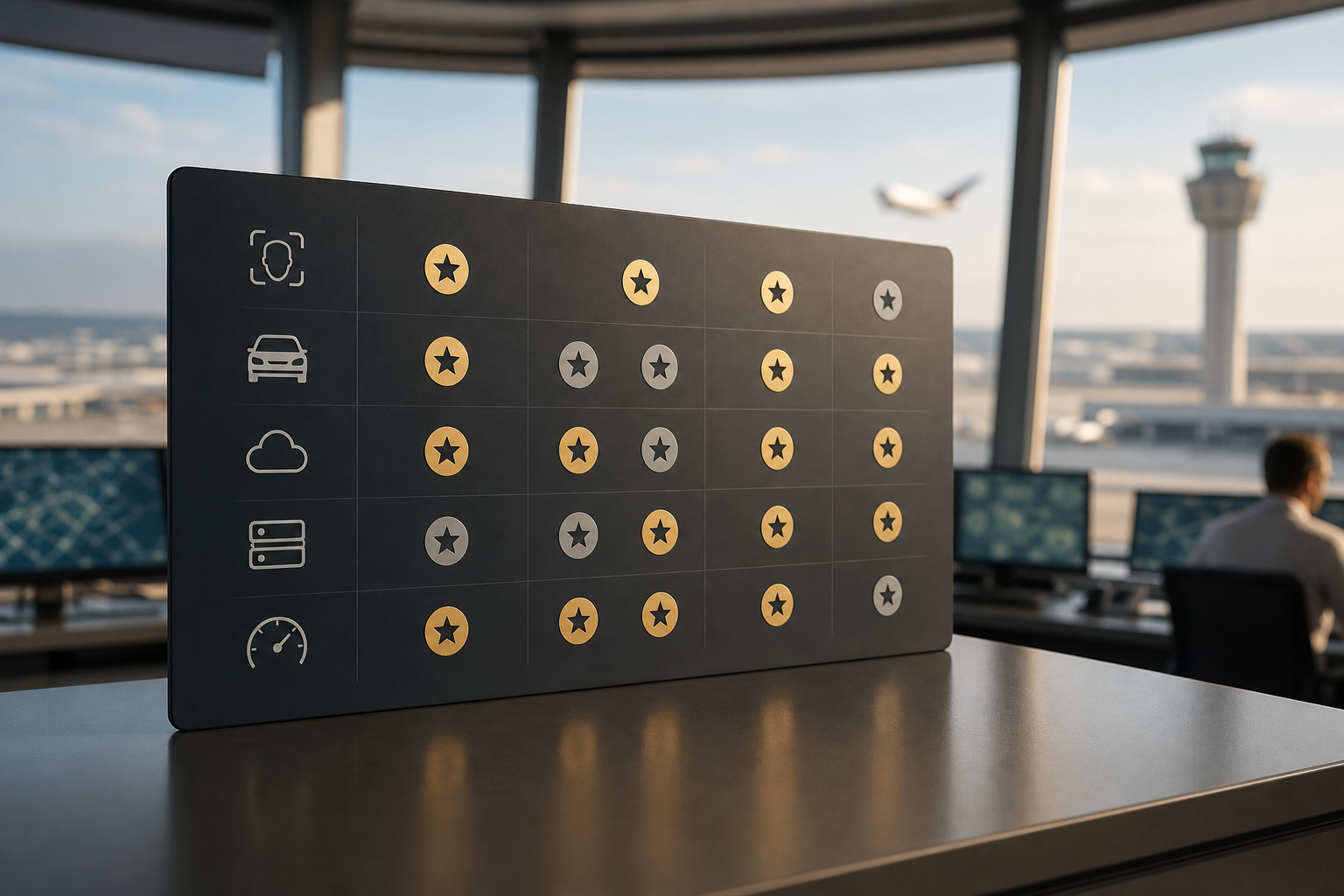
| Dimension | VideoraIQ | Briefcam | Verdict |
|---|---|---|---|
| Face recognition accuracy & gallery depth | 99.4% overall detection; less public gallery benchmarks | Deep gallery matching history | Briefcam |
| License plate / ANPR | Real-time ANPR engine | Integrated LPR search | Tie |
| Real-time alert latency | Sub‑3‑second alerts | Real-time exists; core DNA is forensic | VideoraIQ |
| Camera brand coverage | Works with 200+ brands | More selective | VideoraIQ |
| Deployment | Cloud-only; no servers | On-prem and hybrid | Briefcam |
| Multi-engine detections | 9 engines (face, ANPR, unattended baggage, fire/smoke, intrusion, etc.) | Focused analytics | VideoraIQ |
| Forensic tools | Solid search; broad alerts | VIDEO SYNOPSIS; rich filters | Briefcam |
| Compliance | GDPR + HIPAA | GDPR | Tie (VideoraIQ adds HIPAA) |
Pilot testing playbook for airports and transit in 2026
- Define operational hypotheses. Example: “Reduce average intercept time for watchlisted individuals by 40% within 60 days.” Another: “Achieve plate capture above 95% at night in Garage B.
- Build representative datasets. Include day and night, rain and fog, backlit queues, reflective surfaces, and fast approach angles. Stress-test plate capture and facial profiles in motion.
- Establish KPIs by scene type. Gates, sterile corridors, curbside, and multi-level parking each have distinct occlusion and lighting. Track precision and recall, false alarm rates per hour, and operator verification time by zone. Separate P95 from P99 to expose tail behavior.
- Measure end-to-end latency. Time the path from person or vehicle entering the FOV to a radio-ready alert in the hands of patrol. Record averages and P95 or P99 to expose tail latency during peak loads. Include mobile network hops if dispatch runs on LTE.
- Run dual validation. Pair vendor-reported metrics with independent sampling by your QA team to avoid optimistic bias. Reconcile gaps and document root causes with video examples.
- Verify maintainability. Assess how long it takes to create zones, update watchlists, rotate users, and export cases. Tools that save 30 seconds per action add up over thousands of events.
- Conduct red-team scenarios. Use role players, decoys, and masked test entries to see how systems behave under stress. Measure any operator hesitation or false-dismissal tendencies.
- Plan for week-two operations. Evaluate training time, shift handover quality, SOP clarity, and escalation paths after the vendor leaves the room. Sustainable gains require repeatable habits.
Security, privacy, and data governance checklist
A successful program for face recognition and license plate reading must start with a lawful basis and a completed DPIA. Do that work before any production traffic flows. Build strong role-based access controls that require dual approvals for adding or modifying biometric watchlists. Use auto-expiring entries for incident-only BOLOs so lists do not linger beyond their purpose.
Treat retention and data minimization as separate levers. Set distinct policies for raw video, extracted embeddings and metadata, and alert thumbnails. Avoid holding unnecessary PII longer than policy or regulation allows. Map each retention decision to a legal basis and a business need.
- Quick governance tasks to operationalize now:
- Refresh signage and public notices to match new processing purposes
- Implement monthly watchlist audits and auto-expiry defaults
- Maintain immutable activity logs tied to SSO identities
- Document model versions and confidence thresholds per zone
Transparency is not optional in regulated spaces. Update signage where required and maintain an up-to-date record of processing activities that spells out purposes, data classes, and retention windows. Round this out with vendor due diligence by asking for security whitepapers, SOC 2 or ISO 27001 status, and pen-test summaries. Seek details on training data provenance and bias mitigation approaches that reduce disparate performance across demographics.
When these controls are wired into daily operations, audits move from disruptive to routine. Investigators gain confidence that evidence is both admissible and defensible. Clear approval workflows and immutable logs also deter misuse by making every sensitive action attributable. That posture protects both passengers and staff.
The end state to aim for is a system where privacy protections and operational speed reinforce each other, rather than compete. The organization can act quickly while staying within the guardrails of policy and law. Periodic reviews with legal, security, and operations keep those guardrails fresh.
Cost and procurement notes for 2026 deployments
Look at total cost of ownership through a wide lens that includes subscription fees, hardware purchases, energy consumption, rack space, maintenance, and the sometimes-hidden cost of staff training. Cloud models reduce CapEx and let you scale face recognition and license plate reading analytics across terminals rapidly. They demand bandwidth planning and a predictable OpEx budget that finance can support quarter to quarter.
A phased rollout typically yields the best ROI. Start with sterile corridors, boarding gates, and parking egress lanes. Expand to concourses and service roads once workflows stabilize. Sequence work around construction schedules and airline peak seasons to minimize disruption.
Seek contracts that allow annual true-ups, elasticity in camera counts, and the ability to pause or reassign licenses during construction or seasonal route changes. That way, you only pay for what you actually use. Finally, lock in service levels that matter in the field, such as alert latency, uptime, and support response times. Put language in place around model updates and regression testing so your accuracy does not unexpectedly dip after a software push.
Budget time for change management. Training, SOP updates, and post-deployment tuning often drive the real return. Plan for refresh cycles and camera replacements over a multi-year window.
Get an instant real-time alert demo → if you need real-time multi-threat detection for intercepts and rich post-event investigation in the SOC.
**Schedule a no‑obligation pilot chat →
Frequently asked questions from airport and transit security teams
- How do these systems handle low-light and glare for plates? Look for adjustable shutter speeds, WDR, IR illumination compatibility, and per-camera tuning profiles. Test exit lanes at night where headlight bloom and motion blur are common.
- What about masks, hats, and occlusions on faces? Modern models use partial feature embeddings to maintain matchability under occlusion. Validate accuracy during winter months and in jet bridges where lighting is mixed.
- Can both platforms support multi-tenant operations? Airports with airline partners and retail concessions need partitioned access. Confirm tenant boundaries, namespace separation for watchlists, and cross-tenant reporting controls.
- Do we need special cameras? Not necessarily. Both platforms work with common IP cameras; however, consistent plate capture benefits from cameras with appropriate focal length, mounting angles, and frame rates tuned for vehicles.
- How are false positives managed in crowded scenes? Set per-zone thresholds, use dwell-time filters, and enable multi-signal confirmation. Operator review queues and quick-dismiss shortcuts help keep teams focused on true events.
- Can alerts integrate with radio and CAD systems? Yes, through webhooks, SMTP, SMS gateways, or vendor-specific connectors. Test payload formats and retry logic so alerts persist through spotty networks.
- What about data residency and sovereignty? Briefcam supports on-prem and hybrid deployments that keep data local. VideoraIQ is cloud-only, so ask about regional hosting, encryption, and contractual controls.
- How do we measure success beyond accuracy? Track intercept time, operator workload, training hours saved, and evidence cycle time. Add qualitative feedback from patrol and dispatch to capture usability gains.
- Will model updates affect our baselines? They can. Require release notes, rollback options, and a staging environment to validate changes. Run a small A/B trial before full rollout.
- How do we handle watchlist governance? Use dual-approval workflows, expiry dates, and justification fields for each entry. Audit enrollments monthly and remove stale entries on schedule.
Final note: Regulations and features change. Confirm GDPR alignment, storage periods, and biometric workflows with your legal team and each vendor before you deploy.