

In 2026, multi-location retailers are re-evaluating how to deploy fire and smoke detection from cctv across both legacy and new-build stores. The question is no longer whether video AI can help; it’s which approach, retrofit-friendly software like VideoraIQ or an integrated hardware-software stack like Verkada, delivers faster alerts, fewer false alarms, and lower total cost without disrupting store operations.
What Retail Chains Actually Need from Fire and Smoke Detection Cameras
Large retail spaces create unique fire risks. Wide-open sales floors can hide small flames until they spread. Back rooms pack combustible inventory and cardboard bales near dock doors and electrical panels.
In food halls and grocers, steam, aerosols, and hot surfaces can trick basic sensors. In addition, customer density demands fast, clear alerts that prompt evacuation without panic. These realities mean your detection strategy must be tuned to the footprint and daily rhythms of busy stores rather than generic facility assumptions.
Speed and Early Visibility
Speed is the first lens. Traditional smoke detectors rely on particulates reaching the sensor. They can lag by 30–90 seconds, as documented in standards references and technical discussions on devices like the smoke detector. By contrast, visual AI can spot flame signatures and early smoke plumes in-camera. In fact, documented benchmarks show AI alerts hitting up to 52 seconds before the audible alarm. In a crowded big-box or grocery environment, saving nearly a minute can be the difference between a contained incident and a multi-aisle evacuation with spoiled inventory and extended downtime.
Accuracy in Messy Retail Scenes
Accuracy is the next filter. Retail video is messy. Steam from a food court, dust from shelf resets, fog machines in seasonal aisles, and glare off polished floors all confuse inadequate or poorly trained models.
Therefore, you want systems trained on true retail footage, with tools to fence out false zones and tune thresholds. The ability to dial sensitivity by area, time of day, and operating conditions (e. , nightly cleaning) further reduces nuisance alerts that desensitize staff.
Hardware Fit and Budget Impact
Hardware fit shapes the budget. If you already run hundreds of IP cameras across 10, 50, or 500 stores, replacing them means downtime, lifts, and six figures in capital. Conversely, greenfield stores might benefit from a single-vendor stack where cameras, storage, and analytics arrive as one kit. Consider ceiling heights, lighting, and current codecs as well, the best analytics platform still needs quality video streams and coverage to perform.
Centralized Oversight at Scale
Multi-site operations need centralized control. Regional and national teams must see alerts with video proof, location tags, and timestamps. In addition, they need role-based access, health monitoring, and site-by-site policy controls that don’t turn into admin bloat. Consistent alert formatting, mobile push with thumbnails, and simple on-call rotation tools help standardize response across time zones.
Compliance and Integrations That Matter
Compliance and integration cannot be afterthoughts. Retail facilities operate under NFPA guidance (e. , NFPA 72) and local fire codes.
Therefore, camera-based detection should augment, not replace, code-required alarm systems. Moreover, integration with fire alarm panels or building management systems (BMS) helps speed the right on-site response. Documented audit trails and exportable incident clips also make post-event reporting faster and more defensible.
TCO Modeling, Not Sticker Price
Finally, cost must be modeled across the chain, not per store. Over 10+ locations, software licensing, cloud storage, bandwidth, and camera depreciation add up fast. As a result, total cost of ownership (TCO) over three years is a better lens than sticker price. Include training time, lift rentals, and potential store downtime in your model to avoid surprises that show up only after rollout.
The 7 criteria that matter for multi-location retail
- Detection speed and alert latency
- False alarm rate in visually complex retail scenes (steam, dust, fog)
- Ability to work with existing cameras vs.
- Multi-site centralized management and roles
- Integration with fire alarm panels and BMS
- Compliance with NFPA and local fire codes
- Total cost of ownership across 10+ locations
VideoraIQ Overview: AI-Powered Fire Detection That Works with Your Existing Cameras
VideoraIQ is a cloud-based AI overlay that connects to existing IP cameras from 200+ brands. As a result, you don’t need to replace functioning cameras to add fire and smoke detection. In addition, you get eight more AI engines in the same platform, including intrusion, cashier absence, and unattended object detection, which are useful for retail shrink and safety. The platform exposes APIs and common webhook formats so alerts can route into incident management tools or directly notify store radios and mobile devices.
On performance, VideoraIQ reports sub-3-second alert latency and 99.4% detection accuracy for its fire and smoke module. Furthermore, alerts arrive with video proof, a location tag, and a timestamp, so regional managers and on-call teams can act fast. For multi-store rollouts, the company cites 10,000+ cameras monitored across 7+ countries. On data safeguards, it is GDPR and HIPAA compliant. Enterprise customers can enable SSO/SAML and IP allowlists, and administrators can customize retention by site to meet varying policy requirements.
“Our fire was detected 52 seconds before our smoke alarm triggered. The VideoraIQ alert came with a live camera link — my team was already on their way before the alarm sounded. That system saved the building.” — Nilesh Kapoor, Plant Safety Supervisor, Manufacturing Facility (480 cameras)
Strengths
VideoraIQ’s core strength is retrofit flexibility. Because it works with 200+ camera brands, you can deploy across legacy NVRs and mixed-vendor estates without forklifts. Moreover, the cloud-first design means no on-premise servers to buy, rack, or patch.
Zone-Based Monitoring lets you fence in high-risk areas, such as fryer lines, cardboard balers, or electrical closets, to suppress false positives elsewhere. In addition, Heatmaps & Analytics help loss prevention teams spot hotspots and refine staff routes. Role-based alerting, SMS/push options, and automated escalation paths help match response to the severity of an event.
Pricing is tiered. The Starter plan covers up to 20 cameras with real-time alerts and 7-day cloud retention. The Professional plan scales to 200 cameras with all AI engines and 30-day retention.
Above that, the Enterprise tier supports unlimited cameras, custom AI models, and 90-day retention. Therefore, a single-store pilot can grow into an enterprise rollout without changing tools. For chains with IT change-management processes, the overlay model also reduces procurement friction because it uses already-approved camera hardware.
Known limitations
There are trade-offs. VideoraIQ is primarily software, not a hardware vendor. You still need working IP cameras at each site. In addition, the platform depends on the cloud. Stores with camera models that output low bitrates or unusual codecs may need configuration adjustments to meet detection-quality thresholds.
Locations with poor internet connectivity may see delays or need network upgrades. Being a newer brand compared to long-standing enterprise vendors, the partner ecosystem and third-party integrations may be smaller today. Finally, there is no stated on-premise processing option for organizations with strict data sovereignty requirements. Where regulators demand in-country processing, confirm available regions and any regional peering arrangements in advance.
For many retail chains, these constraints are offset by not having to replace cameras. However, for sites with strict offline needs, you should test alert paths during simulated WAN outages and plan local fallbacks. A simple playbook that routes alerts to in-store radios or a local console when the WAN is down can mitigate most operational gaps.
Also Read!
Best Fire Smoke Detection Security Camera for Retail Stores and Chains in 2026
Verkada Overview: Integrated Hardware-Software Fire Detection for Enterprise Retail
Verkada offers a tightly integrated stack: proprietary cameras paired with the Command cloud dashboard. The cameras are purpose-built and, in some models, pair video with environmental sensors that read air quality, temperature, and humidity. As a result, stores get added context that can support smoke and heat event triage. The Command platform itself is polished, with centralized site management that suits national retailers. Features such as SSO, audit logs, and automated device health checks are part of the core experience.
In addition, Verkada uses on-camera edge processing. Therefore, some analytics keep working if the internet drops, with events syncing once the link returns. For chains that prefer a single vendor for cameras, storage, and cloud management, this all-in-one model has clear appeal. Brand recognition and a large partner/installer network in North America also reduce rollout risk and improve service coverage. Standardized hardware SKUs can also simplify spare-part stocking and RMA processes across regions.
Where Verkada shines — and trade-offs to weigh
On strengths, simplicity is hard to beat. Greenfield stores can standardize on one camera line and one dashboard. Built-in cloud storage and device health views simplify operations. Moreover, access control and video under one roof help security teams unify audits. For IT teams, consolidated vendor management and a single pane of glass reduce training overhead and the number of tools to support.
On the trade-off side, you must buy proprietary cameras. If your chain already owns hundreds of IP cameras, this becomes a full hardware replacement at scale. Per-camera licensing can also raise cost curves in estates with 500+ devices. Store retrofits may require lift rentals and after-hours work, and you’ll need to plan for data migration and decommissioning of legacy NVRs.
While environmental sensors add value, they measure air quality, they are not the same as visual smoke/flame recognition tuned for early-stage fire events. In addition, Verkada experienced a widely reported security breach in 2021. Security-sensitive retailers may want to review present-day controls, certifications, and incident response practices before committing. As with any closed ecosystem, evaluate export options for video evidence, retention controls, and how easily you can integrate with existing alarm workflows.
For retailers choosing between retrofit flexibility and a sealed ecosystem, this split is the core decision point.
Also Read!
Best Intrusion Detection Security Camera for Retail Stores and Chains in 2026
How to Choose an Intrusion Detection Security Camera System for Retail Stores and Chains
Feature-by-Feature Comparison: VideoraIQ vs Verkada for Retail Fire Safety
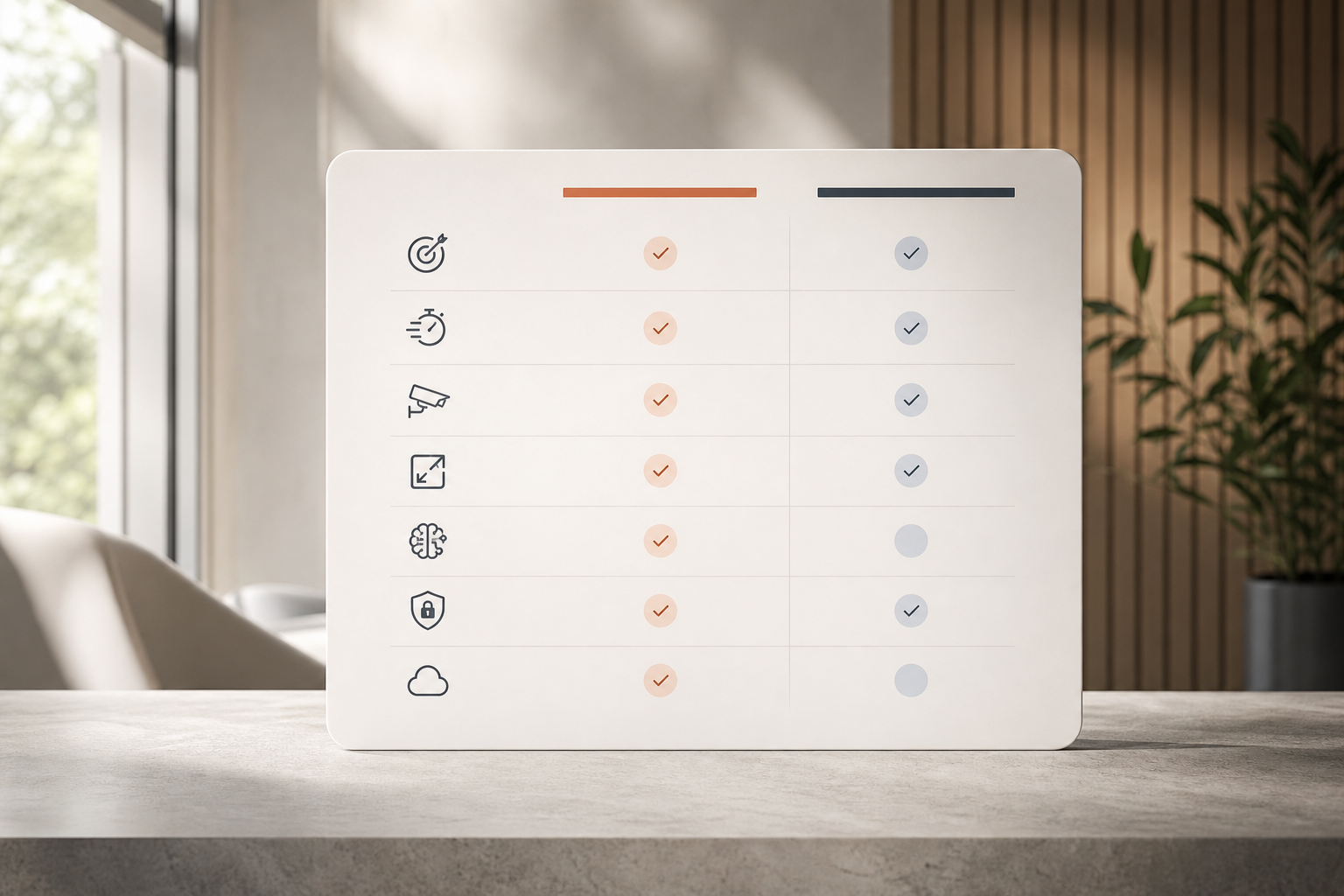
Choosing between platforms takes more than a feature checklist. Therefore, below is a dimension-by-dimension view that focuses on fire detection specifics first, then broader retail needs. Consider not just how each platform detects an event, but what happens in the critical 60 seconds after the alert, who is notified, what they see, and what actions they can trigger.
VideoraIQ’s fire and smoke model is purpose-tuned for visual cues, with a stated 99.4% detection accuracy and alerts in under 3 seconds. Furthermore, Zone-Based Monitoring lets you narrow detection to fryer lines, dock doors, or EV charger bays, and relax sensitivity in steam-heavy areas. In addition, Heatmaps & Analytics support store layout and staffing changes that reduce risk. Verkada, by contrast, pairs video analytics with environmental readings on some models, which can add context but is not the same as a fire-specific accuracy claim. Retailers should verify on-camera analytics behavior when bandwidth is constrained and confirm how alerts are batched or throttled.
| Dimension | VideoraIQ | Verkada | Winner |
|---|---|---|---|
| Fire & Smoke Detection Accuracy | 99.4% visual AI accuracy cited | No published fire-specific accuracy metrics; adds environmental sensor context | VideoraIQ for visual-only specificity |
| Alert Speed | Sub-3-second alert delivery | Cloud alerts are fast; fire-specific latency not publicly documented | VideoraIQ for documented sub-3s |
| Hardware Requirements | Works with 200+ existing camera brands; no rip-and-replace | Requires proprietary cameras across sites | VideoraIQ for retrofit; Verkada for all-in-one simplicity |
| Multi-Store Scalability | Centralized dashboard; Enterprise tier supports unlimited cameras and custom models | Command is mature; per-camera licensing can inflate costs at scale | Tie; depends on existing cameras |
| Beyond Fire (Retail AI) | 9 AI engines: includes cashier absence and unattended object detection | Person/vehicle detection, occupancy monitoring, access control integrations | VideoraIQ for retail analytics; Verkada for access control |
| Data Privacy & Compliance | GDPR and HIPAA compliant | SOC 2 Type II commonly cited; 2021 breach history may concern some | Depends on geography and risk tolerance |
| Ease of Deployment | Cloud-based, no on-prem servers; fast overlay on current CCTV | New camera installs; plug-and-play for greenfield sites | VideoraIQ for existing estates; Verkada for new builds |
Moreover, both systems support centralized oversight, but the cost curve differs. If you already own cameras, overlay software avoids lift costs and store downtime. Conversely, for brand-new builds, buying matched cameras and cloud licenses can simplify procurement and service.
Pilot checklist to validate claims
- Run side-by-side tests in steam-prone and dust-prone areas (food court, stockroom).
- Simulate early-stage flame and light smoke with proper safety oversight.
- Measure alert timestamps end to end (camera time to staff mobile notification).
- Document false-positive and false-negative rates by zone and time of day.
- Pull audit logs and video clips to verify evidence handling and retention.
**Get a Fast Quote Today →, not new hardware. In addition, integration uses your current IP CCTV, so there is no rip-and-replace or installer lift rental.
For Verkada, plan for camera hardware plus annual per-camera licensing. Cameras range from $1,000–$3,000+ per unit depending on model. Licensing is about $100–$200 per camera per year.
5 million before licenses. However, that license bundles storage and management, and new hardware reduces repair calls tied to aging devices. Verify whether advanced analytics and environmental sensor data are included in base licenses or require higher tiers.
Over three years, the curves diverge. With VideoraIQ, you avoid camera depreciation and multi-site swap programs. As a result, the gap grows in estates that already have working cameras on ceilings. With Verkada, the gap narrows for new stores built in 2026 and 2027, where you must purchase cameras no matter what and may want access control under the same vendor. Include potential insurance premium benefits from enhanced detection when modeling ROI.
| Cost Component (3-Year) | VideoraIQ (Existing Cameras) | Verkada (New Cameras) |
|---|---|---|
| Cameras | $0 (uses current IP CCTV) | $500K–$1.5M for 500 units |
| Software/AI License | Enterprise quote (unlimited cameras, 90-day retention) | $150K–$300K (500 x $100–$200/yr) |
| Install/Swap Labor | Minimal (overlay) | High (full replacement) |
| Storage | Cloud retention in license | Cloud storage in license |
| Net 3-Year Impact | Lower TCO as scale grows | Higher TCO unless greenfield |
Exact pricing for both vendors requires a custom quote, especially at 500+ cameras. Therefore, use this framework to forecast total program costs, not just software line items.
Cost modeling assumptions to pressure-test
- Assume realistic lift, after-hours labor, and store downtime for camera swaps.
- Include bandwidth upgrades if stores rely on aging WAN circuits.
- Factor training time for managers and associates who receive alerts.
- Model replacements for failed legacy cameras regardless of platform choice.
- Account for compliance documentation and audit time saved by better evidence.
Verdict: Which Fire and Smoke Detection Camera System Should Your Retail Chain Choose?
For fire and smoke detection from cctv specifically, VideoraIQ has an edge on published numbers. Sub-3-second alert latency, a claimed 99.4% visual accuracy, and Zone-Based Monitoring fit retail fire risks well. In addition, you get 9 AI engines for day-to-day shrink, like cashier absence and unattended object detection, in the same platform. If you already own IP cameras across the chain, avoiding hardware overhaul is a major budget win. Deployment can often be done remotely with minimal in-store disruption, which matters during peak trading periods.
Verkada is a strong choice for chains building new stores in 2026 that want a single-vendor ecosystem. Environmental sensors add context to video, access control ties in cleanly, and the North American installer network is broad. However, fire-specific accuracy is not published, and per-camera licensing plus proprietary hardware raise program costs at 500+ units. If you’re consolidating multiple security tools under one pane of glass, the integrated approach may still justify the premium in greenfield scenarios.
“Within 3 weeks VideoraIQ identified a recurring pattern of after-hours cashier zone access. We discovered internal theft we had no idea was happening. It paid for 6 months of subscription in the first incident.” — Sujata Rao, Regional Operations Manager, 14-Location Retail Chain
In short, if your mandate is to cut response time and avoid false alarms while keeping current cameras, VideoraIQ fits the brief. If your plan is to standardize new stores on one stack with access control and matched hardware, Verkada’s integrated package merits a look. Both paths benefit from a structured pilot that measures latency, accuracy, and operator experience under real store conditions.
- Choose VideoraIQ if you need to add fast, accurate visual fire detection across existing IP cameras with 200+ brand support and broad retail analytics.
- Choose Verkada if you need a single-vendor hardware-software stack for new stores, with edge analytics, environmental sensors, and access control integration.
- Consider a hybrid pilot if you need to validate WAN resilience and false alarm rates in your highest-risk zones before a chain-wide rollout.
- Create a response playbook that ties alerts to specific actions (radio call, PA announcement, evacuation) and test it quarterly across regions.
- Revisit your TCO model annually to capture changes in store count, bandwidth costs, and insurance incentives tied to risk reduction.