

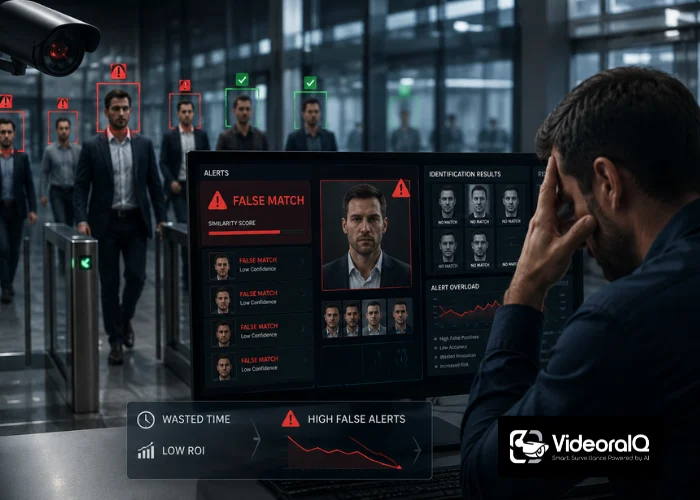
I’ve watched this play out across security procurement conversations for years. The buyer asks about integrations, about camera compatibility, and occasionally about price. Almost nobody asks the one question that will define whether their platform actually works in practice: what does your accuracy rate mean at my alert volume? That omission is expensive.
Listen to the podcast!
The Math That Vendors Don’t Show You
VideoraIQ publishes a figure that most competitors bury: 99.4% detection accuracy. That number only becomes meaningful when you model it against real-world event throughput.
Consider a corporate campus with 200 cameras generating thousands of recognition events across a day. At 95–97% accuracy, the false alert volume can reach hundreds of events per day. Hundreds. On a single estate. That’s not a minor inconvenience; it’s a structural failure. Guards stop trusting the system. Real events get buried in noise. The watchlist becomes wallpaper.
The security industry has a term for this: alert fatigue. It’s the same phenomenon that breaks down clinical alarm systems in hospitals, and it’s just as dangerous here. Research into live facial recognition deployments has shown that the human operator layer the person who acts on a match is where many system failures actually occur. A fatigued operator working through a queue of hundreds of alerts isn’t reviewing anything with real attention. At that point, the platform is running, but your security isn’t.
The fix isn’t to add more guards. It’s to demand accuracy figures that hold at scale, and to understand what those figures translate to at your specific event volume before you sign a contract.
The Latency Problem Is Just as Underappreciated
Accuracy gets at least some attention in vendor briefings. Alert latency barely registers, and it should.
Sub-3-second alert delivery is the gold standard for live response; sub-5-second is the minimum acceptable threshold. Those aren’t arbitrary benchmarks. Think about what happens at a vehicle gate when a blacklisted plate is detected. A 15-second alert delay means the vehicle is already inside the perimeter before any operator can act. The detection happened. The alert was generated. And it arrived too late to matter.
VideoraIQ’s sub-3-second benchmark runs from entry to dispatch-ready payload meaning the alert that reaches the security team already carries the video clip, the location tag, and the timestamp needed to act. That’s not a raw ping. It’s an actionable package. The difference between those two things is the difference between a system that enables interception and one that generates paperwork after the fact.
The 85% Dark Data Problem Underneath Everything
Here’s the context that makes all of this worse: 85% of CCTV footage is never reviewed. The cameras are running. The storage is filling up. And the footage sits unwatched because no human team can cover that volume manually.
This is what AI video analytics is actually solving not replacing a guard’s eyes on a single monitor, but processing feeds at a scale no human operation can match. The AI video analytics market is expanding precisely because the gap between footage generated and footage actually acted on has become untenable for large estates. The value of a platform like VideoraIQ, which monitors 10,000+ cameras across deployments in 7+ countries, comes from closing that gap turning dark footage into live intelligence.
But closing that gap with a low-accuracy system just moves the problem. You’ve replaced unreviewed footage with an unmanageable alert queue. The footage is now “reviewed” in a technical sense, and operationally useless in a practical one.
What to Actually Evaluate Before You Buy
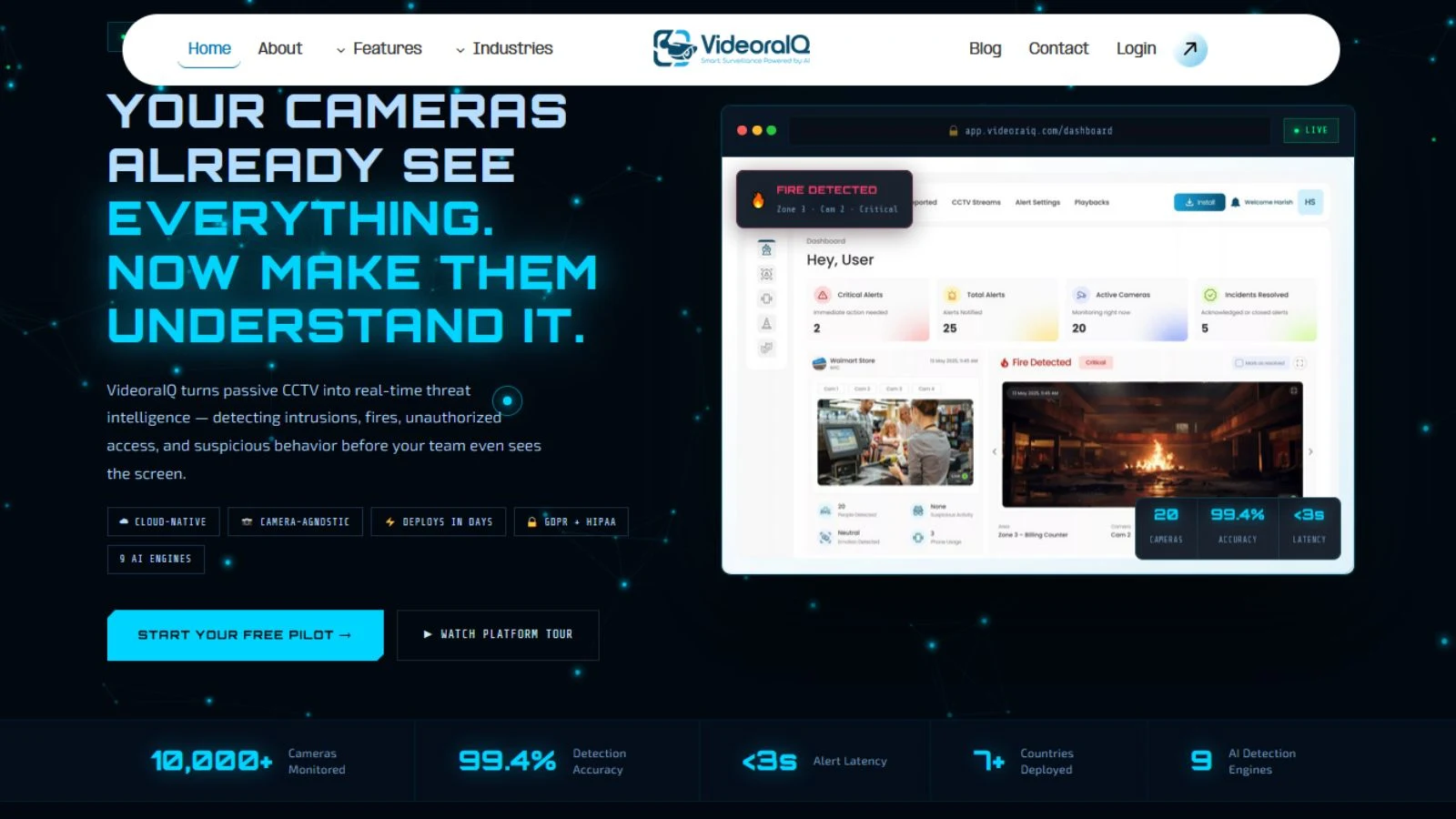
Most procurement checklists focus on the wrong layer. Here’s a framework that targets the failure modes described above.
1. Model Your False Alert Volume, Not Just the Accuracy Percentage
Ask the vendor for their accuracy figure. Then estimate your daily recognition event volume number of cameras multiplied by average throughput per feed. Apply the error rate. The arithmetic is unforgiving: every percentage point of inaccuracy multiplies across thousands of daily events, and even a 200-camera estate running at sub-99% accuracy can generate hundreds of false pings daily figure this out before deployment, not after.
2. Test Latency Under Load, Not in a Demo Environment
Vendor demos run clean feeds on uncongested networks. Request latency benchmarks under realistic concurrent load multiple simultaneous detections across feeds. The sub-3-second standard should hold when three cameras flag events in the same second, not just when one does.
3. Verify the Alert Payload, Not Just the Alert
A bare notification that “something happened” is not an actionable alert. The payload arriving at your security team should include an attached video clip, a location tag, and a timestamp everything needed to decide and act without a follow-up lookup. This is what VideoraIQ’s workflow actually delivers: the moment Intrusion Detection or Face Recognition fires, the operator receives the full context package, not a pointer to go find it.
4. Check Compliance Scope Before Biometric Data Touches Your Network
Face recognition generates biometric data. Vehicle plate recognition generates movement history. Both carry regulatory exposure depending on your jurisdiction. The relevant frameworks span GDPR, HIPAA, CCPA, and BIPA and they govern not just storage but capture and processing. VideoraIQ operates as a GDPR and HIPAA compliant platform, but you still need to map your specific data flows against the regulations active in each deployment country. This is not a step to delegate to the vendor entirely.
5. Confirm Multi-Engine Coverage on Existing Infrastructure
Ripping out existing cameras to deploy a new analytics layer is a cost most operations can’t absorb. VideoraIQ is compatible with 200+ brands of existing IP cameras, meaning the analytics layer drops onto current infrastructure rather than requiring hardware replacement. It also runs nine AI detection engines face recognition, ANPR, fire and smoke detection, line-cross, intrusion, and others across the same feeds simultaneously. That matters for operational density: one camera covering a restricted vehicle entry can log plates, flag restricted-zone breaches, and screen faces against a watchlist without separate hardware or separate alert queues.
The Bias Question Buyers Routinely Skip
One more thing that belongs in any serious evaluation: demographic performance variance. Research on face recognition systems consistently shows higher error rates on Black individuals, women, East Asians, and older people. A headline accuracy figure of 99.4% is meaningful but ask whether that figure holds uniformly across demographic groups represented in your actual monitored population. A system that performs at headline accuracy on one demographic and significantly worse on another creates both operational failures and serious legal exposure. This question isn’t adversarial; it’s due diligence.
Read More!
Face Recognition and License Plate Reading — 2026
Face Recognition and License Plate Reading — 2026 Guide
Operational Reality, Not the Demo
The platforms that fail in production almost never fail because of missing features. They fail because the accuracy rate generates an unworkable alert volume, or because latency turns live detection into post-incident reporting, or because nobody modeled what the numbers actually meant at scale before go-live.
Buy for operational reality, not for the demo. That means accuracy figures modeled against your event volume, latency benchmarks under load, and alert payloads that give your team everything needed to act not just a notification that something happened somewhere.
If you want to see how these benchmarks hold across a real deployment, start your free VideoraIQ trial and run it against your own infrastructure before you commit.