

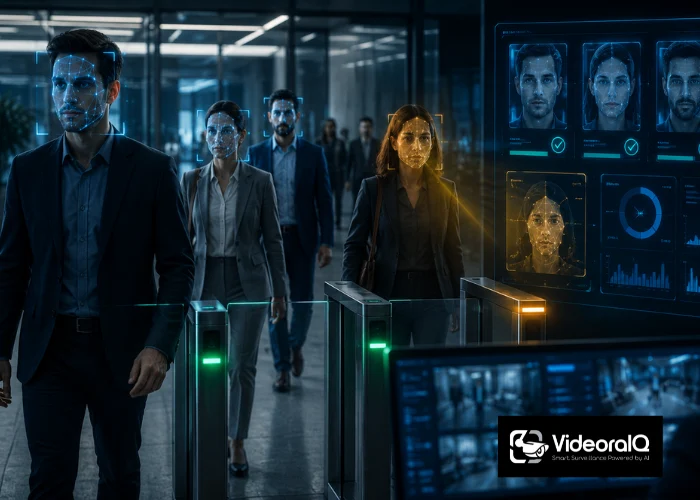
Ninety-seven percent accuracy sounds like a pass. In face recognition for physical security, it is a quiet operational disaster.
I have watched procurement teams sign off on AI video analytics platforms based on headline accuracy numbers that, when you run the actual arithmetic, translate into hundreds of nuisance alerts every single shift. Guards stop responding. Watchlists get ignored. And the threat the system was bought to catch walks straight through it.
This is the number that matters, and almost nobody quotes it during a sales demo.
Listen to the Podcast!
The Math Nobody Shows You in the Demo
Take a 200-camera corporate campus. At peak hours those cameras are collectively processing thousands of face-detection events per day. At 95–97% accuracy, that deployment can generate hundreds of false-positive alerts daily — real human faces flagged as watchlist matches when they are not. That is not a hypothetical. That is what happens on real estates with real camera counts.
Independent research into large-scale biometric deployments confirms the pattern: even well-regarded commercial face recognition engines produce some rate of incorrect matches, and the cumulative false-match count across thousands of daily scan events is a documented noise problem for live operators. The numbers look small in percentage terms. They do not look small when an operator is triaging a queue of alerts mid-shift.
The recommended detection accuracy threshold for 24/7 SOC teams is ≥99%; anything below swamps the team with false pings — and a team buried in false pings is, effectively, a team that has stopped monitoring.
Alert Speed Is the Other Half of the Equation
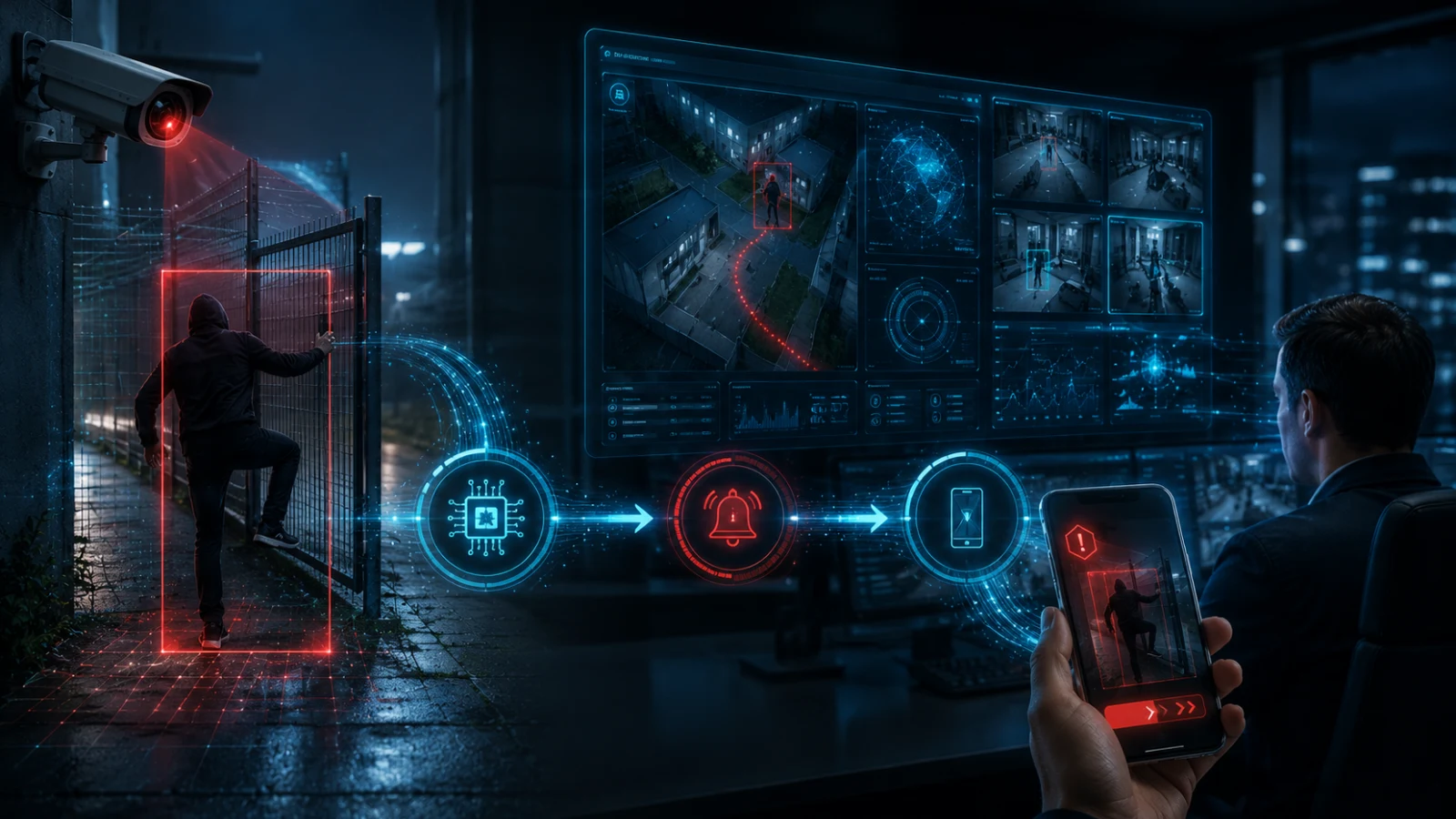
Accuracy and latency are not separate concerns. They are the same concern.
A system that delivers a correct match 12 seconds after the event has already failed in most physical security scenarios. Sub-3-second alert delivery is the gold standard for live response — the benchmark cited for environments like airports and transit stations where interception depends on getting the right information to the right person before a subject moves on. The same logic applies to vehicle access: a 15-second delay at a vehicle gate means a suspect vehicle is already inside the perimeter before the alert is acted on. The identification was accurate; the response was still too late.
These two variables, accuracy rate and alert latency, are what buyers should be stress-testing in a proof of concept, not the feature list on a slide deck.
What a Fragmented Stack Does to Both Numbers
Many sites compound the problem before the AI even enters the picture. They run separate systems for face recognition and number plate recognition. Two platforms, two alert streams, two timelines that do not talk to each other.
The failure mode is predictable: duplicate alerts and mismatched event timelines force guards to manually correlate what the AI flagged while the vehicle clears the barrier. The human is doing the work the system was supposed to do, under time pressure, with imperfect information. Accuracy figures for each individual engine are irrelevant at that point.
A unified platform — where nine distinct AI detection engines, including face recognition and ANPR, share a single alert timeline with attached video clips, location tags, and timestamps — removes that manual correlation step entirely. The security team receives one alert with the full context already assembled. For a detailed look at how unified stacks compare against split deployments in practice, the 2026 face recognition and licence plate reading comparison covers the trade-offs in detail.
The Accuracy Bar: VideoraIQ Sets

VideoraIQ an AI video-intelligence platform covering video analytics, live streaming, and face authentication for security and surveillance — operates at 99.4% detection accuracy across deployments spanning 10,000+ cameras in live environments across 7 or more countries. Alert delivery runs in under 3 seconds. Those two numbers together are what make a live-response workflow actually viable.
The face recognition engine matches in real time against watchlists and generates automatic access logs – no manual entry, no paper list of former contractors whose credentials nobody revoked. The ANPR function logs every vehicle entry and exit and runs blacklist matching across all sites simultaneously.
What keeps that accuracy figure above 99% matters as much as the figure itself. VideoraIQ works with cameras from 200+ brands, meaning it is tested and refined against the full range of hardware conditions operators actually run — not a curated lab set. An engine validated only in controlled demo conditions behaves differently at a busy vehicle gate in variable lighting at 2 AM.
That real-world exposure matters. Ananya Mehta, Head of Facilities at a 200-camera corporate campus, said a single 2 AM intruder event caught by VideoraIQ “justified the entire platform cost”. Edge conditions are where platforms earn their accuracy claims — or quietly abandon them.
How to Run a Pilot That Actually Tests This
The right pilot is not a full-estate rollout. Start with roughly 20 cameras before scaling to a multi-hundred camera deployment. The goal of that initial phase is not to prove the system works in ideal conditions — it is to find where it breaks.
Run the pilot across three conditions that surface accuracy and latency problems:
- High-traffic entry points during peak hours. Volume stress-tests both the matching engine and the alert pipeline. If latency creeps above 3 seconds at peak load, that is your answer before you have signed a multi-site contract.
- Low-light and adverse weather. Outdoor cameras at perimeter lines are where visual AI earns its keep or exposes its limits. Face recognition and ANPR both degrade faster than vendors admit in controlled demo environments.
- Watchlist update speed under operational conditions. Add a new entry mid-shift and measure how long before the live cameras are matching against it. A stale watchlist is as dangerous as a missed match.
Track two numbers for the duration: false positive rate (how many alerts required no action) and mean time from event to operator receipt. If false positives are running above a handful per shift on 20 cameras, the extrapolated noise on 200 cameras will be unworkable. Address it at the pilot stage or do not scale.
The Compliance Dimension Buyers Underestimate
Face recognition data carries regulatory weight that number plate data does not. Biometric identifiers sit inside the scope of GDPR, CCPA, BIPA, and HIPAA depending on jurisdiction and sector, and a platform that cannot demonstrate alignment with them is a procurement risk regardless of its accuracy score.
This is not a box-ticking exercise. Compliance frameworks constrain how long biometric data can be retained, who can access it, and under what conditions it can be shared. A security team that has not mapped those constraints before deploying face recognition is building operational exposure into the system from day one.
VideoraIQ is GDPR and HIPAA compliant. That is a starting point, not a complete legal assessment — operators still need to verify their own jurisdictional obligations — but it removes a significant baseline risk from the procurement conversation.
Read More!
How Does Video Analytics and Facial Recognition Work?
Face Recognition False Alerts Are Killing Your Security ROI
The 85% Problem Underneath All of This
There is a statistic that reframes the entire accuracy debate. 85% of CCTV footage is never reviewed. Most camera estates are recording continuously and producing nothing actionable — footage sits on a drive until a post-incident review requires someone to scrub through hours of video, looking for a specific moment.
AI detection changes that ratio. But it only does so if accuracy is high enough that operators trust the alerts, and latency is low enough that the alerts arrive while a response is still possible. A system running at 95% accuracy with a 12-second lag does not solve the 85% problem — it adds a new layer of noise on top of it.
The question to ask any vendor is not “What is your accuracy rate?” It is: “At what camera count does your accuracy hold, and what is your 99th-percentile alert latency under peak load?” Those two questions separate platforms built for demo conditions from platforms built for operational ones. For a broader framework on evaluating these criteria, the guide to how AI face recognition helps organisations at scale is worth reading before any vendor shortlist conversation.
The 97% figure will keep appearing in vendor decks. Now you know what to do with it.