

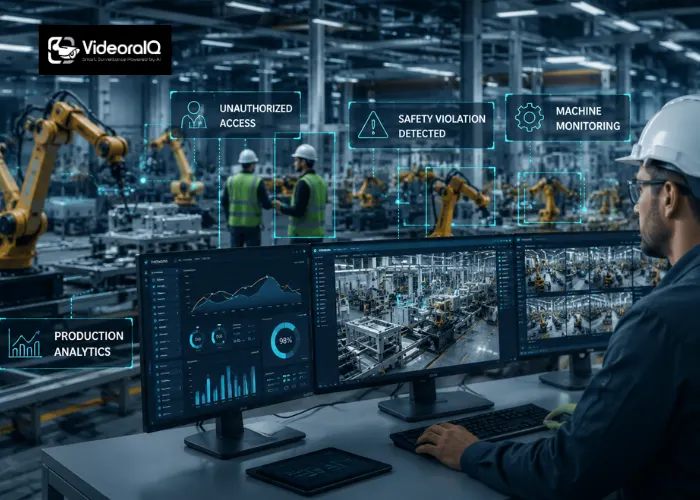
Most manufacturing security managers I’ve spoken with spend their budget on cameras and almost nothing on what happens after the footage is recorded. That’s the mistake. A single operator monitoring live feeds may watch 20–60 simultaneous streams, and 85% of CCTV footage is never reviewed at all. On a plant floor where a forklift corridor breach or an early-stage fire can kill someone, that gap isn’t acceptable.
AI video analytics closes it. But only if you deploy it against the right threat vectors, in the right sequence. What follows is the framework I’d hand a plant security lead on day one.
Listen to the podcast!
Why Manufacturing Is a Different Problem
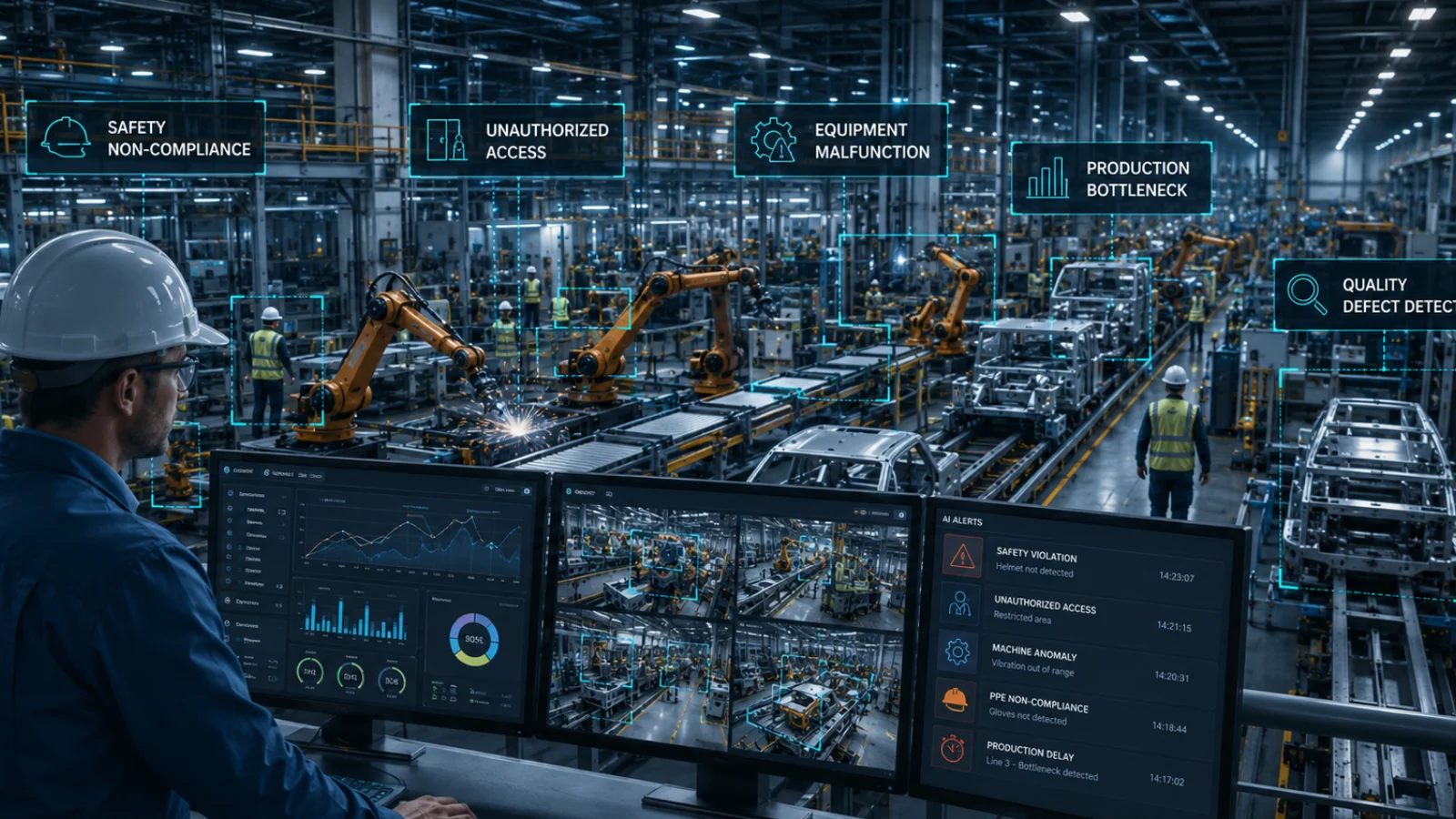
Office buildings and retail sites have relatively stable threat profiles: unauthorized entry, shoplifting, and package theft. Manufacturing plants are different. You have rotating shift workers, heavy machinery operating on fixed corridors, hazardous materials in restricted bays, and delivery vehicles moving through the same gates as pedestrians. The threat isn’t one bad actor; it’s the constant interaction between humans and equipment across a site that may already run 50 to 500+ cameras.
Traditional DVR and NVR stacks weren’t designed for this. They can bookmark motion events. They cannot classify a forklift crossing a pedestrian safety line, a person entering a no-go zone, or smoke rising near a pallet stack. Bundled VMS analytics modules often fare no better; they’re afterthoughts bolted onto recording software, not purpose-built detection engines.
The global AI-powered video analytics market was valued at $5.63 billion in 2025 and is projected to reach $23.03 billion by 2034, driven precisely because operators in high-risk environments discovered this gap the hard way.
The Four Threat Vectors That Matter on a Plant Floor
1. Restricted Zone Intrusion
Every plant has areas that should be off-limits during operational hours: transformer rooms, chemical storage, server infrastructure. The problem is that perimeter signage doesn’t stop an unfamiliar contractor or a distracted worker. VideoraIQ‘s Intrusion Detection The engine watches configured restricted zones continuously and triggers an alert the moment a breach occurs, attaching a video clip, a location tag, and a timestamp. The security team doesn’t need to be watching that feed. The system is.
What this means operationally: alerts are actionable from the first second. Your team receives the clip and location, not a notification that “motion was detected in zone 4.”There is a meaningful difference.
2. Safety Line Violations on Machinery Corridors
OSHA’s powered industrial truck guidance exists because forklifts and pedestrians sharing space kill people. The mechanism for enforcing separation on camera, historically, was a human operator watching a feed and hoping to catch the moment of crossing. That doesn’t scale.
Line-cross detection changes the enforcement model. An operator draws virtual tripwires on any camera feed of the pedestrian boundary alongside a forklift aisle and the edge of a loading dock, and the system alerts in real time whenever that line is crossed. Sub-5 seconds is the floor for industrial alert latency; under 3 seconds is ideal. VideoraIQ targets under 3 seconds from event to notification. At 3 seconds, a supervisor can intervene before a situation becomes an incident.
3. Fire and Smoke in High-Bay Environments
High-bay warehouses are the scenario where traditional detection systems fail most visibly. Flames can grow significantly before smoke travels the height needed to trigger ceiling-mounted heat sensors. By the time the alarm sounds, containment is already harder.
Visual AI detection works differently. It identifies smoke and flame behavior within the camera frame not heat at a fixed point on the ceiling. VideoraIQ’s Fire & Smoke Detection identifies threats 40–60 seconds ahead of traditional heat sensors. On a factory floor storing raw materials or finished goods, that window is the difference between a suppressed incident and a total loss. Safety teams receive a live feed notification the moment visual detection fires. No waiting for the sprinkler threshold.
4. Vehicle Access and Blacklist Matching
Supplier vehicles, contractor vans, and delivery trucks cycle through manufacturing sites constantly. Manual gate logging is slow, inconsistent, and produces records that are difficult to audit after the fact. Number Plate Recognition (ANPR) solves the logging problem automatically; every vehicle is recorded on entry and exit, but the more operationally significant feature is blacklist matching. If a flagged plate enters the site, the system triggers an alert immediately. No manual check. No lag.
For multi-site operations, this matters even more. VideoraIQ runs ANPR matching across all connected sites simultaneously, so a vehicle flagged at one location is caught at any other.
The Deployment Sequence That Actually Works
Here’s where teams go wrong: they try to instrument the whole site at once, discover alert volume is unmanageable, and either switch everything off or ignore alerts entirely. Neither outcome is security.
The correct approach is staged.
- Pilot on 10–20 cameras in one terminal or cluster: This is the recommended scope before scale-out. Pick your highest-risk area, typically the zone with the most machinery, hazardous materials, or restricted access points.
- Configure detection zones before you go live: Virtual tripwires for Line-Cross Detection and restricted area boundaries for Intrusion Detection need to reflect actual operational layout. A tripwire drawn across a path that legitimate workers cross every shift will generate noise, not signal. Get a shift supervisor involved in the configuration review.
- Verify resolution on key lanes: Minimum 1080p with stable frame rates is required for reliable AI detection on lanes and open areas. If legacy cameras in the pilot zone fall below this, address those first. VideoraIQ works across 200+ camera brands via ONVIF and RTSP, so most existing hardware connects without replacement.
- Run for two weeks before judging: The first week surfaces configuration errors: tripwires in the wrong place and zones that clip into normal workflow paths. The second week shows you what the real alert pattern looks like once tuning is done. Only then scale out.
The Compliance Layer You Cannot Skip
Face Recognition and ANPR both capture biometric and personally identifiable data. In manufacturing environments with union agreements, or in facilities operating across multiple jurisdictions, this is not a technicality. VideoraIQ is GDPR and HIPAA-compliant, and GDPR and HIPAA are the named compliance frameworks governing facial and plate recognition data on the platform.
Practically, this means documenting what data is captured, where it is stored, and for how long. VideoraIQ offers named retention tiers of 7, 30, and 90 days. Choose the tier that matches your regulatory exposure, not the most convenient one. Auditors and union reps will ask.
Read More!
Unified AI Video Analytics vs. the Split-Stack Trap
Accuracy Means Nothing Without Configuration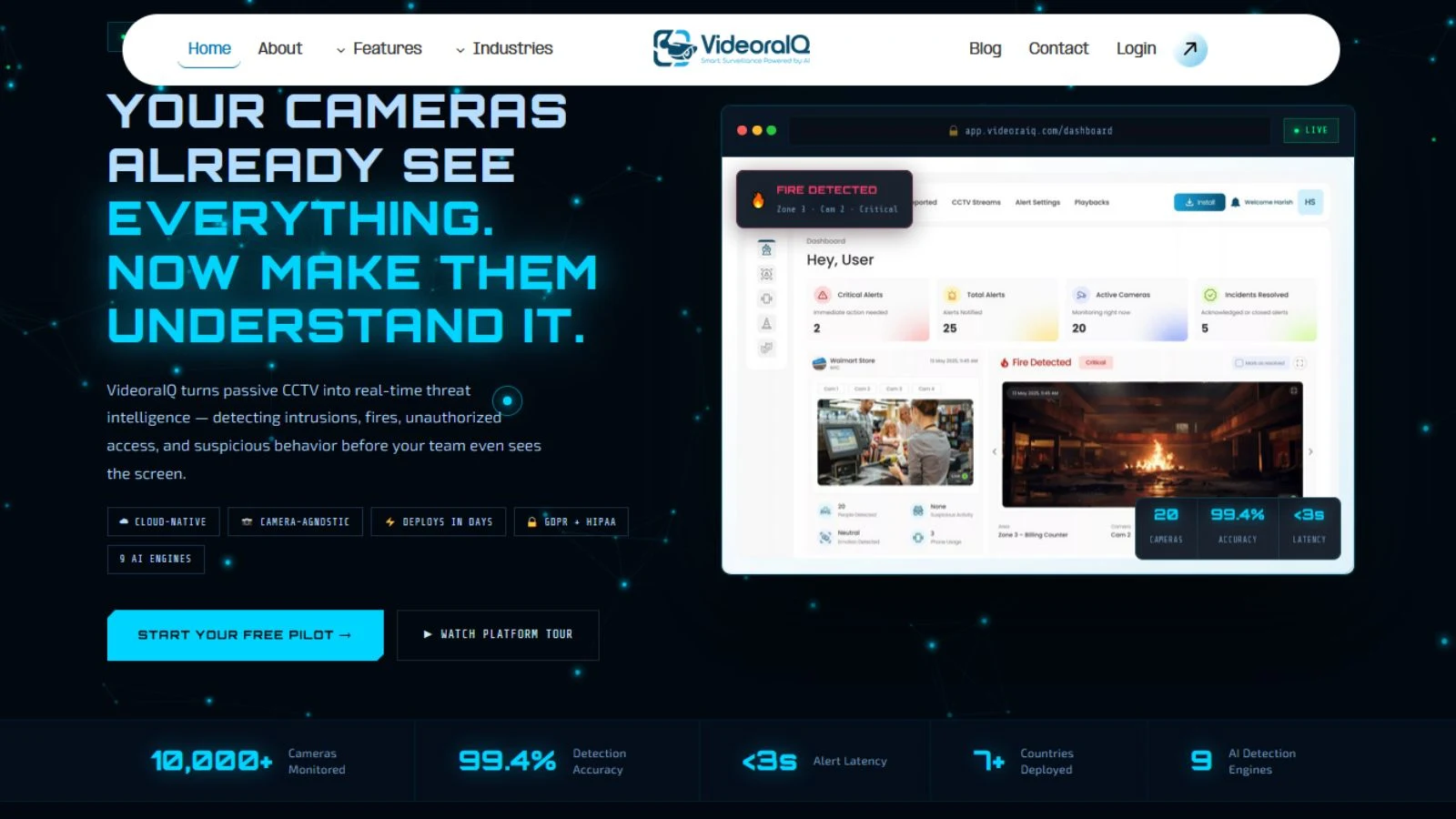
A detection engine’s accuracy figure only tells you how well the model performs under controlled conditions. On a site running hundreds of cameras with continuous monitoring, what actually determines the usefulness of alerts is how tightly you’ve scoped the detection zones, whether alerts are filtered by time of day, and whether alert logic is matched to shift schedules.
The cashier absence detection workflow illustrates this cleanly. Floor managers are alerted when a station becomes vacant relative to configured shift schedules not simply when no one is visible on camera. That context is what separates a useful alert from noise. Apply the same discipline to every detection engine you deploy: the zone boundary, the crossing direction, and the time window. Configuration is where most of the signal-to-noise work happens, not in the model itself.
A veteran plant security lead put it plainly: “On live monitoring, humans get tired. The system doesn’t.” That’s the operational case in one sentence. The question isn’t whether AI analytics outperforms manual monitoring at scale; it does. The question is whether you’ve configured it tightly enough to trust the alerts it sends.
VideoraIQ monitors over 10,000 cameras across deployments in 7 or more countries. The platform exists for exactly this environment: complex sites, multiple threat vectors, and security teams that cannot be everywhere at once.
If you’re ready to close the gap between cameras installed and threats actually caught, start your free VideoraIQ trial and run your first pilot zone this week.