

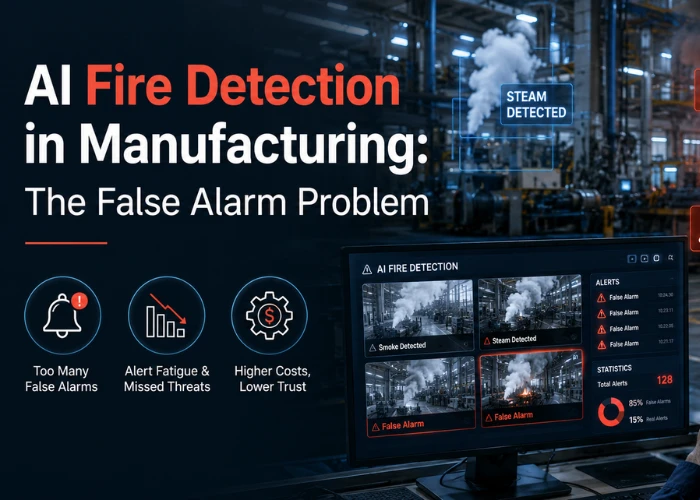
Nilesh Kapoor’s team got the alert 52 seconds before the smoke alarm triggered. The live camera link was already in their hands. They dispatched before the ceiling sensor had any idea something was burning. That outcome — real, documented, from a 480-camera manufacturing facility — is exactly what good AI fire detection looks like in practice.
It’s also not the norm. Most manufacturing deployments don’t fail at the dramatic moment. They fail in the weeks before, when the system cries wolf so many times that operators start ignoring alerts. By the time a real fire starts, nobody is reacting.
The vendors selling AI fire detection are happy to talk about accuracy. What they rarely walk you through is the specific environmental noise inside a factory that will make your detection engine miserable — and what you actually need to configure before go-live.
Listen to the podcast!
The Real Threat: Alert Fatigue Before the Fire
Here is something that rarely gets said plainly: 85% of CCTV footage is never reviewed during normal operations. AI detection exists precisely because humans can’t watch hundreds of feeds simultaneously. But if the detection engine generates enough false positives, operators develop alert fatigue — and you’re back to the same problem, this time not because nobody’s watching, but because nobody’s reacting.
In a retail or office deployment, false positives are annoying. In a manufacturing plant, the visual environment is genuinely hostile to computer vision. Knowing which conditions will trigger spurious alerts — and how to mitigate them before deployment — is what separates a working system from a liability.
The Manufacturing Environment Your Vendor Didn’t Model For
There are named failure modes that recur specifically in industrial settings. They’re not theoretical.
Welding
Welding produces visible sparks, intense light flares, and a brief smoke-like particulate plume. To an untrained detection model, it looks indistinguishable from the early stages of a fire. Maintenance bays and fabrication floors are especially problematic. Ask the vendor directly: has the model been trained on welding-specific footage? Then ask whether it supports scheduled suppression zones — so active welding areas don’t generate alerts during known work windows.
Conveyor Friction and Cardboard Dust
High-volume packaging and logistics lines generate real particulate clouds — cardboard dust, paper fiber, foam pellets — that scatter light and create haze on camera. At certain densities and lighting angles, that haze reads as smoke. This is a common complaint in fulfilment environments where conveyors run continuously.
Steam
Food manufacturing, chemical processing, and any facility running steam-based equipment will produce visible water vapor that moves the way smoke moves. The camera doesn’t know the difference based on visual appearance alone. Detection engines that rely only on color and motion patterns will flag steam repeatedly. Those that additionally model plume behavior, dispersion rate, and cross-reference thermal context — or that flag by zone type — perform significantly better here.
HVAC Airflow
This one cuts both ways. Strong HVAC airflow can physically move smoke away from point sensors, meaning traditional detectors alert late in open production spaces. That’s the argument for visual AI — it catches what moves laterally before it reaches a ceiling sensor. But the same airflow will also disperse a real plume quickly on camera. Camera placement matters enormously here.
What the Numbers Actually Mean in a Manufacturing Context
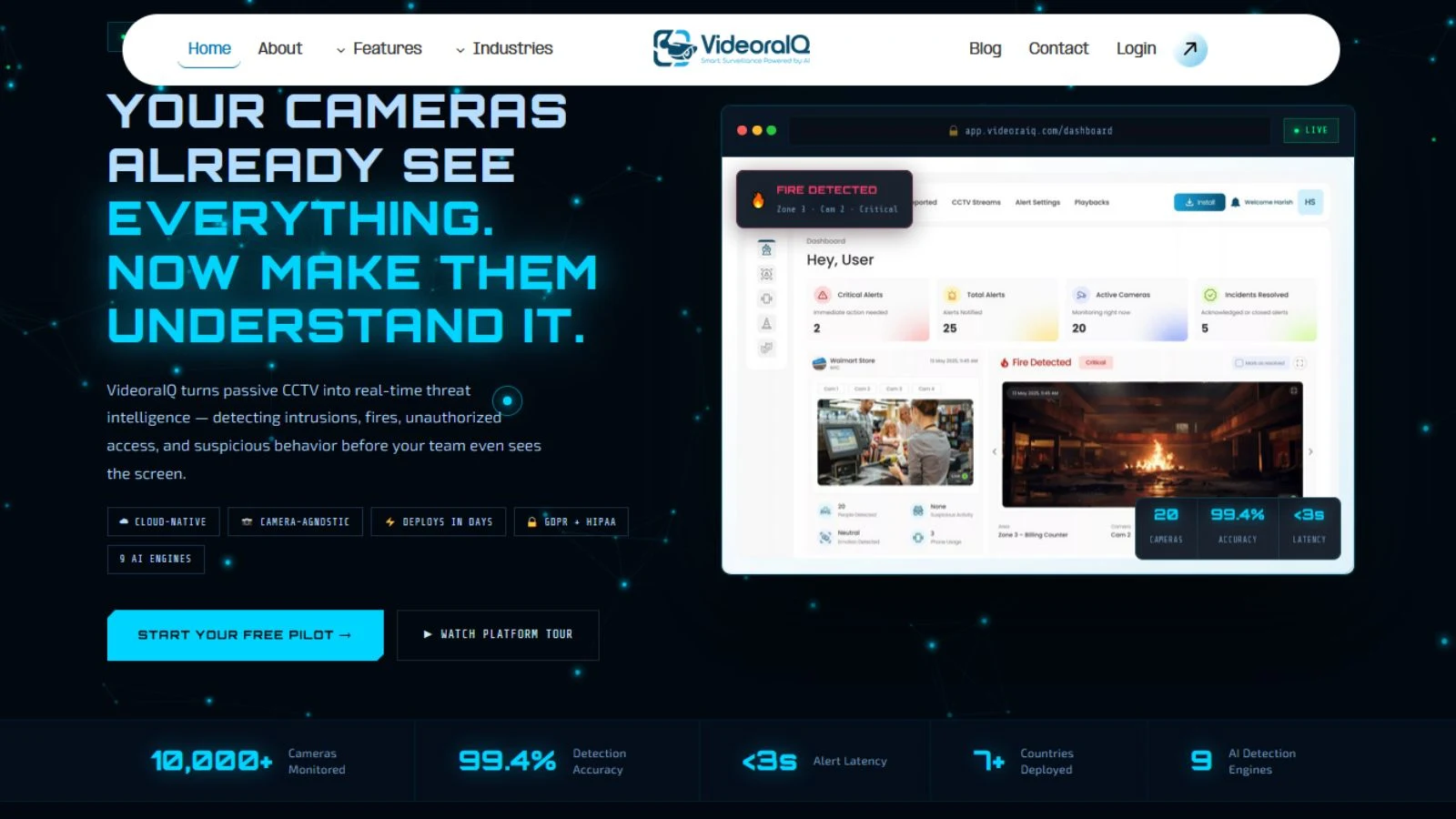
VideoraIQ reports 99.4% detection accuracy and under-3-second alert latency from camera to operator. Those numbers matter — but they need to be understood correctly.
Detection accuracy is measured against a defined dataset. The question to ask any vendor: does that dataset include the specific visual noise present in your facility? A high accuracy figure trained largely on clean office or retail footage does not automatically transfer to a facility running three shifts of welding and conveyor operations. This isn’t a knock on the technology — it’s a commissioning question that buyers consistently fail to raise.
Latency is similarly nuanced. Latency should be understood as a distribution — median, 95th percentile, and worst-case — measured from camera frame capture through gateway hops, inference, and event delivery to your operator. Under 3 seconds is the target; sub-10 seconds is the threshold for occupied spaces where evacuation time matters. Ask for all three numbers, not just the median.
The broader market context supports why getting this right matters now. The global AI-powered video analytics market was valued at $5.63 billion in 2025 and is projected to reach $23.03 billion by 2034, growing at 16.8% annually. More vendors means more immature models entering the market. Scrutiny on commissioning quality has never been more important.
The 40–60 Second Advantage—and When You Lose It
Visual AI fire detection identifies threats 40–60 seconds before traditional heat sensors. That gap is the entire value proposition. Heat sensors wait for combustion byproducts to physically reach a ceiling-mounted device. A camera detects the visual signature of ignition or early smoke at the point of origin — regardless of airflow, ceiling height, or room geometry.
Separately, computer vision deployed for smoke detection can achieve accuracy rates of 95–98% while cutting false alarms below 2% in well-configured deployments. “Well-configured” is doing a lot of work in that sentence.
You lose the 40–60 second advantage in three specific ways:
- Poor camera placement: A camera pointed down a long aisle from 20 metres away will detect a spreading fire. It will not reliably detect early-stage ignition in a corner bin. Placement logic for fire detection is different from access control or perimeter monitoring — the two should be planned separately.
- Alert fatigue from unconfigured zones: If your welding bay, steam line, and dust-generating conveyor are all generating alerts from day one, operators will mute the notification channel. Configure suppression zones and zone-specific sensitivity thresholds before go-live — not after your first week of false positives.
- Compliance misunderstanding: Most jurisdictions currently accept video image analytics only as a supplementary detection signal, not as the sole initiating device, unless the camera-analytics combination carries specific listed certifications under NFPA 72, EN 54, or equivalent standards. Running AI detection without maintaining your traditional sensor infrastructure isn’t a cost-saving—it’s a compliance gap. VESDA-type aspirating detectors pair well with visual AI in high-volume spaces precisely because the two technologies fail differently.
A Practical Commissioning Checklist for Manufacturing Deployments
Before go-live, work through these in order:
- Map every false-positive risk zone: Walk the floor and identify every area with welding, steam, airborne particulate, glycol fog, or unusual lighting. Mark them explicitly.
- Verify camera compatibility: VideoraIQ works with 200+ IP camera brands without hardware replacement — but confirm your specific models are on the compatibility list before procurement.
- Configure zone-level sensitivity and suppression schedules for every high-noise area identified in step one. Match suppression windows to shift schedules.
- Confirm time synchronisation: PTP or NTP synchronisation across cameras, gateways, and servers is essential for log and evidence alignment — especially if an incident ever goes to insurance or legal review.
- Run a live latency test: Generate a controlled smoke event in a low-risk area and measure the full chain from camera capture to operator alert. Get your median and 95th-percentile numbers on record.
- Keep your traditional sensors: Treat video AI as the early-warning layer it is. It earns its cost by giving you those 40–60 seconds. It is not a replacement for listed fire alarm systems under current standards.
Read More!
Fire and Smoke Detection from CCTV: Campus Setup (2026)
The Piece Most Buyers Skip
The technology works. A 480-camera manufacturing facility getting a 52-second head start on a fire event is not marketing copy — it’s a documented operational outcome. VideoraIQ’s platform, deployed across 10,000+ cameras in 7+ countries, is built specifically for this class of deployment.
But technology doesn’t self-configure. The buyers who get Nilesh Kapoor’s outcome are the ones who treated commissioning as seriously as procurement. They mapped their noise sources, set zone-level parameters, and kept their legacy systems in place as the complementary layer regulators expect.
For a deeper look at how visual AI fire detection compares against incumbent platforms in real-world conditions, the VideoraIQ vs Avigilon breakdown and the VideoraIQ vs Araani comparison are worth reading before any vendor decision. Both go into the architecture and deployment trade-offs that top-level accuracy numbers don’t tell you.
If your facility is still relying on ceiling sensors alone, the 40–60 second gap isn’t a feature comparison. It’s time your team doesn’t have. See how VideoraIQ’s Fire & Smoke Detection works across your existing camera infrastructure — and find out whether your environment can be configured to perform from day one.