

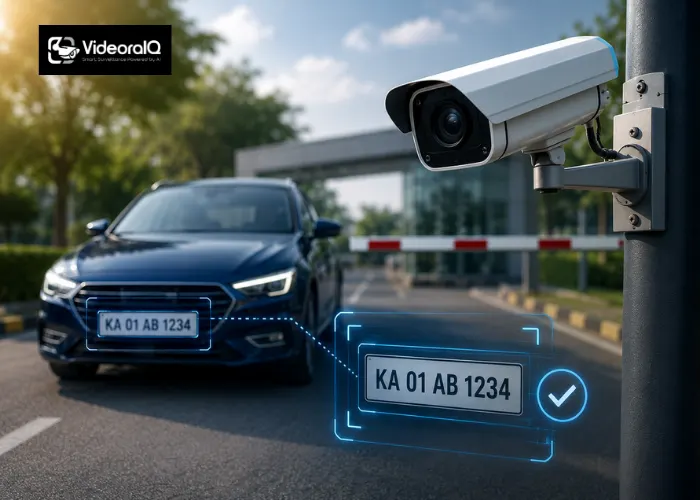
A vehicle flagged on a watchlist drove through a different site three days later, and no alert was fired. That isn’t a hypothetical — it’s a documented operational failure pattern in multi-site ANPR deployments. Procurement teams spent weeks comparing vendor accuracy benchmarks. Nobody checked whether the camera at site two could read a plate reliably at 3 p.m. in late autumn.
That gap — between vendor-quoted performance and field performance — is almost always a site survey problem, not a software problem.
The global ANPR market was valued at $3.65 billion in 2025 and is expanding fast. Many organisations are installing cameras right now without running the physical checks that determine whether those cameras work. Here’s the checklist most deployment guides omit.
Listen to the podcast!
Why Accuracy Claims Break Down in the Field
VideoraIQ publishes a detection accuracy benchmark of 99.4% across more than 10,000 cameras. That figure is real. It is also achieved under conditions where cameras were correctly positioned, lighting was accounted for, and vehicle speeds fell within a readable range.
Accuracy benchmarks measure what a system can do. Site surveys measure what your specific environment will allow it to do. Those are different questions. Skip the second one and the first number becomes irrelevant.
The five checks below come directly from pre-deployment practice. They sound simple. Most buyers still skip at least two.
The Five Site Survey Checks
1. Sun Angle at 15:00
Direct low-angle sunlight hitting a camera lens at the wrong time of day will wash out a plate entirely — not degrade it, erase it. You need to be at the physical camera position at the time of day when sun angle is lowest and pointed most directly at the lens. In temperate climates, late afternoon in autumn and winter is typically the critical window.
Check it at 15:00 specifically. Not at 10 a.m. during the walkthrough. Not in July when the sun is high. If you’re installing near a west-facing gate and haven’t verified the 15:00 sun angle in the worst month, you’re running a guess, not a deployment.
2. Weather Exposure
Rain, condensation, and lens fogging are obvious. Less obvious: the long-term effect of wind-driven particulates on an exposed lens in an industrial or coastal environment. A housing rated IP67 is not the same as a camera positioned so it self-cleans. Check where water pools and drains. Check whether prevailing wind will carry grit across the lens repeatedly.
This also sets your cleaning schedule. A camera you need to wipe down every two weeks in winter is a maintenance commitment. Factor that into resourcing before the mount goes up, not after.
3. Vehicle Speed at the Gate
ANPR capture requires the shutter to freeze a plate within the camera’s field of view long enough to read it cleanly. At 5 km/h through a controlled barrier, that’s straightforward. At 30 km/h through an open entrance, it becomes a genuine engineering constraint — shorter focal length, faster shutter, or a narrower lane.
Measure actual vehicle speeds at your site: not what the signage says, what vehicles actually do. A car park entrance where drivers roll in slowly is a different problem from a logistics gate where trucks are waved through without stopping. Both need ANPR. Neither should be configured identically.
4. Camera Angle
Standard guidance for plate recognition sets a horizontal offset of no more than 30 degrees from the direction of travel and a vertical offset of no more than 25–30 degrees from horizontal. Outside those windows, occlusion, perspective distortion, and reflection compound quickly.
The real-world mistake isn’t ignorance of those figures — it’s failing to account for mixed traffic. A camera angled correctly for a standard saloon will misread the plate on a high-sided van if that van’s plate is mounted low and the camera is set for eye-level capture. Audit the vehicle types that actually use your entrance. Mixed traffic means either the camera height or your angle tolerance needs to cover the full range.
5. Lighting Cycle
Infrared illuminators handle most low-light scenarios well. What they handle poorly is transition: the seconds around dusk and dawn when ambient light and artificial illumination are mismatched, and auto-exposure is actively adjusting. During that window, plate capture quality drops. In environments with moving vehicles, the result is missed reads.
Survey the lighting cycle at the site. Note when external lighting activates. Check whether overhead structures cast sharp contrast lines across the lane — these confuse exposure metering independently of ambient conditions. If your site still has sodium or mercury vapour lights, note that too: their colour spectrum interacts differently with IR illuminators than LED replacements do.
What Skipping the Survey Actually Costs You
The operational failure pattern mentioned at the start of this article — a flagged vehicle passing through a site undetected — is typically attributed to software configuration. A physical deployment problem is just as common an underlying cause. A camera that misreads one character in five under poor lighting produces false negatives on blacklist matching even when blacklist propagation is working correctly.
Procurement guides increasingly note that organisations with bounded requirements often need only a targeted module, while larger or more complex facilities need to think harder about scalability. The same logic applies to site surveys: the stakes rise steeply when you’re covering multiple sites, multiple lane types, and multiple environmental conditions simultaneously.
VideoraIQ’s ANPR module runs vehicle entry and exit logging with blacklist matching across all sites from a single shared dataset — recognition happens at the edge, the watchlist is centrally managed. That architecture closes the batch-sync propagation gap that causes multi-site misses. But central architecture does not compensate for a camera mounted without checking the afternoon sun. The software cannot fix what the physical environment prevents.
Compliance Starts at the Camera Mount, Not the Settings Panel
The ethical deployment of ANPR is a live concern in 2025. Organisations need to balance security capability with proportionality — capturing only the data the deployment justifies, retaining it only as long as is defensible, and protecting it consistently across sites.
This connects to the physical survey in ways that aren’t obvious at procurement. A camera positioned to capture a public pavement alongside the target lane may be reading plates it has no legal basis to log. A camera with an overly wide field of view may be recording bystanders beyond the intended zone. These are not software configuration problems. They are camera placement problems, and they need to be caught during the site survey — before concrete is poured.
VideoraIQ is GDPR and HIPAA compliant at the platform level — compliance is built into the architecture rather than left to per-site administrator configuration. But platform-level compliance assumes the physical installation is capturing data it’s lawfully entitled to capture. That assumption has to be verified on the ground.
The Right Order of Operations
Run the site survey before you finalise camera specifications — not after. The survey output should directly inform lens selection, housing type, IR illuminator range, and mounting height. Finalise hardware first and survey second, and you’ll compromise on at least one of the five checks because you’re working backwards from equipment already ordered.
For multi-site deployments: survey each site independently. The temptation is to treat sites as equivalent and replicate a configuration that worked elsewhere. Sun angle, vehicle speed, and lighting cycles are site-specific. A setup that achieves clean plate capture at a covered car park entrance will perform differently at an open logistics gate in another city.
VideoraIQ’s alert latency target of under three seconds from blacklist match to operator notification is only meaningful if the plate was read in the first place. Three seconds of latency on a missed read is still a missed read.
Read More!
ANPR Blacklist Matching: The Multi-Site Blind Spot
Why Boom Gates Are Losing to ANPR in 2026
Re-Survey Before the Seasons Shift
After installation, plan a targeted re-survey — not a full repeat, but a focused check of sun angle and lighting performance as conditions change. A camera that works cleanly in September may struggle in December. ANPR is not a fit-and-forget technology. The physical environment changes; the survey should reflect that.
The organisations that achieve consistent plate recognition performance are not necessarily running the most sophisticated software. They are the ones that treated the site survey as technical due diligence rather than a formality before the real work began.
To see how a centrally managed, edge-processed ANPR deployment handles multi-site watchlist matching in practice, start your free VideoraIQ trial and bring your site survey findings with you.