

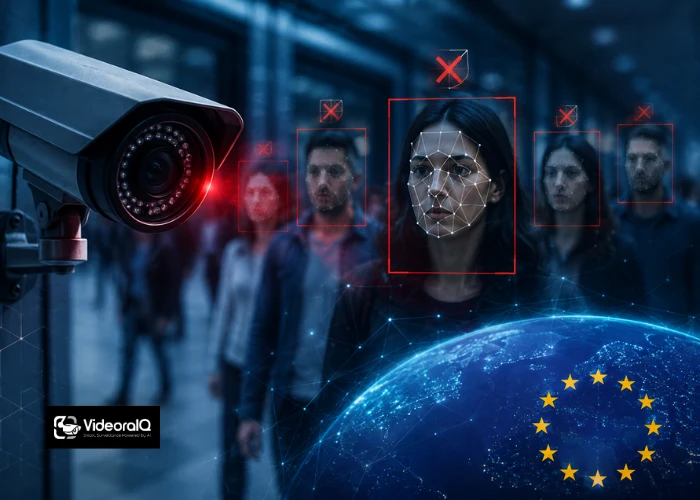
Hundreds of false-positive alerts per shift. Each one is a biometric record. Each record is regulated. Most procurement teams never run that arithmetic before they sign.
One number should stop every security director cold. At a 200-camera corporate campus, a face recognition engine operating at 95–97% accuracy produces hundreds of false-positive alerts per shift, generating regulated biometric data for non-events at scale. The system is not just noisy. It is quietly building a liability stockpile — one misidentification at a time.
This is the conversation the vendor brochure never starts.
Listen to this podcast!
The Math Nobody Does at Procurement
Face recognition accuracy figures are almost always quoted at the model level, measured on clean benchmark datasets. Real-world conditions — variable lighting, partial occlusions, ageing watchlist photos, wide camera angles — push operational accuracy well below that headline number. The gap between 97% and 99% sounds trivial. At scale, it is not.
A 200-camera campus at 95–97% accuracy generates hundreds of false-positive matches every shift — a documented noise problem for live operators, not a hypothetical. No security team reviews that volume meaningfully. Operators stop trusting alerts. Dismissals happen on instinct rather than evidence. The system that was supposed to harden your perimeter becomes background noise — except it keeps logging. Every false match is a biometric record sitting somewhere on your infrastructure.
That matters enormously once you understand what those records are under the law.
False Positives Are Not Noise — They Are Regulated Data
GDPR Regulation (EU) 2016/679 classifies biometric data—including face geometry—as special-category data: the highest-sensitivity tier, alongside health records and racial or ethnic origin. A false-positive match is still a biometric processing event. The subject’s facial data was captured, compared, and logged. The match being wrong does not make the record disappear, and it does not make the processing lawful after the fact.
The financial consequences of getting this wrong are documented. EU regulators fined Clearview AI seven times since 2020, totalling over €100 million, including a €30.5 million fine from the Dutch DPA in 2024. Those were for systematic data collection practices. Enterprises running inaccurate face recognition at scale face a structurally similar risk: mass biometric data processing with inadequate lawful basis or insufficient accuracy controls.
For multi-site operators, the exposure compounds. Enterprises operating across jurisdictions may face GDPR, HIPAA, CCPA, and BIPA simultaneously. Illinois BIPA requires written consent before a private entity collects biometric identifiers. A false-positive match in an Illinois facility is a BIPA event even if the person was never on a watchlist and never consented. The system did not know that when it logged the match. Your legal team will learn it later.
The Storage Problem Nobody Mentions
There is a related figure that changes how you think about retention policy. 85% of CCTV footage is never reviewed, meaning biometric data is captured, stored, and never acted on. For traditional CCTV, that is a waste-of-storage problem. For a face recognition system generating false-positive match records, it becomes a data minimisation violation under GDPR — and a potential class-action exposure under BIPA, which allows statutory damages per violation.
Accuracy is not just an operational metric. It is a data governance metric. Every percentage point of error rate is a multiplier on your regulated-data exposure.
What 99.4% Actually Means in Practice

VideoraIQ publishes a detection accuracy of 99.4%. The practical difference between that figure and the 95–97% operational range documented above is not an abstract quality improvement — one produces actionable alerts, the other produces a compliance liability engine.
At 99.4%, false-positive volume drops far enough that trained operators can actually review and adjudicate each alert. Watchlist matches get investigated rather than dismissed. The biometric records being generated correspond to genuine processing events — not algorithmic noise. The recommended detection accuracy threshold for 24/7 SOC teams is ≥99%; anything below that swamps the team with false pings that erode both operational trust and legal defensibility simultaneously.
Ananya Mehta, Head of Facilities at a 200-camera corporate campus, put it plainly after a single 2 AM intruder event was caught in real time: the detection “justified the entire platform cost.” That kind of outcome only happens when operators trust the alert enough to act on it — and trust only comes when false-positive volume is low enough to sustain attention.
The platform monitors over 10,000 cameras across deployments in seven or more countries, and the Face Recognition module generates automatic access logs with real-time watchlist matching. That workflow only holds together operationally when false-positive volume is low enough that teams do not filter out the signal along with the noise. VideoraIQ is also GDPR and HIPAA compliant, which matters most precisely in the multi-jurisdiction scenario described above.
Running more than 50 cameras? See how VideoraIQ’s 99.4% accuracy benchmark holds up across your specific camera count →
How to Actually Test Accuracy Before You Commit

Vendor-quoted accuracy figures are measured under controlled conditions. Your procurement process should stress-test them under yours. Here is a concrete framework that costs almost nothing to run.
Step 1: Pilot at the Right Scale
The recommended pilot size is roughly 20 cameras before scaling to a full deployment. That is enough to surface real-world false-positive rates without committing to a full rollout. During the pilot, log every alert — not just confirmed matches. Count false positives manually for one week. Multiply by your planned camera count. That projected volume at scale is the number your legal counsel needs to see before anything is signed.
Step 2: Run the Watchlist Latency Test
Accuracy is only half the operational picture. Latency matters too — specifically, how fast a newly added watchlist entry propagates to live cameras. Add a new watchlist entry mid-shift and measure how long before live cameras match against it. Most vendors will not volunteer this test. A system that takes ten minutes to propagate has a ten-minute blind spot on every new threat. For a platform claiming alert latency of under three seconds, that propagation time should be correspondingly fast. If the vendor cannot give you the figure, that is itself an answer.
Step 3: Audit What Gets Stored
Ask your vendor directly: what biometric data is retained after a false-positive match, for how long, and under what access controls? Many teams skip this question because they assume the system only logs confirmed matches. Most systems log attempted matches. That is the record that matters for compliance purposes. If the vendor does not have a clear answer, run a test match against a known non-watchlist face and pull the logs. What you find tells you exactly what your DPA would find in an audit.
Read More!
Face Recognition And License Plate Reading — Retail 2026
Face Recognition Watchlists: The False Positive Trap
The Accuracy Threshold Is a Risk Decision, Not a Quality One
Buyers tend to frame face recognition accuracy as a product quality question — higher is better, but 97% is probably fine. That framing is wrong. Given the regulatory environment described above, accuracy is a risk management decision with a calculable cost attached to every percentage point below the threshold where false-positive volume becomes operationally and legally manageable.
The global AI-powered video analytics market was valued at $5.63 billion in 2025 and is projected to reach $23.03 billion by 2034. That growth reflects genuine demand — face recognition works when deployed correctly. The organisations that extract lasting value will be the ones whose deployments keep false-positive volumes low enough to stay legally defensible.
The ones that buy on headline price and a 97% accuracy figure will spend those savings — and more — on remediation, legal review, and regulator correspondence.
Start with the math. Run the pilot. Ask what gets stored. The architecture decisions made at procurement stay with you for years.
Start your free VideoraIQ trial and see what 99.4% detection accuracy looks like across your camera estate before you commit to anything else.