

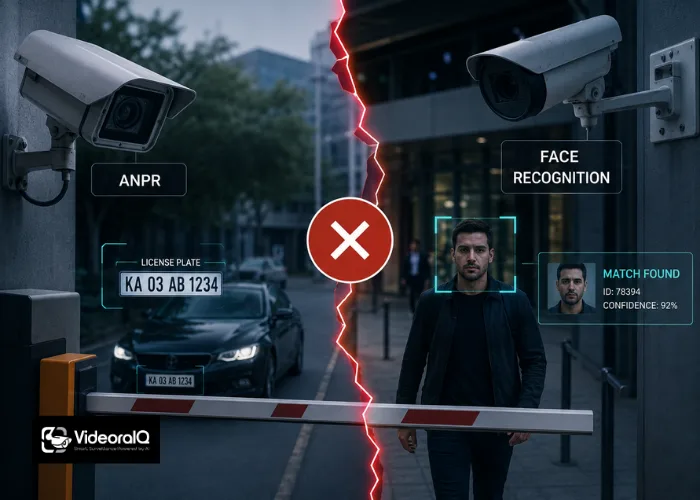
Separate ANPR and face recognition platforms, each firing accurate alerts, are not the same as a functioning security operation. I’ve watched this distinction cost teams dearly — and the gap rarely shows up in a vendor demo.
The scenario plays out the same way across industries. A security team buys a well-reviewed face recognition system. They buy a capable ANPR solution. Both score well in controlled testing. Then, during a live incident at a busy logistics park with multiple entry points, a blacklisted vehicle enters through the vehicle gate while an unrecognised face attempts access at a side entrance thirty seconds later. The guard has two screens, two alert queues, and two timestamps to manually reconcile under pressure. The connection between the events is obvious in retrospect. In the moment, it takes too long to see it.
That is the split-stack failure mode. Not accuracy. The seam between platforms.
Listen to this podcast!
Two Good Systems Can Still Make a Bad Operation
The AI-powered video analytics market was valued at $5.63 billion in 2025 and is projected to reach $23.03 billion by 2034, driven by deep learning and edge computing converging at scale. That growth means buyers now have more point solutions to choose from than ever — face recognition from one vendor, number plate recognition from another, intrusion detection bolted on from a third.
Each vendor demo looks clean. Each alert fires correctly in isolation. The trouble is that a split-stack deployment creates two independent watchlists, alert thresholds, and evidence-export formats that evolve independently. A vehicle blacklist updated in one system does not automatically cross-reference the face watchlist in the other. The systems aren’t broken individually. The seam between them is.
Alert latency compounds this. A 15-second gap at a vehicle gate means a suspect vehicle is already inside the perimeter before an operator acts. Add the time to switch applications, locate the timestamp in the second platform, and correlate the two events. No accuracy rating compensates for that manual step. Running a split stack also doubles training overhead, vendor audit surface, and failure points — costs that rarely appear in the initial procurement comparison.
Where Accuracy Numbers Mislead Buyers
Procurement processes evaluate each system on its own accuracy score and assume the combined operation inherits those scores. It doesn’t.
At 95–97% face recognition accuracy, a 200-camera corporate campus generates hundreds of false-positive alerts per shift. That noise level is manageable when operators watch one consolidated stream. When they’re juggling two — face recognition alerts appearing separately from ANPR — the cognitive load doubles. Operators start triaging by dismissing anything that doesn’t look urgent on first glance. Alarm fatigue sets in.
NIST evaluations show that the best-performing face recognition algorithms achieve a false positive rate of roughly 0.003% — about one false identification in 33,000 attempted matches. Elite accuracy is achievable. But the question is never just “how accurate is the detector?” It’s “Does the alert reach the operator in context and fast enough to act?”
The false positive trap in face recognition watchlists is worth reading before you set vendor requirements. It matters most if your deployment spans a manufacturing floor, transit hub, or any environment with faces in motion and vehicles at non-standard angles.
What a Unified Alert Timeline Actually Changes
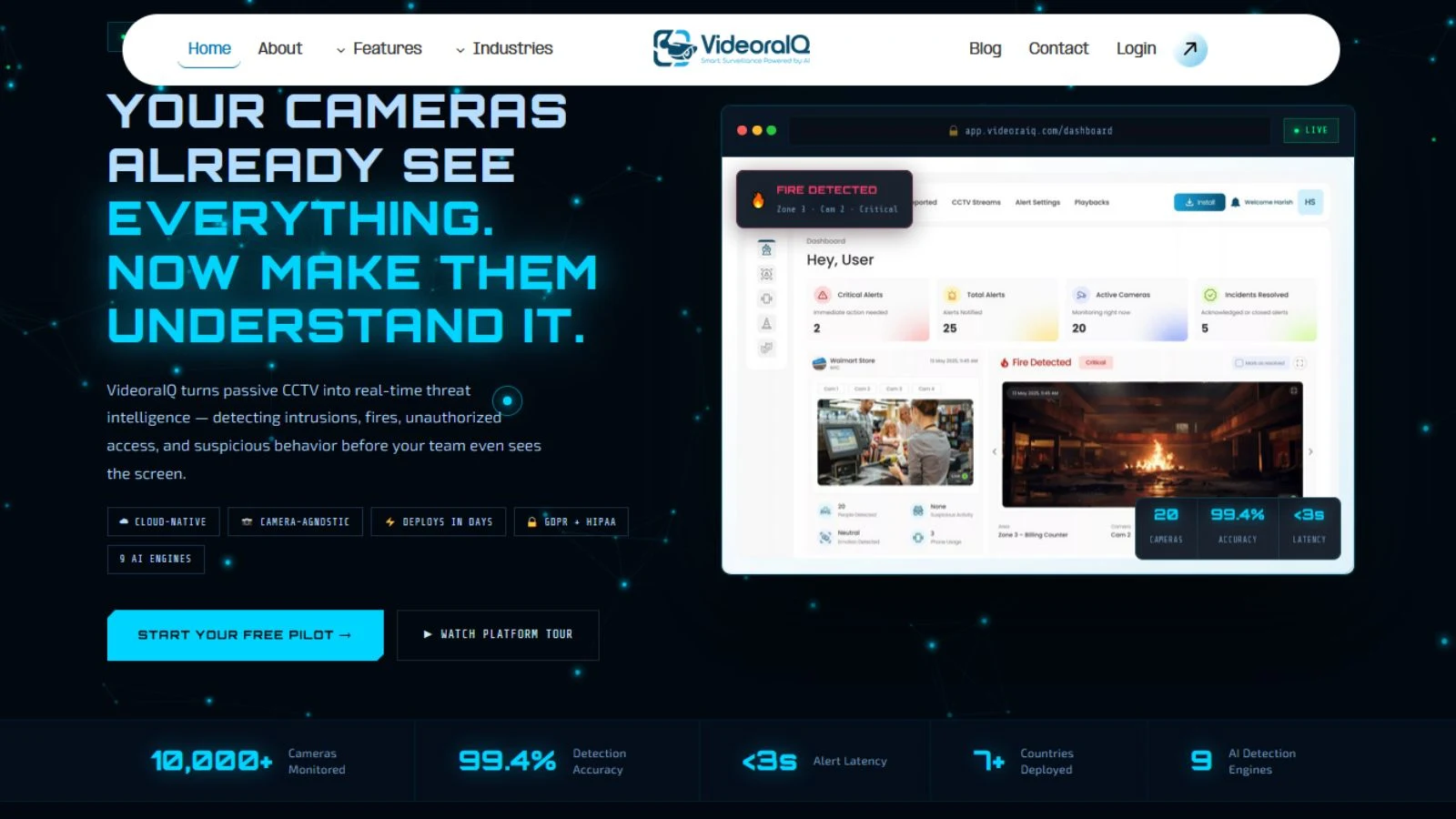
VideoraIQ consolidates its AI detection engines—Face Recognition, Number Plate (ANPR), Intrusion Detection, Line-Cross Detection, Unauthorised Access, and Fire & Smoke Detection—on a single unified alert timeline. Every alert carries an attached video clip, a location tag, and a timestamp. Face matches and vehicle logs land in the same operational view.
That structural shift changes the operator’s job. A blacklisted plate enters via ANPR. Thirty seconds later, a face match fires at the nearest access point. Both alerts appear on the same timeline with clips and location tags attached. The connection is visible immediately — no manual correlation, no screen-switching, no context lost between applications.
For face recognition, real-time watchlist matching generates automatic access logs without operator intervention. For vehicles, ANPR logs every entry and exit and runs blacklist matching across all sites simultaneously, generating cross-site movement history records. A vehicle flagged at one facility is caught at every other without a manual list update.
Sub-3-second alert delivery matters here precisely because both streams arrive at that speed. A fast face recognition alert paired with a slow ANPR alert still creates a correlation gap. Consistent sub-3-second delivery across all detection engines is what makes a unified timeline operationally meaningful rather than just architecturally tidy.
See VideoraIQ’s unified alert timeline in practice — request a 10-minute product walkthrough and bring your current camera count.
The Pilot Test That Exposes Split-Stack Problems Early
Run a structured pilot across roughly 20 cameras before scaling — not just measuring each system’s accuracy in isolation. Track two additional metrics: false positive rate across all alert types combined and mean time from event to operator receipt as a single number reflecting when the operator has enough context to act.
Three stress conditions are worth building in. High-traffic entry points at peak hours. Low-light or adverse weather conditions. And a live watchlist update mid-test — add a new entry mid-shift and measure how long it takes to propagate to active cameras. Most vendors will not volunteer that last test. If false positives run above a handful per shift across 20 cameras, the extrapolated noise across 200 is unworkable. That calculation gets worse when you add a second platform’s noise to the first.
For combined face recognition and ANPR deployments, the operational and technical considerations differ meaningfully from single-modality rollouts — worth reviewing before finalising pilot scope.
The Compliance Angle Nobody Budgets For
Running two separate biometric platforms doubles your compliance surface. GDPR classifies biometric data as special-category data — the highest-sensitivity tier, alongside health records and racial or ethnic origin. CCPA, BIPA, and HIPAA layer additional obligations depending on jurisdiction and sector. Each vendor’s data handling, retention policies, and audit trails must be independently verified and documented.
The regulatory exposure is not theoretical. EU regulators have fined Clearview AI seven times since 2020, totalling over €100 million. And critically, under GDPR and HIPAA, “the systems weren’t integrated” is not accepted as a regulatory defence — a consistent data-handling policy must be demonstrated across every system that processes biometric data.
A unified platform means one compliance audit, one data retention policy, and one vendor to hold accountable. VideoraIQ is GDPR and HIPAA-compliant, deployed across more than seven countries — meaning the compliance framework has been stress-tested across multiple regulatory environments, not engineered for a single market. Across those deployments, the platform monitors over 10,000 cameras at 99.4% detection accuracy. Those are live operational figures, not pilot numbers.
Read More!
Alert Fatigue Is Your Biggest Security Vulnerability
Face Recognition and License Plate Reading for Retail
The Operational Calculus
Split stacks are tempting because they let you buy best-of-breed at each layer. The hidden cost is the seam. Every integration point between systems is a place where alert context gets lost, correlation takes time, and operators make decisions on incomplete information.
One question cuts through any procurement process. When a blacklisted face and a blacklisted vehicle appear within 60 seconds of each other, how long does it take an operator to recognise both events as connected and act? If the honest answer involves switching applications and manually matching timestamps, you have a split-stack problem regardless of what the individual accuracy numbers say.
Start your free VideoraIQ trial — bring your camera count, your current alert volume, and the question your split stack still can’t answer cleanly.