

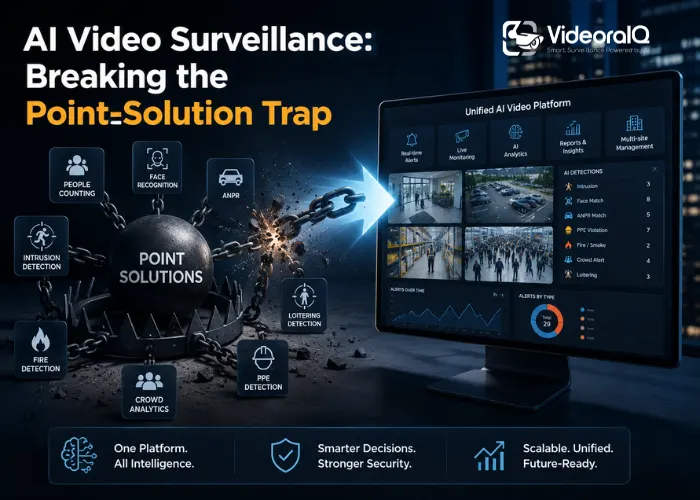
Most security procurement mistakes don’t happen at the moment of a breach. They happen eighteen months earlier, in a conference room, when someone decides to buy the “best-of-breed” point solution for each detection category.
I’ve watched this play out repeatedly. One vendor for face recognition. A different one for number plate recognition. A third system for fire detection. Each with its own dashboard, its own alert queue, and its own timestamp format. When something actually happens — a vehicle tailgates through a gate, the same moment a face triggers a watchlist hit — operators are manually correlating three separate event timelines while the threat clears the perimeter.
This is the point-solution trap. And it’s more common than any vendor in this space will admit.
Listen to the podcast!
The Timeline Mismatch Problem Is Real
Here’s the specific failure mode. Sites running separate face recognition and ANPR platforms produce duplicate alerts and mismatched event timelines, forcing guards to manually correlate events while vehicles are already clearing barriers. That’s not a theoretical risk — that’s what happens when two systems that weren’t designed to share context try to describe the same physical event.
Think about what “manual correlation” actually means at 2 AM with a skeleton crew. An operator has three open windows, two alert sounds firing within seconds of each other, no shared reference point. By the time they’ve confirmed the events are linked, a 15-second alert delay at a vehicle gate means a suspect vehicle is already inside the perimeter before any operator can act. The systems worked individually. The gap between them is where the breach lived.
Why Nine Engines on One Feed Changes the Equation

VideoraIQ runs nine AI detection engines simultaneously on the same camera feeds: face recognition, ANPR, fire and smoke detection, line-cross detection, intrusion detection, unauthorised access monitoring, and others. Every engine shares the same timestamp, location tag, and clip. When a face match and a blacklisted plate appear at the same entry point within seconds of each other, those events arrive in a single correlated alert. There’s nothing to manually stitch together.
That architectural choice — one feed, many engines, one event record — is what separates a system that assists operators from one that actually catches things. The global AI-powered video analytics market is projected to reach $23.03 billion by 2034, up from $5.63 billion in 2025. That growth isn’t driven by organisations buying more point solutions. It’s driven by hard-won recognition that fragmented detection is expensive to operate and dangerous to rely on.
Alert Fatigue: The Symptom Nobody Budgets For
Point solutions don’t just create timeline gaps. They multiply alert volume without improving signal quality. Every system is calibrated independently. Every threshold is set by a different team. The result is an alert queue that grows faster than any SOC team can process.
There’s a published benchmark worth knowing: a 200-camera corporate campus running face recognition at 95–97% accuracy generates hundreds of false-positive alerts per day. Hundreds per day. The recommended threshold for 24/7 SOC teams is ≥99% detection accuracy; anything below that swamps the team with false pings until operators stop trusting the system entirely. The watchlist becomes wallpaper. Real events get buried in noise.
Multiply that by three or four separate systems, each with its own false-positive rate, and you’ve built an environment where the psychological cost of vigilance outpaces what any team can sustain. It’s directly comparable to clinical alarm fatigue in hospitals — a well-documented failure mode where sheer alert volume causes staff to under-respond to the ones that matter.
VideoraIQ’s 99.4% detection accuracy across deployments matters precisely here. At that level, false positives drop from a daily flood to an occasional exception. Operators respond to alerts because the alerts are worth responding to.
The Fire Detection Gap Nobody Raises in Procurement
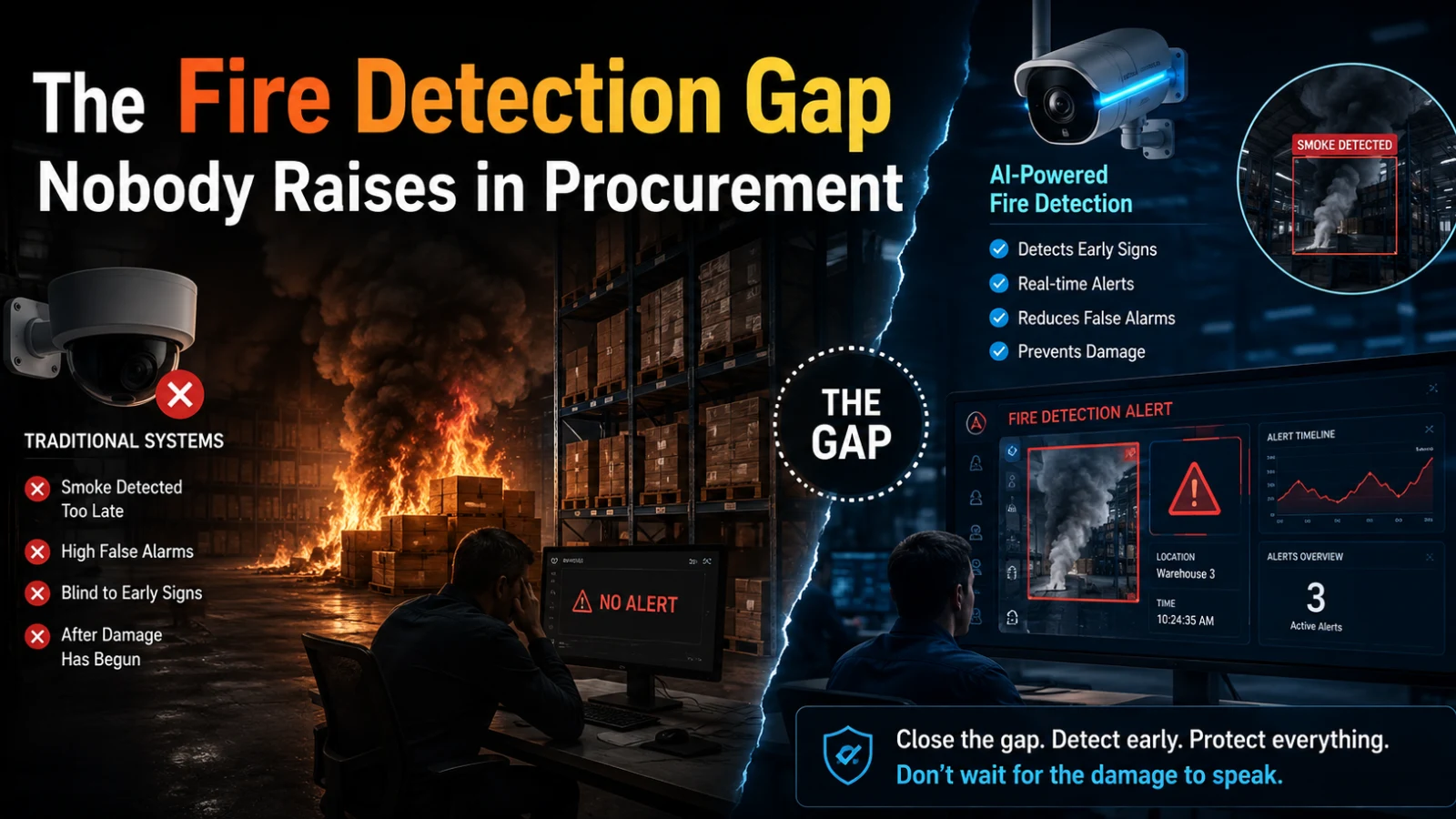
Most organisations treat fire detection as a separate category — something facilities management handles with heat sensors and sprinkler triggers. That’s a mistake measurable in minutes.
VideoraIQ’s Fire & Smoke Detection uses visual AI to identify threats 40–60 seconds before traditional heat sensors. Forty to sixty seconds sounds modest until you apply it to a manufacturing floor, a server room, or a transit hub. Those are the seconds when evacuation decisions get made — or don’t. A visual detection system running on feeds already covering your perimeter requires no separate infrastructure. It runs on what’s already there.
When fire detection shares a platform with intrusion and access alerts, a restricted-zone fire event generates one notification. It tells the safety team exactly where to look — video clip, location tag, and timestamp included. No separate system to check. No second login.
The Practical Case for Unified Detection
I want to be direct about where unified platforms don’t automatically win. Integration requires setup. Drawing virtual tripwires for Line-Cross Detection, configuring watchlists for Face Recognition, and mapping entry and exit points for ANPR — these aren’t zero-effort tasks. A unified system that’s badly configured is still a liability.
The right approach is to treat the pilot phase seriously. Start with roughly 20 cameras before scaling to a multi-hundred camera deployment, and measure two things obsessively: false positive rate and mean time from event to operator receipt. Test at high-traffic entry points during peak hours, under low-light and adverse weather at perimeter lines, and check watchlist update speed mid-shift. Those three stress conditions expose most of what will fail at scale.
VideoraIQ is compatible with 200+ brands of existing IP cameras, which removes the hardware replacement cost that makes unified deployments look expensive on paper. In most cases, the cameras are already there. What’s missing is a platform that treats their feeds as a shared intelligence source rather than isolated streams.
The scale argument holds too: VideoraIQ monitors 10,000+ cameras across deployments in 7+ countries, and 85% of CCTV footage is never reviewed by human operators. No team is watching all of it. The question is whether the AI layer connecting those feeds is coherent enough to catch what humans will inevitably miss — and whether the alert it generates is rich enough to act on before the moment passes.
Read More!
Unified Video Analytics: Why Split Stacks Cost More
How AI Video Surveillance Is Transforming Modern Security Systems
What a “Rich Alert” Actually Means
This is worth being specific about, because vendors use “alert” to mean everything from an SMS ping to a full event package. VideoraIQ’s alert payload includes an attached video clip, a location tag, and a timestamp — not a bare notification. A ping tells you something happened. A clip with a location tag tells you what to do next. That distinction drives operator response time more than almost any other factor.
Ananya Mehta, Head of Facilities at a 200-camera corporate campus, said a single 2 AM intruder event caught by the platform “justified the entire platform cost.” That’s one night, one catch, one cost justification. Three conditions made it possible: accuracy high enough that the alert got taken seriously, latency low enough that the operator could still act, and a payload rich enough to know exactly where to send a response.
Point solutions, on average, fail one of those three conditions. Usually more than one.
For organisations ready to move past the fragmented approach, how face recognition and ANPR work together in 2026 is a useful place to understand what correlated detection looks like in practice. On compliance: VideoraIQ’s platform is GDPR and HIPAA compliant — relevant frameworks also include CCPA and BIPA depending on region.
The point-solution era made sense when AI detection was young and each problem required a specialist. That’s no longer the constraint. The constraint now is integration — and organisations are still paying for its absence in timeline mismatches, alert fatigue, and the events that fall through the gap between systems.
See how VideoraIQ’s unified detection platform works across your existing camera infrastructure — and stop paying for the gaps between your systems.