
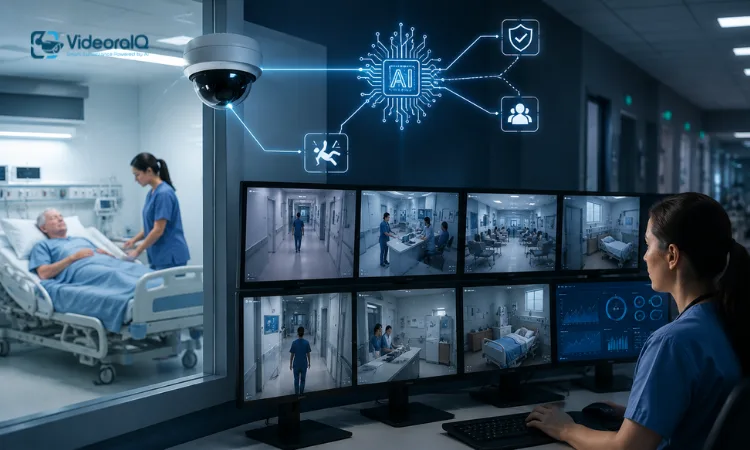
If we say that hospitals are the safest place, the reality is much more complicated. Daily monitoring needs to check whether patients are wandering into restricted areas, which may cause staff to face workplace issues. Several medical areas go unmonitored, and the security team is too late to review the footage, only after an incident happens.
A reliable cloud security system changes this equation entirely, shifting hospitals from reactive to proactive. When AI-powered video analytics are layered on top of existing cameras, every corridor, ward, and critical zone becomes intelligent.
This blog explores how AI video analytics is actively improving patient safety, reducing risks, and helping hospitals build a smarter, more responsive security environment.
Listen to the Podcast.
The Real Problem: Your Cameras Are Watching But Not Thinking
Most hospitals have cameras. Dozens of them. But here’s the painful truth 85% of CCTV footage is never reviewed in real time. Security guards can’t monitor every screen at once. Incidents get discovered in the morning briefing, not in the moment. This gap between “recording” and “understanding” is where patient safety breaks down.
A confused patient steps out of a ward at 2 AM. A stranger enters a pharmacy storage room. A fight breaks out in a waiting area. All of this gets captured on camera, and none of it triggers an immediate response.
A smart cloud security system powered by AI doesn’t just record. It thinks, detects, and alerts in under 3 seconds. That’s the fundamental shift hospitals need today.
How AI Video Analytics Actually Works in a Hospital Setting?
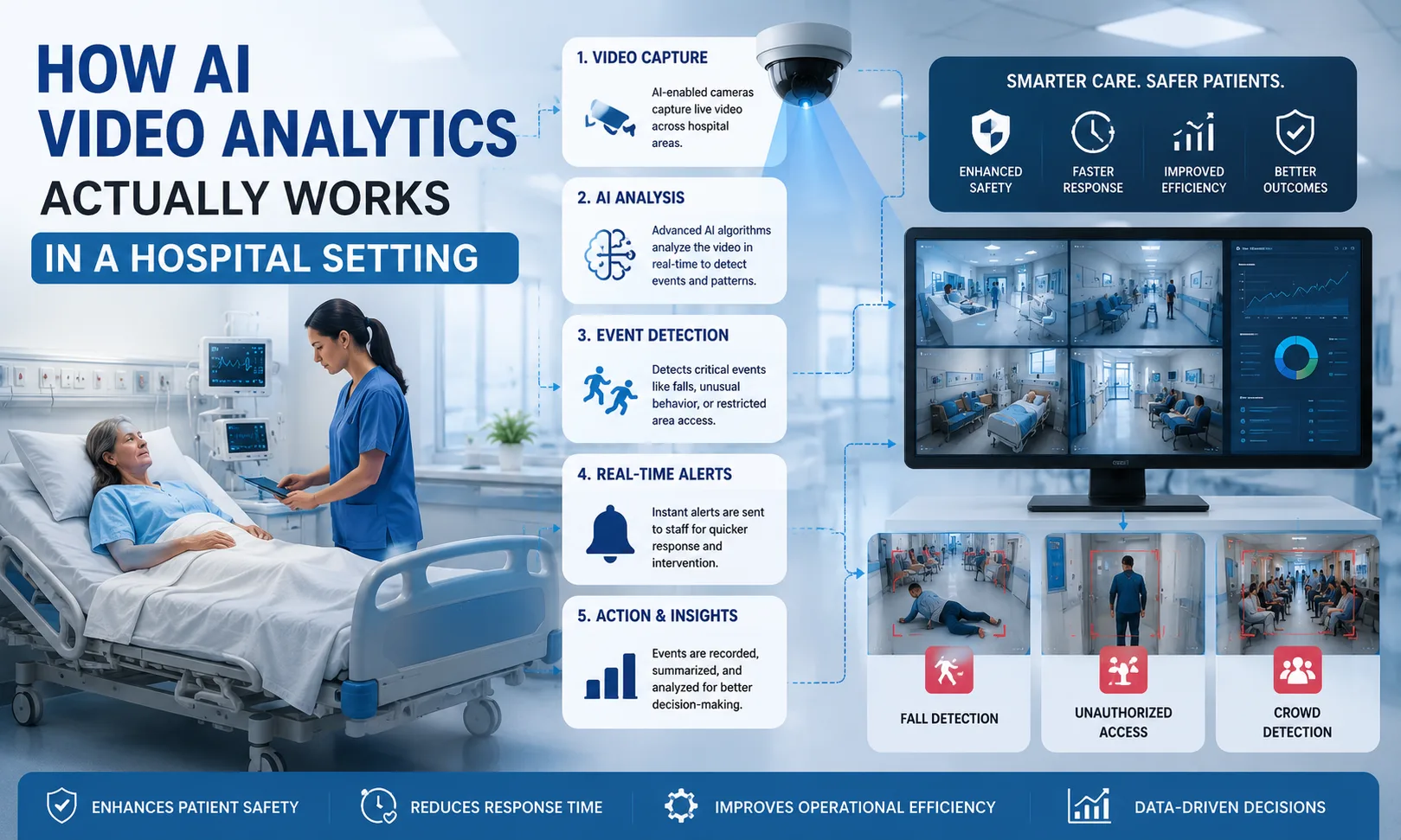
AI video analytics uses computer vision and machine learning to analyze camera feed in real-time. It does not rely on humans noticing anything unusual but rather performs pattern recognition, identifies behavior patterns, and notices abnormalities.
By implementing AI video analytics along with a cloud-based security system, you can further boost your security capabilities. Video footage will be processed and stored in the cloud, allowing hospital administrators to track multiple wards, floors, and even multiple hospitals from a single console without installing any costly equipment.
Here’s what that looks like in practice:
- Intrusion detection fires an alert the moment someone enters a restricted zone
- Face recognition identifies known individuals against a watchlist in real time
- Fire and smoke detection triggers 40–60 seconds before traditional heat sensors
- Unauthorized access alerts protect pharmacies, ICUs, and server rooms
- Patient movement tracking helps staff locate individuals in distress quickly
All of this happens automatically, 24/7, without human fatigue or distraction.
Key Benefits of AI Video Analytics for Hospital Patient Safety
Hospitals that upgrade to an AI-powered cloud security system experience measurable improvements not just in security, but in overall operations and patient outcomes.
- Faster Incident Response: Real-time alerts with timestamped video clips mean security teams arrive at the scene with full context, not just a vague “check camera 14.” Response times drop from minutes to seconds.
- Reduced Workplace Violence: AI can detect aggressive behavior patterns early, such as raised hands, sudden movements, crowd clustering near exits, and alert staff before a situation escalates. This protects both patients and healthcare workers.
- Wandering Patient Prevention: Patients with dementia or post-surgical confusion can be tracked across wards. The moment a patient crosses a defined boundary, an alert goes out immediately.
- Pharmacy and Drug Storage Protection: Controlled substance areas can be designated as restricted zones. Any unauthorized entry triggers an instant alert with a live video link, closing a major compliance gap.
- Hygiene Protocol Enforcement: AI can monitor whether staff are following PPE and handwashing protocols, a critical capability that became glaringly important during the pandemic era and remains vital today.
Real-Time Threat Detection: From Passive Cameras to Active Protection
One of the most critical problems faced by security managers in hospitals is that once an anomaly or threat is spotted on screen, it is often too late to take any effective action. An AI-driven cloud-based security system addresses that problem.
With VideoraIQ’s platform, designed specifically for industries such as healthcare, there are 9 AI engines running constantly that scan through the video being generated by every camera. Every alert comes with a video snippet as well as location and timestamps so that you can act with certainty.
In contrast to conventional CCTV systems that only capture video feeds, an AI-driven cloud security solution analyzes footage and generates alerts only when there is something to be alarmed about.
Protecting Restricted Zones: Pharmacies, ICUs, and Beyond
An extra layer of protection is demanded by hospitals because of the pharmacy stocked with controlled substances, ICUs where only authorized persons are entered, and server rooms that hold sensitive patient data. These aren’t just for security purposes and concerns; they are regulatory ones.
With AI-powered unauthorized access alerts, hospitals can define exactly which zones are restricted and who is permitted entry. The moment an unrecognized individual attempts access, the cloud security system triggers an instant alert automatically, without relying on a guard to notice.
This is where a cloud security camera system goes beyond traditional badge-based access control. Even if someone tailgates through a door with legitimate credentials, AI can flag the behavior based on visual anomalies and headcount mismatches. It’s a layer of protection that badge systems simply can’t provide.
Compliance and Privacy: Built-In, Not Bolted On
Hospitals operate under strict regulatory frameworks, such as HIPAA in the United States, and equivalent data privacy standards globally. Any surveillance system deployed in a healthcare setting must meet these standards, and that’s non-negotiable.
A modern cloud security system designed for healthcare handles this from day one. VideoraIQ, for example, is built with end-to-end encryption, role-based access controls, full audit trails, and HIPAA-aligned data practices. Patient identity anonymization is supported, ensuring that surveillance doesn’t compromise patient privacy.
This matters because many hospitals are still running legacy systems that weren’t designed with compliance in mind. Upgrading to a cloud system security framework means compliance is a feature, not an afterthought. Administrators get documented audit logs of who accessed footage, when, and why, something regulators and legal teams increasingly expect.
Read More :
VideoraIQ: The Smart Cloud Security System Built for Healthcare
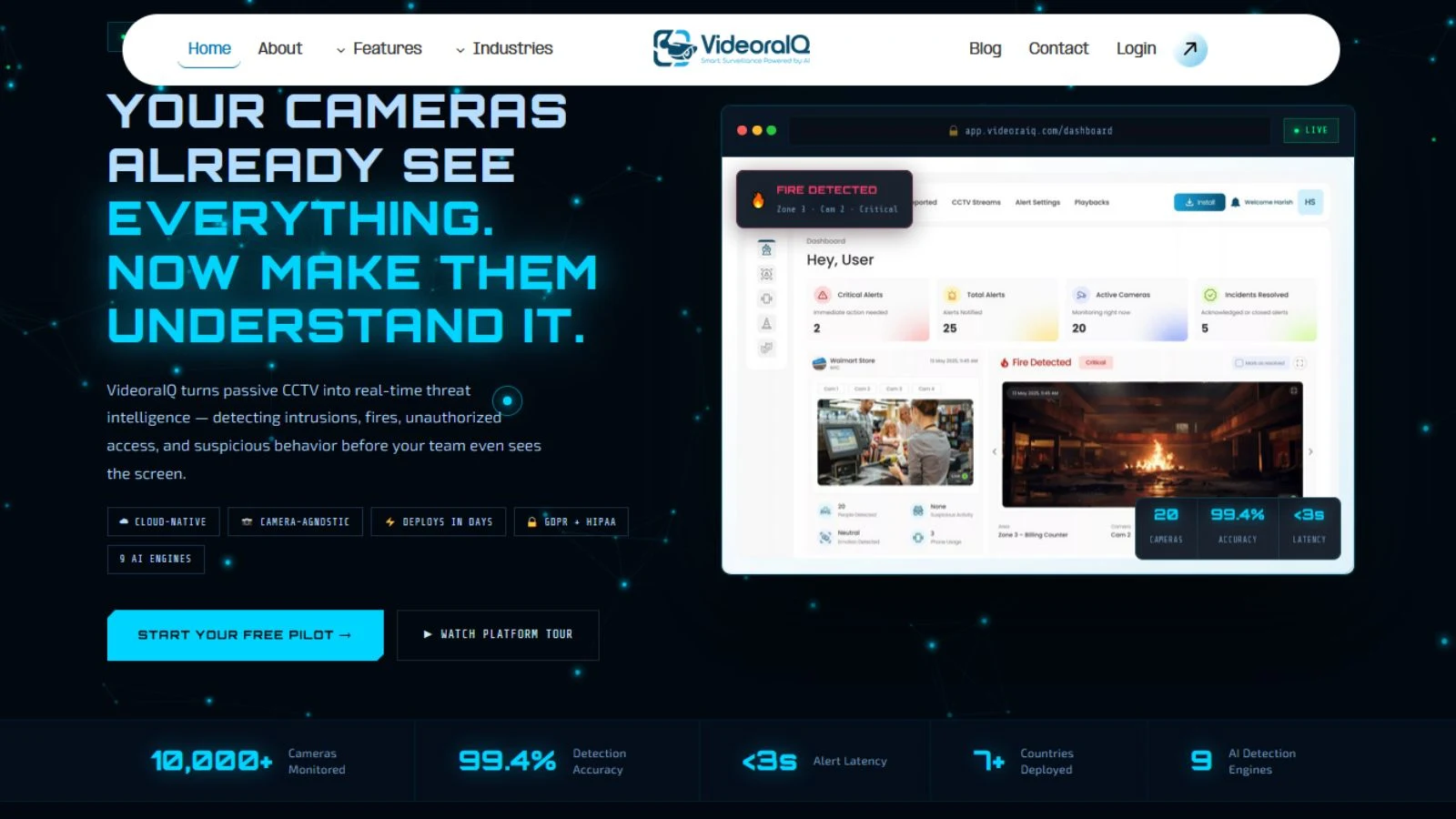
If your hospital is still relying on passive cameras and reactive security reviews, VideoraIQ is exactly what you need to close that gap.
VideoraIQ is an AI-powered cloud security system that connects to your existing cameras, Hikvision, Dahua, Axis, Bosch, and 200+ other brands, with zero hardware replacement required. It goes live in under 72 hours and immediately puts 9 AI detection engines to work across every connected feed.
Here’s what VideoraIQ brings to healthcare environments specifically:
- Real-time threat detection, violence, wandering patients, and unauthorized access are flagged instantly
- Staff and patient tracking: locate individuals in distress quickly across wards and critical care units
- Hygiene protocol monitoring: AI ensures PPE and handwashing compliance without manual checks
- Pharmacy and drug storage alerts: with instant notifications for any unauthorized access attempt
- HIPAA-aligned security: end-to-end encryption, audit trails, and identity anonymization built in
- Queue and flow management: monitor patient movement in waiting areas to reduce bottlenecks
- The multi-site dashboard: manages security across an entire hospital network from one centralized view
- Alerts with video proof: every notification includes a timestamped clip and camera location, delivered in under 3 seconds.
VideoraIQ doesn’t just monitor your hospital. It thinks, learns, and acts so your team can focus on care, not on watching screens.
Staff Safety: Protecting the People Who Protect Patients
Patient safety and staff safety are two sides of the same coin. Healthcare workers face some of the highest rates of workplace violence of any profession. And yet, most hospitals still rely on manual call buttons and post-incident reports to address the problem.
An AI-powered cloud security system changes this dynamic. By detecting early warning signs of aggressive behavior, such as agitated body language, raised voices, and, along with visual cues, such as sudden crowd gathering and aggressive language, the system alerts security teams before a situation becomes dangerous.
When staff know that every area of the hospital is actively monitored and that help can be dispatched in seconds, it changes the culture of safety. It also reduces liability. Documented, timestamped video of every incident means hospitals have clear records for investigations, insurance claims, and legal proceedings.
Fire and Smoke Detection: 40–60 Seconds That Save Lives
Traditional smoke and heat sensors are reactive. They wait until fire or heat reaches a detectable threshold, by which time the situation is already serious. In a hospital filled with patients who cannot self-evacuate, those extra seconds are critical.
AI-powered fire and smoke detection through a cloud security system identifies the visual signatures of fire and smoke up to 40–60 seconds before a traditional sensor triggers. The moment anomalies are detected, security teams and facility managers receive an alert with a live camera feed so they know exactly where to respond.
This isn’t a minor upgrade. For a hospital where mass evacuation is a logistical challenge, early warning is the difference between a contained incident and a catastrophe. Every second of advance notice saves lives.
Scalability: From Single Hospitals to Multi-Site Networks
One aspect of a cloud security system that isn’t talked about enough is its ability to scale. What starts as a small network of 20 cameras could easily scale up to 200. A healthcare organization may have the need to centrally monitor its many facilities across several cities.
An on-premise solution would struggle greatly to scale without upgrading the hardware in each individual location. Cloud security solutions scale effortlessly through scaling what exists in the cloud and adding additional cameras to the same dashboard.
This is a revolutionary cloud security system for hospital administrators running a multi-location network. Everything from the same view, one set of alerts, and one compliance model working from any browser or mobile application anywhere in the world. This is the power of a cloud security solution, and the reason why more and more healthcare organizations are leaving legacy technology behind.
Conclusion
AI-Powered video analytics is no longer a futuristic concept for hospitals. It’s a reality that can be deployed right now by hospitals. By converting cameras from static devices to smart devices, the cloud security system enables hospitals to gain the ability to monitor, secure, and react within seconds as opposed to hours. This is one of the aspects of a cloud security system that isn’t talked about enough: its ability to scale. Cameras are present. The only question now is whether they are thinking or just watching.
Frequently Asked Questions (FAQs)
Q: Can AI video analytics differentiate between a patient who is simply walking slowly and one who is experiencing a medical emergency or attempting to elope?
A: Yes, advanced AI systems analyze behavioral patterns, not just movement. A patient who is wandering erratically, crossing defined boundary zones, or moving toward exits during unusual hours triggers specific elopement alerts that are distinct from normal patient mobility. The AI learns zone-specific behavioral baselines and flags deviations from them.
Q: If a hospital already has a Cloud Video Security System from a legacy provider, does switching to an AI-powered platform require replacing all the cameras?
A: No. Modern AI-powered platforms like VideoraIQ are camera-agnostic and connect to existing IP cameras via RTSP protocol, supporting 200+ brands, including Hikvision, Dahua, and Axis. Hospitals retain their existing hardware investment entirely.
Q: How does a cloud security system handle HIPAA compliance when storing patient-area footage in the cloud?
A: Compliant platforms use end-to-end encryption, role-based access controls, full audit trails, and identity anonymization features to align with HIPAA requirements. Access to footage is logged, restricted by role, and auditable, ensuring patient privacy is protected even within a surveillance context.