


Somewhere around month four of a new deployment, a physical security director stops trusting the system. Not dramatically; no single incident triggers it. Operators start ignoring alerts. False positives accumulate. The analytics dashboard sits open in a browser tab that nobody refreshes. A six-figure investment becomes wallpaper.
This pattern repeats across retail chains, hospital campuses, and municipal transit authorities. Almost every time, the root cause is identical: the organisation bought its AI video analytics from the same vendor that sold it the cameras or the video management system.
That bundled decision is where it goes wrong.
Listen to the podcast!
Why Bundled Analytics Feels Logical at Procurement Time
The pitch from Genetec, Avigilon, and Milestone is coherent. Single-vendor accountability. Tighter hardware-software integration. Lower integration risk. Procurement teams love it. IT loves it. And in controlled demos on certified camera hardware, against the scenarios their models were trained on, the analytics modules from these vendors genuinely do work.
The problem surfaces in production.
VMS vendors build analytics as a feature attached to their core product, not as a primary engineering investment. Their models are trained on broad, generic datasets designed to function across thousands of camera models and dozens of deployment contexts. That generality is a commercial necessity for them. It is a technical liability for you.
When your deployment involves a covered parking structure with mixed lighting, a loading dock with constant forklift movement, or a stadium concourse during event transitions, a generic model drowns operators in noise. According to SNS Insider research via Yahoo Finance, the global video surveillance market is projected to grow from $59.92 billion in 2025 to $188.19 billion by 2035, and a meaningful share of that growth is organisations replacing or layering over bundled analytics that underdelivered.
Three Failure Modes Nobody Raises in Sales Calls
1. Model Rigidity at the Scene Level
Bundled analytics modules typically expose a fixed rule set: loitering detection, perimeter crossing, crowd density thresholds. What they rarely offer is the ability to retrain or fine-tune against your specific environment. Deploy crowd detection in an emergency waiting area and the model may flag seated patient clusters as anomalous gatherings constantly because stationary groups are normal there, and the model has no way to learn that. Threshold tuning helps marginally. The underlying model cannot be adapted to what your cameras actually see.
2. Alert Fatigue Cascades Into Liability
Operators who distrust alerts stop responding at the same speed. Our own analysis of key video analytics platform failure modes is direct on this: when a system flags irrelevant activity shadows, minor movements, pedestrians constantly outside a zone, security team movements, or ignores alerts entirely, it defeats the purpose of the system. In a security context, that latency is not just an operational drag. It is a liability exposure. Incident review footage showing an operator received an alert 90 seconds before an event and took no action is exactly the kind of record that ends up in litigation. The analytics failure gets reframed as a human-factors failure.
That reframing isn’t arbitrary. Guard fatigue from monitoring multiple screens simultaneously is a documented failure mode; missed events compound when operators are conditioned to dismiss noise.
3. The Integration Ceiling
Bundled analytics live inside the VMS ecosystem. Exporting structured intelligence event data, face match results, and behavioural flags to external SIEM platforms, access control systems, or enterprise dashboards usually requires proprietary connectors that are expensive, brittle, or simply unavailable. Organisations that want analytics flowing into a Splunk instance or a custom SOC dashboard hit that ceiling fast. Before any platform decision, buyers must verify compatibility with their existing VMS or IVMS software, a step the bundled-vendor pitch conveniently skips.
Read More!
Fire and Smoke Detection from CCTV: VideoraIQ vs Araani
Intrusion and Perimeter Breach Detection: 2026 Camera Guide
What a Purpose-Built AI Video Analytics Layer Actually Looks Like
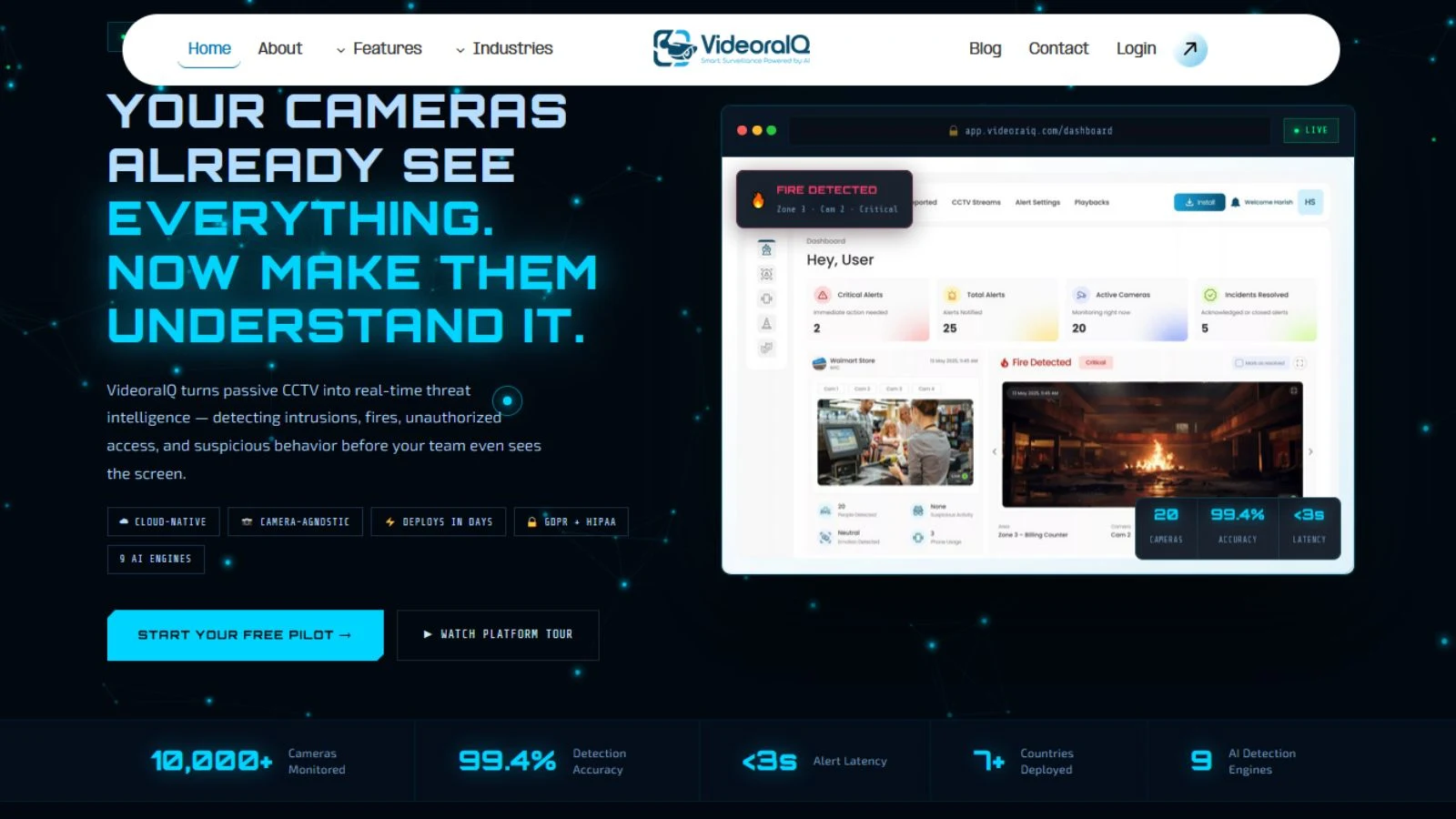
VideoraIQ is an AI video intelligence platform built to sit on top of existing camera infrastructure regardless of whether you run Genetec, Milestone, or a hybrid of VMS environments. That architecture is the distinction most buyers underweight at procurement time.
A dedicated analytics platform separates the inference layer from the video management layer. Your VMS does what it does well: recording, retention policy management, and operator interface. The analytics engine handles the hard computer-vision work object classification, behavioral pattern recognition and face authentication with models that can be tuned to your physical environment and your specific threat profile.
The practical difference shows up in specifics. Face Recognition matches live camera feeds against watchlists and flags unknown visitors in restricted zones in real time, generating automatic access logs. Intrusion Detection delivers an instant alert with a video clip, location tag, and timestamp the moment a defined zone is breached. Line-Cross Detection lets operators draw virtual tripwires directly on a camera feed no external configuration tool and triggers real-time alerts with video proof on any crossing event. These are not feature-list items. They are workflows an operator can actually use without routing around the system.
On accuracy: VideoraIQ reports 99.4% detection accuracy and alert latency under 3 seconds. The platform monitors more than 10,000 cameras across enterprise, banking, telecom, and healthcare environments in 7+ countries. Generic bundled modules do not publish equivalent figures because they cannot hold them consistently across heterogeneous environments.
The Evaluation Framework That Actually Works
Before recommending whether an organization should augment or replace bundled analytics, walk through four questions. These come from watching deployments succeed and fail not from vendor positioning documents.
What is your false-positive rate today, by camera zone? If you cannot answer this per-zone, your current system has no accountability mechanism. Purpose-built platforms surface this by default. Bundled systems often omit it entirely.
Can you retrain or fine-tune your current models against your own footage? Ask your VMS vendor directly. The answer will tell you everything about the ceiling of that system.
Where does the structured analytics output need to go? If the answer is anywhere outside the VMS interface a SIEM, an access control platform, a business intelligence tool map the integration path before contract signing, not after. As detailed in our video surveillance analytics software compliance guide, platforms handling biometric or sensitive data must provide encrypted storage, role-based access controls, configurable retention policies, and audit logging to satisfy GDPR, HIPAA, and CCPA requirements. Bundled modules frequently leave these as afterthoughts.
Who owns model performance SLAs in your contract?
Bundled analytics typically fall under general software support terms. Dedicated analytics vendors can be held to detection accuracy commitments. That contractual structure changes the vendor’s incentive to keep models current.
Where the Market Is Actually Heading
The AI video analytics space is fragmenting in a useful direction. The MarketsandMarkets intelligent video analytics forecast segments the market across deployment models and analytics types: video content analytics, facial recognition, crowd and behaviour detection, and automatic number-plate recognition. That segmentation reflects how buyers actually procure now: by specific use case, not by bundled module.
Smart city deployments are accelerating this unbundling. The InsightAce Analytic smart cities AI video analytics report points to multi-agency environments: transit, municipal security, and traffic management, where no single VMS vendor controls the full camera estate. In those deployments, a platform-agnostic analytics layer is not a preference. It is a technical requirement.
Avigilon and Genetec are not going away. For deployments with homogeneous hardware and genuinely limited analytics requirements, bundled solutions are defensible. The mistake is assuming they scale without a ceiling.
The Honest Trade-Off
Adding a dedicated AI video analytics layer does increase integration complexity at the outset. There is a middleware conversation to be had with your VMS vendor. API configurations. Stream mapping. A deployment team needs to connect camera feeds to the analytics platform.
That upfront friction is real. So is the alternative: a system your operators stop trusting by month four, a false-positive rate nobody is measuring, and analytics intelligence locked inside a VMS silo.
The organisations that get this right treat the analytics layer as a separate procurement decision from the VMS decision. They specify detection accuracy requirements, not just feature checklists, and they test against their own footage in their own environments before committing. The right evaluation is not a vendor demo of curated footage. It is a live parallel test on the environment you actually operate, comparing alert volumes and confirmed-event rates zone by zone.
If your current system generates alerts your team has learnt to ignore, that is not an operator problem. It is a model problem. And it is solvable, but not by tuning thresholds on a system that was never built for your context.
Start your free VideoraIQ trial and run your own footage against a purpose-built analytics layer before your operators make the decision for you by routing around the one you have.