

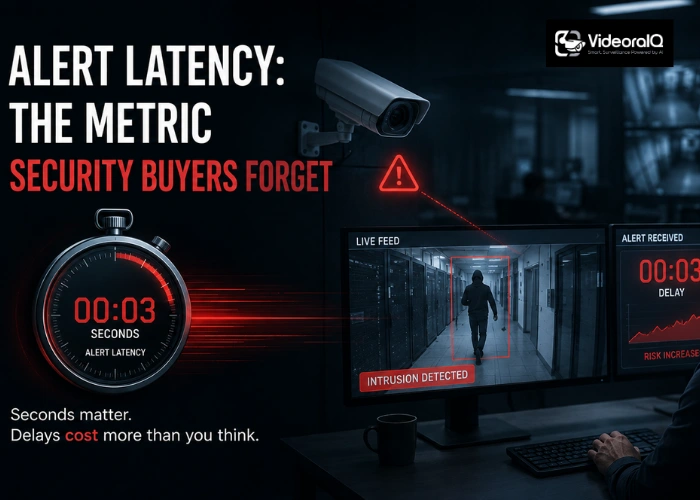
Forty-six per cent of every alert a security analyst touches turns out to be nothing. Not occasionally — every single shift, nearly half the workload. The Microsoft/Omdia State of the SOC 2026 report put that number in black and white, and anyone who has spent time on a security operations floor will tell you it feels even higher on bad days. The result is predictable: analysts start skimming. They develop a learned reflex for dismissal. And when a real event finally fires, it competes for attention against the same queue that cried wolf a hundred times before.
I have watched security teams evaluate video analytics platforms for years. They ask about detection accuracy first, almost every time. Accuracy is a reasonable question. But it is the wrong first question. The metric that actually determines whether a real threat gets a real response — on the ground, in the moment — is alert latency. How many seconds pass between a camera detecting something and a trained operator receiving actionable context? That number shapes everything downstream. And most buyers never ask for it.
Listen to this podcast!
Why Accuracy Alone Tells an Incomplete Story
A headline accuracy figure sounds reassuring until you think about what it means across a large camera estate. Run even a strong percentage against a platform monitoring thousands of feeds, and the residual false-positive volume is still enormous. The SANS 2025 survey found that 73% of security teams name false positives as their single biggest detection challenge — not breach complexity, not encryption, not attacker sophistication. Noise.
High accuracy matters. Nobody is arguing otherwise. But accuracy without speed compounds the noise problem rather than solving it. An alert that arrives forty seconds after an event, with no attached evidence, forces the operator to do investigative work before they can even judge whether the alert is worth pursuing. Under alert fatigue conditions, that friction is often enough to push the event to the bottom of the queue. By the time anyone reviews it, the relevant window has closed.
Contrast that with an alert that arrives in under three seconds, with a timestamped video clip and a precise location tag already attached. The operator does not need to pull footage. They do not need to cross-reference a floor map. They assess, decide, and dispatch — or dismiss — in one motion. The decision cost collapses.
What Three Seconds Actually Means in Practice
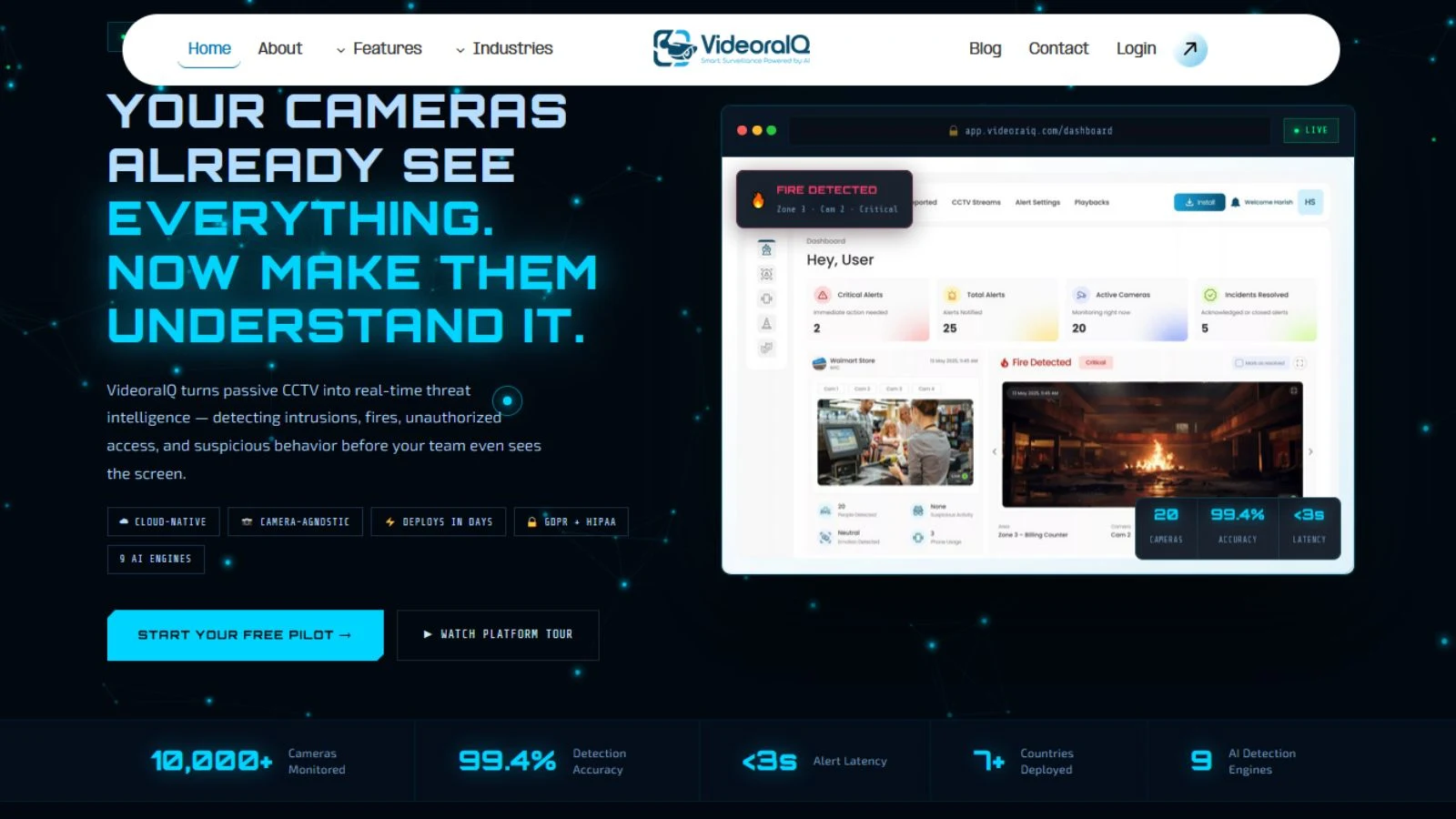
VideoraIQ publishes an alert latency figure of under three seconds from detection to notification. That number is worth sitting with. Three seconds is roughly the time it takes to read this sentence. In a manufacturing environment, an intruder entering a restricted zone demands an immediate interception, not an incident report filed afterwards. The same is true for a cashier station going vacant mid-shift, or a blacklisted vehicle rolling through a gate. Three seconds separates a response from a retrospective.
The platform’s Intrusion Detection module delivers each alert with an attached video clip, a location tag, and a timestamp — not as an afterthought, but as part of the alert structure itself. An operator receiving that package does not ask “where?” or “when?” Those questions are already answered. The cognitive load sits where it belongs: on the decision to respond, not the investigation preceding it.
The same design logic runs through every detection module. When the AI intrusion detection system flags a restricted-zone breach, the evidence travels with the notification. When Face Recognition matches a face against a watchlist, an access log is generated automatically — the record exists before any human intervenes. When Number Plate Recognition flags a blacklisted vehicle, the entry is timestamped and logged across all sites simultaneously. The platform monitors over 10,000 cameras with a stated detection accuracy of 99.4%, deployed across seven or more countries. At that scale, the architectural choice to embed context into every alert is not cosmetic. It is what keeps response rates viable.
The Operational Gaps That Latency Exposes
Alert latency matters most at the edges of a security workflow — the moments where the gap between event and awareness is widest. Three scenarios illustrate this clearly, all drawn from the verified workflows the platform supports.
Shift transitions on the floor. A cashier station goes vacant. Whether that reflects a break running long, an unauthorized departure, or something more serious depends on context that a floor manager cannot assess from a distance. VideoraIQ matches station vacancy against configured shift schedules and alerts floor managers in real time. The alert is not a raw motion flag; it is a structured notification tied to an operational rule. That distinction matters under alert fatigue — a rule-matched alert carries inherent credibility that a generic motion event does not.
Fire and smoke in low-sensor environments. Traditional heat sensors activate when ambient temperature crosses a threshold. That process takes time — often 40 to 60 seconds more than visual AI detection. The platform’s Fire & Smoke Detection module uses computer vision to identify the visual signature of smoke and flame before heat accumulates. Safety teams receive a live feed notification immediately. In a manufacturing environment where accelerants or combustible materials are present, that 40-second window is not a rounding error. It is the difference between an evacuation and an injury report.
Perimeter line-crossing in complex sites. Physical barriers cannot adapt to changing operational layouts. Virtual tripwires can. An operator draws a line on a camera feed — say, across a loading bay entrance. Then another around a server room perimeter. Another along a corridor restricted to certain hours. The Line-Cross Detection module monitors every boundary continuously from that point forward. When the line is crossed, the alert fires immediately. No guard rotation required. No physical infrastructure to modify. The boundary lives in software and updates in minutes.
Each of these scenarios shares a structural feature: the threat window is narrow, and the alert needs to arrive inside it. This is what makes latency the load-bearing metric. Accuracy determines whether the alert fires correctly. Latency determines whether the alert arrives in time to matter.
How to Evaluate Latency Before You Buy
Most vendors do not publish alert latency prominently, which means buyers need to ask directly and push for specifics. Vague language around “real-time” or “near-instant” detection is not a latency figure. Ask for the time between a triggering event and the moment a notification lands in the operator interface — end to end, not just the detection processing time on the server.
Then ask what travels with the alert. A bare notification that something happened somewhere on your camera estate is operationally close to useless. The follow-up investigation consumes exactly the time that fast detection was supposed to save. The alert payload — clip, location, timestamp, detection type — is the unit of operator productivity. Evaluate it as such.
Consider the compliance posture too. Platforms processing biometric data, particularly in face recognition workflows, must meet regulatory obligations that vary by region. VideoraIQ is GDPR and HIPAA compliant — a relevant baseline for any operator running the platform in healthcare environments, EU jurisdictions, or anywhere that personal data retention is regulated. This is not a feature to overlook during procurement; it is a condition of legal operation in an increasing number of markets.
Finally, think about coverage density. A platform running AI-driven detection across a handful of cameras can absorb some latency without operational consequence. At scale — across multi-site deployments, high-throughput access points, or facilities with continuous public movement — latency compounds. Every second of delay, replicated across hundreds of simultaneous events, represents a meaningful degradation in effective response capacity.
Read More!
Alert Latency: The Spec Security Buyers Never Check
Video Analytics Alert Speed: Why 3 Seconds Is the Line
The Market Is Growing. The Noise Problem Is Growing With It.
The global AI-powered video analytics market was valued at $5.63 billion in 2025 and is projected to reach $23.03 billion by 2034. More platforms, more cameras, more alerts. The State of AI in SecOps 2025 found that teams overwhelmed by alert noise respond by ignoring notifications and suppressing detections — a self-defeating cycle that leaves genuine threats unaddressed. The answer is not fewer detections. It is better-packaged detections that reach operators faster.
Accuracy sets the ceiling. Latency determines how close to that ceiling your real-world operation actually runs. Ask for both numbers. Verify both. Build your evaluation around both.
If you are re-examining your video analytics stack with that lens, start your free VideoraIQ trial and see what sub-three-second detection looks like across your site.