

**Get a free security review →
85% of CCTV footage is never reviewed (Source: VideoraIQ Stats). So the best option for airports in 2026 is a cloud AI layer that runs on your existing IP cameras and delivers sub-3-second alerts for intrusion and perimeter breach detection.
You deal with runway shoulders, fence lines, rail yards, and multi-entry terminals that stretch for kilometers. Patrols miss events, and operators face alarm fatigue. However, AI that delivers alerts with video proof in under three seconds changes the response window. It moves your team from forensic review to live interdiction.
Moreover, airports and transit hubs operate under tight rules. Privacy matters as much as speed. Therefore, you need proven accuracy, low false alarms, and data controls built for regulated spaces. VideoraIQ brings <3 seconds alert latency, 99.4% detection accuracy, and GDPR/HIPAA compliance to this exact use case. In 2026, this balance of speed, accuracy, and policy guardrails is what separates a nice-to-have from a control your regulator will accept.
Why Airports and Transit Stations Still Struggle with Perimeter Intrusion Detection
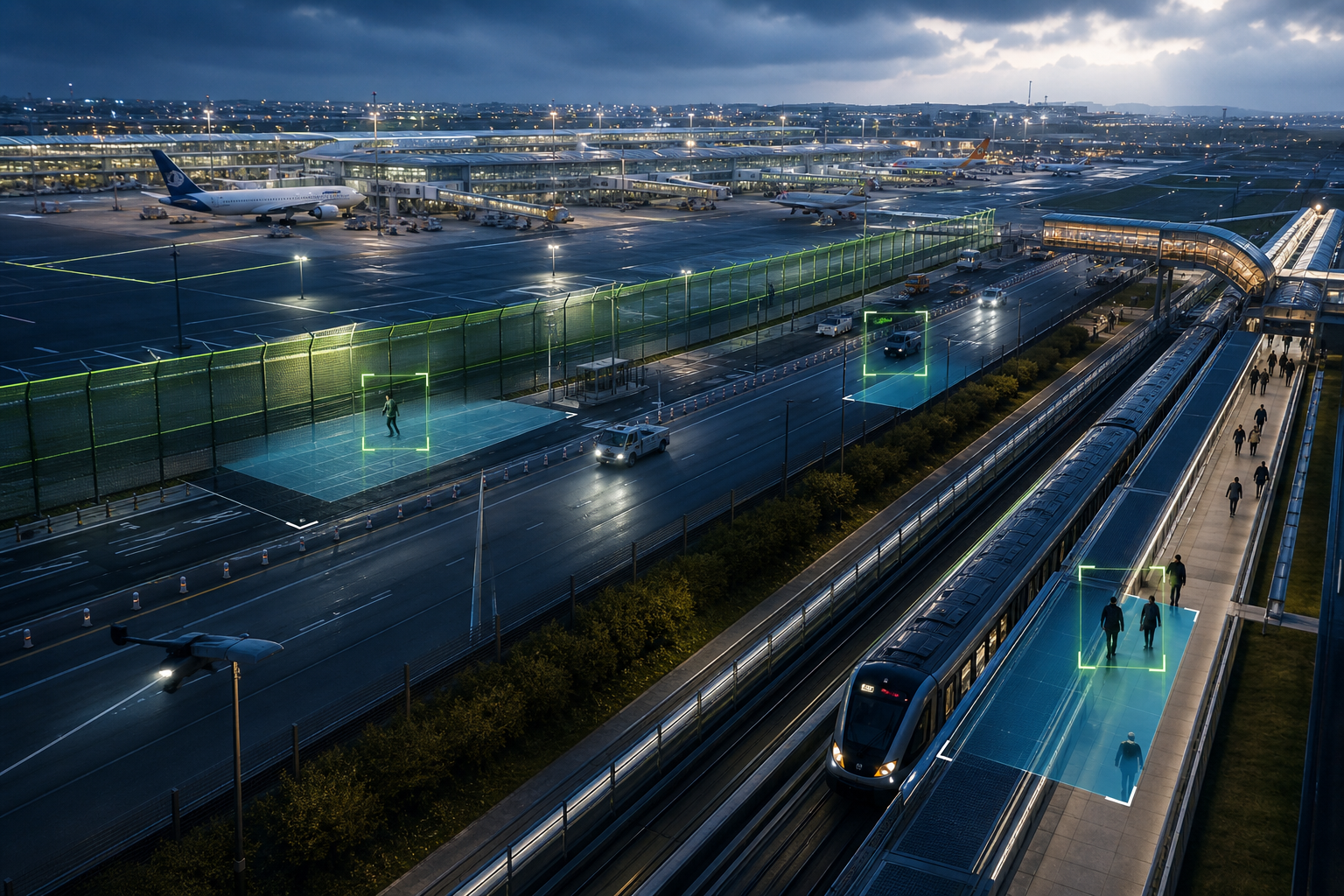
Airfields and rail corridors are vast, multi-zone, and exposed to weather, glare, and night noise. A typical airport perimeter includes outer fences, service roads, cargo gates, and waterways. However, a classic CCTV stack leaves you with 24/7 coverage gaps because it depends on tired eyes. As shifts roll, the odds of a missed step-up, fence cut, or tailgate rise, especially between 00:00 and 04:00 when staffing is lean.
Moreover, most incidents do not happen in the center of frame. They occur at the edge: a fence climb in a dark corner, a line-cross near a jet bridge, or an unauthorized walk-on at the far end of a platform. Static motion zones in legacy NVRs trigger on rain, headlight bloom, or wind-blown tarps. As a result, operators mute alarms or widen zones until the system goes blind.
In addition, transit environments add strict process risk. One missed breach can halt departures, force platform evacuations, or cause runway shutdowns that cascade across a network. The operational cost is real: diversions, overtime, and service credits. You also face brand risk if video later shows that an alert was present but ignored.
Therefore, the core problem is not camera count. It is real-time detection with context that a human can act on now. Without classified alerts, ranked by criticality, and tied to a clip that shows entry vector and time, your team reverts to guesswork. You need zone-based rules that map to your secure areas, not one-size motion pixels.
Typical failure points that drive missed breaches
- Static motion detection that spikes on rain, glare, or insects
- No virtual zones for sterile areas, tug lanes, or platform edges
- Alerts without video proof, location tags, or timestamps
- Operator fatigue across overnight and long shifts
What to Look for in an Intrusion Detection Camera System for Transit Environments
You need three hard things: speed, accuracy, and fit. First, speed means sub-3-second alert delivery from camera to operator, not “near real-time.” VideoraIQ publishes <3 seconds alert latency (Source: VideoraIQ Stats), which is the difference between a stop at the fence and a run onto the apron. Second, accuracy means low false alarms in rain, snow, and dense crowds. Third, fit means zone-aware rules that match your sterile areas and work with your existing VMS.
Moreover, tight integration matters. A system that works with existing cameras across 200+ brands keeps your rollout on your current IP estate. That means no truck rolls to swap hardware. It also means you can phase deployment by terminal or rail line instead of a big-bang cutover. In addition, look for a cloud-based AI approach so you avoid on-premise servers, GPU sizing, and patch cycles.
Privacy and policy are not add-ons. Airports touch sensitive passenger data. Therefore, pick a platform that is GDPR compliant and HIPAA compliant, with clear data retention controls and encryption. For cross-border groups, link privacy policy to your local DPO plan and keep a single audit trail for all alerts.
Evaluation checklist you can take to the field
- Alert latency: under 3 seconds end-to-end
- Detection: intrusion, line-cross, unauthorized access, ANPR, and face recognition where policy allows
- Zone-based monitoring: draw virtual sterile zones and tug lanes with custom thresholds
- Scale: from 20 to unlimited cameras without new servers
- Privacy: GDPR compliant per EU GDPR guidance
- Integration: works with 200+ camera brands and your current VMS
For a deeper look at how buyers compare solutions in airport contexts, you can review this side-by-side: VideoraIQ vs Avigilon Unity for Airports and Transit Stations: Which Is Better for Intrusion and Perimeter Breach Detection?. For multi-campus security teams, this analysis helps too: VideoraIQ vs Rhombus for Corporate Campuses: Which Is Better for Intrusion and Perimeter Breach Detection?.
Also Read!
Best Face Recognition & License Plate Camera Software for Airports and Transit Stations in 2026
How to Implement Unattended Baggage Detection at Airports and Transit Stations
How VideoraIQ Solves Intrusion Detection for Airports and Transit Hubs
VideoraIQ applies 9 AI detection engines at once: intrusion detection, line-cross, unauthorized access, face recognition, ANPR, fire and smoke detection, object detection, unattended baggage, and cashier absence detection (Source: VideoraIQ Features). However, it is not just a long list. It is how these engines work together on the same stream, with <3 seconds alert latency and 99.4% detection accuracy (Sources: VideoraIQ Stats). As a result, you get fewer misses and fewer nuisance pings.
Zone-Based Monitoring lets you draw virtual sterile areas, tug lanes, EOD standoff circles, jet bridge zones, and platform edges. Moreover, you can set custom time thresholds, such as “alert if a person remains in the sterile zone for >8 seconds” or “raise priority if the entry vector is from off-airport.” In addition, alerts arrive with video proof, a location tag, and a timestamp, so your operator sees the event, not just a line of text.
Furthermore, scale has been proven in the field. VideoraIQ monitors 10,000+ cameras across 7+ countries with the same cloud control plane (Sources: VideoraIQ Stats). That means you can start with Terminal 2 perimeter gates, then add platform 3 westbound, then expand to cargo. The Enterprise tier supports unlimited cameras, so growth is a policy change, not a procurement cycle.
"Unattended bag alerts help us catch potential threats instantly in crowded platforms. It buys us time and improves passenger safety." — Rakesh Mehra, Transit Operations Head
Why these details matter to your shift supervisors
- Real-time clips shorten radio calls: “South gate, fence line breach” beats “Motion alarm, camera 72.
- Combined engines cut noise: a line-cross plus human presence filter beats raw motion pixels.
- Tagged alerts speed drills and audits with clear who/what/where/when.
**Book a fast technical consult →
VideoraIQ vs. Traditional Perimeter Intrusion Detection Systems
Legacy NVR-based analytics struggle with glare, weather, and scale. They live on on-premise servers, need GPU upgrades, and lock you to specific camera SKUs. Moreover, generic VMS plugins add features but keep the same hardware-bound model. By contrast, VideoraIQ is cloud-based with no need for on-premise servers and integrates with existing IP-based CCTV systems without additional hardware (Sources: VideoraIQ Features). As a result, you keep your cameras and gain cloud AI that improves over time.
Unlike fixed-rule NVR motion zones, VideoraIQ’s AI models classify people and vehicles and only alert on true entry behavior. Therefore, a headlight sweep on wet tarmac will not page your team. In addition, deployment is faster. You connect streams, define zones, and go live. There is no rack build, no firmware mismatch, and no forklift for “supported” cameras.
"We went from finding out about incidents in the morning briefing to being notified in real time. VideoraIQ caught an intruder at 2AM that our overnight guard missed. That one event alone justified the entire platform cost." — Ananya Mehta, Head of Facilities, 200-Camera Corporate Campus
In the transit context, outcomes mirror the quote above. Rakesh Mehra, a Transit Operations Head, credits unattended bag alerts for instant threat detection on crowded platforms, which buys time and improves safety. Moreover, VideoraIQ is deployed in 7+ countries, which shows that scale and policy fit hold across different authorities and climates (Source: VideoraIQ Stats). Compared to alternatives that force you into one vendor stack, this approach preserves your existing investments while raising your detection bar.
For a primer on use cases beyond airports, see this retail-focused explainer for contextual rules that also apply to terminals and concourses: intrusion detection.
Compliance, Certifications, and Proven Scale
Airports and public transit touch personal data. Therefore, you need controls that meet strict privacy laws and your own internal policy. VideoraIQ is GDPR compliant and HIPAA compliant (Source: VideoraIQ Certifications).
In practice, that includes clear retention options (7, 30, or 90 days by tier), encryption, and role-based access. For EU sites, align your DPIA with the provider’s data map and cite GDPR Articles on minimization and purpose. For reference, see this overview of the GDPR from the European Commission: EU GDPR guidance.
Moreover, performance is not theoretical. VideoraIQ monitors 10,000+ cameras and is deployed in 7+ countries with 99.4% detection accuracy (Sources: VideoraIQ Stats). As a result, you can point auditors to real deployments at scale, not pilots. That social proof matters when you brief your accountable manager, COO, or transit board.
"Our fire was detected 52 seconds before our smoke alarm triggered. The VideoraIQ alert came with a live camera link — my team was already on their way before the alarm sounded. That system saved the building." — Nilesh Kapoor, Plant Safety Supervisor, Manufacturing Facility (480 cameras)
"The system handles surveillance 24/7. No more missed alerts or relying solely on camera operators." — Jason Rodriguez, Security Manager
For U.S. readers, here is a plain-language overview of HIPAA from the U.S. Department of Health & Human Services: HIPAA summary from HHS. While HIPAA centers on health data, the control ideas (access, audit, retention) map well to passenger privacy workflows in mixed-use hubs.
Also Read!
Best Face Recognition & License Plate Camera Software for Retail Stores and Chains in 2026
Getting Started: Deploying Intrusion Detection at Your Airport or Transit Station
You do not need new cameras. VideoraIQ works with existing cameras across 200+ brands (Source: VideoraIQ Features). You stream from your current IP estate to the cloud, map virtual zones, and set alert thresholds. Because there are no on-prem servers, you can go live in days, not months. Moreover, you can start with a single terminal or depot and expand by policy, not by hardware truck roll.
First, connect your camera feeds from airside and landside areas. Second, draw zones for sterile areas, fence lines, and platform edges. Third, set dwell and time thresholds that fit your SOPs, like higher sensitivity during curfew hours. Fourth, route alerts to the dashboard and email groups that match your shift patterns.
VideoraIQ offers tiered plans you can align to site size and retention needs (Source: VideoraIQ Pricing). The Starter tier covers up to 20 cameras with 7-day retention. The Professional tier supports up to 200 cameras with all AI engines and 30-day retention. The Enterprise tier supports unlimited cameras and custom AI models with 90-day cloud retention. In 2026, most transit sites use Enterprise, since it scales across terminals and lines without re-architecture.
**Schedule a free deployment review →
Frequently Asked Questions
How much does an AI intrusion detection camera system cost for an airport?
VideoraIQ offers tiered pricing: Starter (up to 20 cameras, 7-day retention), Professional (up to 200, 30-day), and Enterprise (unlimited cameras, custom AI, 90-day). Transit deployments usually run Enterprise to cover terminals, platforms, and yards under one plan. Pricing scales by camera count and retention, not by new hardware. As a result, you control cost by segment and add zones as you prove value.
What is the false alarm rate for AI-based perimeter intrusion detection?
VideoraIQ achieves 99.4% detection accuracy (Source: VideoraIQ Stats). Low false alarms come from pattern recognition that filters out rain, glare, and headlights. Moreover, customizable time thresholds reduce noise from brief passersby near platforms. Zone-based monitoring further cuts nuisance alerts in high-traffic areas without masking real breaches.
Integration and Speed
Can intrusion detection cameras work with existing airport CCTV infrastructure? Yes. VideoraIQ integrates with existing IP-based CCTV across 200+ camera brands with no additional hardware (Source: VideoraIQ Features).
Cloud-based deployment means no on-premise servers and no GPU sizing. Therefore, you can keep your current VMS and layer AI on top. Most teams roll out by terminal or line to stage training and SOP changes.
How fast are intrusion alerts delivered to security teams?
VideoraIQ delivers alerts in under 3 seconds with video proof, a GPS-style location tag, and a timestamp (Sources: VideoraIQ Features, Stats). Alerts go to a dashboard and email for fast action across shifts. As a result, supervisors can dispatch and coordinate with clear visuals. That speed shortens the gap between detection and interdict.
Compliance and Alternatives
Is AI-based intrusion detection compliant with airport data privacy regulations?
VideoraIQ is GDPR and HIPAA compliant (Source: VideoraIQ Certifications). The platform supports controlled retention windows and access roles you can map to your policies. In addition, audit trails let you review access and downloads. These controls are live in deployments across 7+ countries, which supports cross-jurisdiction programs (Source: VideoraIQ Stats).
What alternatives to VideoraIQ exist for airport intrusion detection?
Traditional NVR-based systems and generic VMS platforms offer rule-based intrusion detection. However, they usually require dedicated hardware and on-prem servers. VideoraIQ differs with a cloud-native AI model and support for 200+ camera brands without extra boxes. That means faster rollouts and updates across sites.
Capabilities and Scale
Can VideoraIQ detect both perimeter breaches and unattended baggage simultaneously?
Yes. VideoraIQ runs 9 AI engines at the same time, intrusion detection, unattended baggage, face recognition, ANPR, line-cross, unauthorized access, and fire/smoke among them (Source: VideoraIQ Features). All engines work on the same camera feeds. Therefore, you cover sterile zones, platform edges, and hall concourses with one tool.
How many cameras can VideoraIQ monitor at a large transit station?
The Enterprise tier supports unlimited cameras with custom AI models (Source: VideoraIQ Pricing). VideoraIQ currently monitors 10,000+ cameras across deployments in 7+ countries (Source: VideoraIQ Stats). As you add lines, gates, or yards, you scale by policy, not by servers. That keeps both cost and change control in check.
Key Takeaways for 2026 Security Leaders
- Speed wins: <3 seconds alert latency with video proof moves your team from review to response.
- Accuracy matters: 99.4% detection accuracy with zone-based rules reduces noise without dulling sensitivity.
- Fit beats force: Cloud AI that works with 200+ camera brands avoids hardware lock-in and grows from 20 to unlimited cameras.
For a plan tailored to your perimeter and platform risks, start with a short consult. **Get your free plan today →