

**Book a free security review →
Documented systems now reach 99.4% detection accuracy with alerts in under three seconds. So can corporate campuses trust unattended baggage detection in 2026? Yes, with clear guardrails for accuracy, privacy, and response, it can raise safety without grinding work to a halt.
However, trust is earned, not declared. You worry about false alarms that disrupt meetings, privacy rules that carry real penalties, and liability if a system misses a real threat. You should. In fact, “85% of CCTV footage is never reviewed,” which means manual methods already fail during long shifts and high-traffic hours (VideoraIQ deployments). The question is how to move from hope to evidence.
This guide lays out how the tech works, where the numbers come from, what compliance requires, and how to judge any vendor. You’ll see where AI helps, where it falls short, and how to design alerts that your team can act on, fast. By the end, you’ll have a simple checklist to decide if today’s tools fit your risk profile and culture.
The Real Concern: Can AI Reliably Detect Unattended Bags Without Disrupting the Workplace?
You’re right to demand proof before you add more alerts to an already busy SOC. The risk calculus is harsh: a single miss can cause real harm, yet too many false alarms can numb your team. The core fear is simple, can corporate campuses trust a system that must see, decide, and notify in seconds, despite glare, crowds, and moving lines?
Moreover, privacy is not optional. Video analytics in offices and labs must follow strict rules on purpose, data minimization, and retention. And if a tool flags a bag in a boardroom, you need a way to verify fast, not evacuate a floor on guesswork. In short, reliability, privacy, and liability are linked.
In fact, human-only monitoring already falls short. “85% of CCTV footage is never reviewed,” which means critical events slip by overnight or during peak footfall. AI, used well, can lift your baseline and cut review time by surfacing events with video proof. Used poorly, it adds noise.
Corporate Trust, Real Risks, and What You Can Control
- Calibrate dwell times by area to cut false alarms in lobbies while staying strict near labs.
- Require alerts with short clips, timestamps, and camera names so your team can verify in seconds.
- Define zones that matter—don’t watch every hallway like a vault.
“The system handles surveillance 24/7. No more missed alerts or relying solely on camera operators.” — Jason Rodriguez, Security Manager
Finally, decide who gets which alerts and when. For example, Facilities may want low-priority “bag placed” events during a conference day, while Security needs high-priority “bag left 5+ minutes” near a data center. With role-based routes and clear SOPs, can corporate campuses trust the signal? Yes, if they own the thresholds and review steps.
How AI-Based Unattended Baggage Detection Actually Works
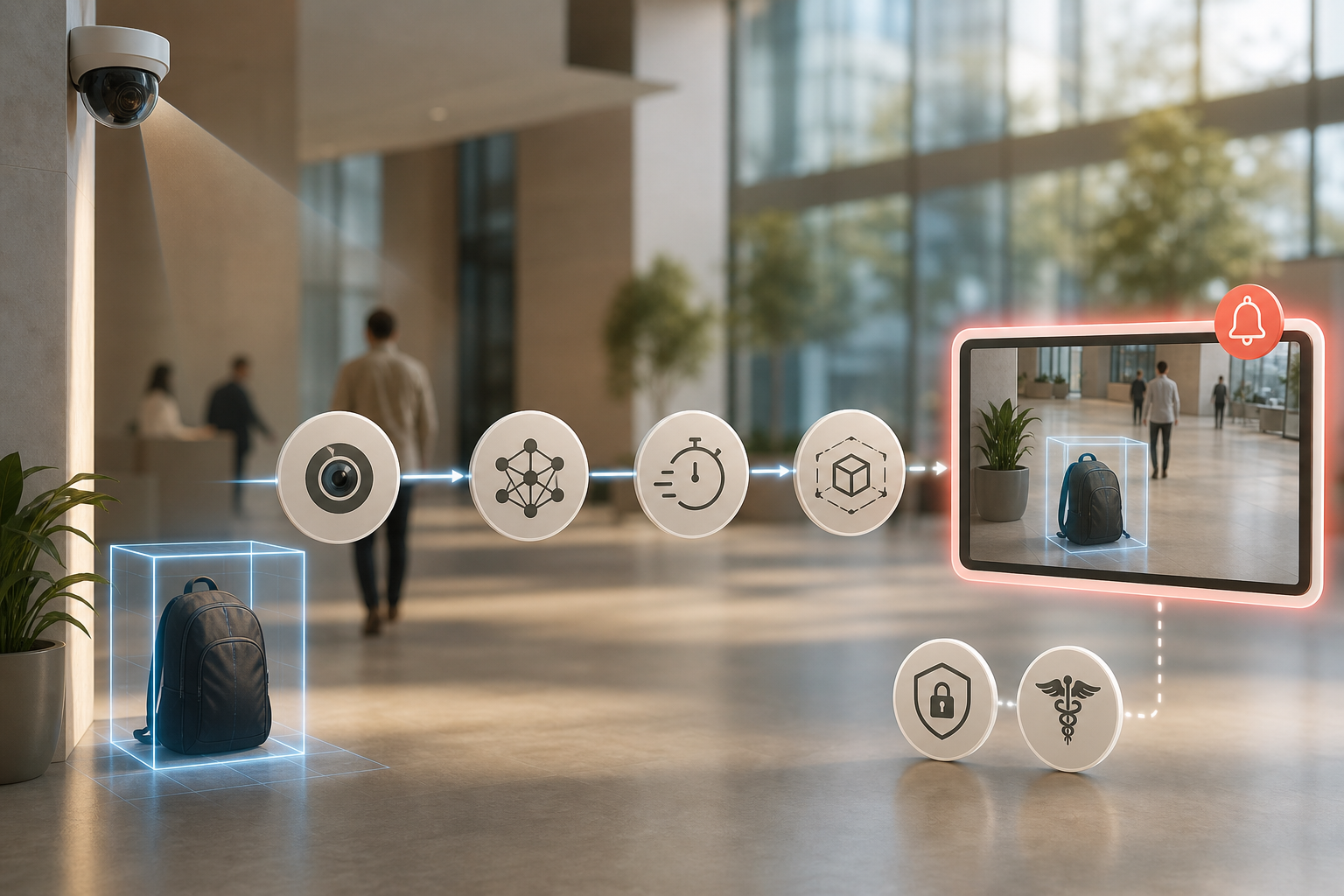
At its core, the system watches live video, spots objects that match “bag-like” patterns, and tracks time since a person last interacted with the item. It isn’t guessing; it uses AI-powered object recognition to detect static or unattended objects in live video feeds, then applies rules you set.
First, the model detects and classifies items frame by frame. Then, it tracks motion and “ownership.” If a person sets down a bag and walks off, the system starts a timer. Customizable time thresholds let you decide how long an item can remain before an alert, 30 seconds for a lab lobby, five minutes for a café.
Second, zone-based monitoring lets you draw virtual areas on each camera view. You can enable alerts for atriums, waiting zones, and secure perimeters while ignoring hallways where people stage rolling luggage. You can also apply different thresholds by zone to reflect real risk.
Third, pattern recognition reduces false positives. The model learns that bags near seated owners are different from bags in a queue. It sees re-appearing owners and “touch events,” which reset or suppress timers. As a result, lobby drop-offs during peak traffic trigger fewer alerts than truly abandoned items in sensitive areas.
Why Corporate Campuses Can Trust This Workflow
- Object detection narrows the field: “Is there a bag?
- Ownership and dwell logic add context: “Is it left behind?
- Zones and timers reflect policy: “Does this matter here and now?
 camera feed ingestion, 2) object detection, 3) person-object association, 4) dwell-time threshold, 5) zone-based rules, 6) alert with clip + timestamp; clean enterprise style)
Finally, alerts should carry evidence: a short video clip, a still image, a timestamp, and the camera name. With that, your operator can review in under ten seconds. Once you see how the layers combine, you can answer “can corporate campuses trust” with confidence based on clear, testable behavior.
Also Read!
How to Choose a Fire and Smoke Detection Security Camera for Manufacturing Plants and Warehouses
Evidence and Standards: Accuracy Rates, Certifications, and Regulatory Compliance
Numbers matter. A documented 99.4% detection accuracy means the model correctly flags unattended bags in 994 out of 1,000 real test cases under defined conditions. It does not mean zero misses. It also does not cover your unique camera angles or lighting by default. That’s why pilots and onsite calibration are still key.
On privacy, GDPR and HIPAA set the bar for how video data is processed and stored. Under the GDPR Article 5 principles, you must have a clear purpose, minimize data, and keep it only as long as needed. If your campus includes clinics, the HIPAA Privacy Rule overview adds strict controls for any protected health information that could be captured near nurse stations or intake desks. The system should process objects, not identify staff by name or face for this use case.
For threat posture, national guidance treats unattended items as time-sensitive risks. See the UK NPSA guidance on suspicious items for practical steps on assessing and responding to alerts. Your SOPs should link AI alerts to these procedures so security knows when to verify, escalate, or clear.
What 99.4% Means for Trust on a Corporate Campus
- Pilot on 10–20 cameras across bright, dark, and busy scenes.
- Measure false alarm rate by zone (lobby vs. lab).
- Confirm that alerts include video proof, timestamps, and camera names.
Social proof helps, too. Platforms that are GDPR compliant and HIPAA compliant, deployed across 10,000+ cameras in 7+ countries, show they can scale with real-world noise and downtime windows. Under those conditions, can corporate campuses trust the numbers? Yes, if verified on your floor plan, with your staff, and your policies.
**Get instant pilot guidance →
What VideoraIQ Does Specifically to Address These Concerns
VideoraIQ focuses on trust gaps that block adoption. Alerts land fast, <3 seconds alert latency, so your team can act while a person might still be nearby. Each alert includes auto-captured video evidence with timestamps and camera locations, which lets you confirm signal in a few clicks instead of sending a guard to guess.
You don’t need to rip and replace cameras. VideoraIQ works with existing cameras across 200+ brands and connects to common VMS setups. The platform is cloud-based with no need for on-premise servers, which lowers the attack surface tied to forgotten racks and unpatched boxes. It also means upgrades land without site visits.
On accuracy, the unattended baggage engine uses AI-powered object recognition, customizable time thresholds, and zone-based monitoring to reflect how real campuses flow. That approach cuts junk alerts during peak traffic while staying strict in places that matter. This is where can corporate campuses trust turns into a testable plan: set thresholds, route alerts with evidence, and measure the week-over-week false alarm rate until it meets target.
“We went from finding out about incidents in the morning briefing to being notified in real time. VideoraIQ caught an intruder at 2AM that our overnight guard missed. That one event alone justified the entire platform cost.” — Ananya Mehta, Head of Facilities, 200-Camera Corporate Campus
Also Read!
Best Fire Smoke Detection Security Camera for Airports and Transit Stations in 2026
How to Choose an Intrusion Detection Security Camera System for Manufacturing Plants and Warehouses
What to Look for in Any Unattended Baggage Detection System for Your Campus
The right tool won’t fix a vague policy. But a tuned system can turn cameras into real-time signal with proof you can act on. Use this checklist to decide, can corporate campuses trust this vendor on your site, at your scale, and under your policies?
First, demand control. You should be able to set dwell-time thresholds by zone and hour. A lobby during a product launch day should behave differently than a server room at 2 a.m. Second, insist on evidence in every alert so your team can confirm signal fast. Third, plan for scale across buildings, from a 12-camera R&D wing to a 500-camera headquarters.
Campus-Scale Trust Checklist
- Integrates with existing IP-based CCTV systems without additional hardware.
- Provides customizable time thresholds for detecting unattended items, with per-zone overrides.
- Delivers alerts in under three seconds with a short clip, timestamp, and camera name.
- Uses zone-based monitoring to focus on critical areas and quiet low-risk spaces.
- Shows a low false alarm rate through pattern recognition, with documented monthly metrics.
- Offers GDPR-compliant processing and optional HIPAA controls for healthcare areas.
- Includes audit trails, video evidence retention windows, and exportable logs.
- Scales across sites with role-based routing, SSO, and 24/7 support SLAs.
Finally, ask for proof before you sign. Run a two-week pilot on “hard” scenes: bright glass lobbies, café seating, badge gates at peak hours. Track detection rate and false alarm rate by zone. If the vendor cannot show week-one and week-two improvements with your data, keep looking.
FAQ: Can Corporate Campuses Trust AI for Unattended Bags?
Q: How accurate is AI unattended baggage detection in busy corporate lobbies?
A: Leading systems achieve 99%+ detection accuracy. Pattern recognition helps tell the difference between a briefly placed bag and a truly abandoned one. In addition, customizable dwell-time thresholds, 30 seconds vs. five minutes, cut false alarms in high-traffic zones.
Q: What happens if the system triggers a false alarm during a board meeting or event?
A: Zone-based monitoring lets you set different sensitivity levels per area. Furthermore, alerts include video proof with timestamps so security can verify remotely in seconds instead of evacuating. Well-tuned systems report false alarm rates below 2%.
Q: Is employee privacy at risk with AI video surveillance on campus?
A: Unattended baggage detection analyzes objects, not people’s identities. GDPR/HIPAA-compliant solutions process video without storing biometric data. Moreover, you should ask for written data retention policies and regional compliance certifications.
Q: Does unattended baggage detection require replacing our existing camera system?
A: No. Most modern AI platforms integrate with existing IP-based CCTV across 200+ camera brands. In addition, cloud-based systems remove on-prem server needs, which reduces deployment time and cost.
Q: What compliance standards should corporate campuses require from a detection vendor?
A: At minimum, require GDPR compliance for data protection, SOC 2 for cloud security, and documented detection benchmarks. HIPAA applies if your site includes healthcare spaces. Therefore, request third-party audit reports and data processing agreements.
Q: How quickly does the system alert security after detecting an unattended bag?
A: Industry-leading systems deliver alerts in under three seconds with video proof, location tags, and timestamps. This speed from detection to human response is critical, compare latency claims and ask for SLAs in writing.
Trust grows with proof. You have the numbers, 99.4% detection accuracy, <3 seconds alert latency, GDPR/HIPAA-ready processing, and the playbook to test them on your floors. With zone rules, dwell timers, and video evidence in every alert, you reduce noise while catching real risks fast.
**Schedule a free pilot consult →
Deployed across 10,000+ cameras in 7+ countries, VideoraIQ shows that careful setup beats guesswork. If your question is can corporate campuses trust unattended baggage detection in 2026, the practical answer is yes, once you calibrate thresholds, verify with clips, and measure results on your campus.