

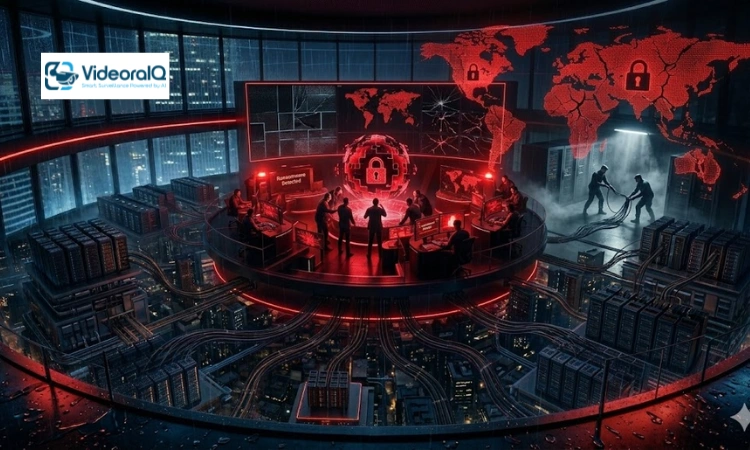
Security used to be simpler, at least conceptually. You protected your servers, locked your server room, and called it a day. That world is gone. Modern enterprises now operate across cloud environments, remote offices, IoT devices, contractor networks, and physical facilities that constantly interact with each other, creating new vulnerabilities at every intersection.
As a result, enterprise IT security in 2026 is no longer a single discipline. It has evolved into a layered security ecosystem where digital threats and physical risks overlap continuously, and where the gaps between the two are often the exact points attackers exploit.
What Enterprise IT Security Looks Like in 2026

Enterprise IT security today is far more complex than traditional network protection. The old approach of securing a single office network is no longer enough. Modern organizations must manage security across cloud infrastructure, connected devices, remote work environments, third-party access, and physical facilities simultaneously.
Cloud is the standard
Most companies now run systems in the cloud, on-premise setups, and hybrid environments. This spreads data across many places, which makes enterprise IT security more complex. Security teams must protect information wherever it lives.
There is no clear perimeter anymore
The old network “wall” is gone. In enterprise IT security, every device can be a potential entry point. This includes laptops, phones, sensors, and cameras. Because of this, enterprise IT security must monitor everything, all the time.
Tools are unified and automated
Modern enterprise IT security uses connected platforms instead of separate tools. These systems bring security data together in one place. They also use automation and AI to detect threats faster and respond before damage spreads.
The Overlap Between Digital Security and Physical Security

In many organizations, digital security and physical security are still handled separately. They often have different budgets, different teams, and different reporting structures. This separation creates real risk.
Today, the two are deeply connected. Access control systems are often connected to networks. Surveillance systems feed into enterprise dashboards. Building systems like HVAC often run on the same networks as business applications.
This means a stolen password from a phishing attack could be used to unlock a door. A poorly secured camera system could expose sensitive parts of the network. The line between IT security and physical security is not technical anymore. It is just how companies are organized.
Organizations that treat both areas as one system are better at closing gaps that isolated teams often miss.
Key Security Risks Enterprises Must Address
Cybersecurity Risks
Ransomware is still one of the most damaging threats to enterprises. Attackers often stay inside systems for weeks or even months before launching an attack. During this time, they map systems, steal data, and disable backups.
Phishing and stolen credentials are still the most common way attackers get in. Cloud misconfigurations can expose sensitive data without any advanced hacking. Weak or unpatched endpoints, especially remote devices, also remain a major risk
Physical Security Risks
Physical security risks can cause direct damage. These include theft of equipment, tampering with data centers, and loss of intellectual property.
Gaps in surveillance coverage or outdated systems make it harder to detect incidents or investigate them later. Another major risk comes from insiders. Employees or contractors with access to buildings can cause serious harm if they misuse their access
Combined Risks
Some of the most serious threats combine both physical and digital access.
Attackers may use stolen credentials to enter a building and then access internal systems directly. Network-connected devices like cameras, sensors, and building controls can also be used as entry points into IT systems.
Social engineering attacks can also mix both worlds, combining digital deception with physical access attempts.
These risks are often overlooked because most security teams are still split between physical security and IT security.
Role of Surveillance Systems in Enterprise Security
CCTV and video monitoring have evolved well beyond their original purpose. In a modern enterprise security context, surveillance systems contribute to real-time situational awareness, support incident investigation, and provide documentation for compliance audits.
Integrated with broader security dashboards, surveillance feeds become active data sources — not passive recordings reviewed after the fact. When a door access event triggers an alert, correlated video from that location gives security teams immediate context. When an anomaly appears in network traffic originating from a specific facility, physical monitoring data helps determine whether a physical security event is connected.
This integration transforms surveillance from a reactive tool into a genuine component of proactive enterprise IT security solutions. The value isn’t just in recording what happened — it’s in helping security operations respond to what’s happening now.
Importance of Integrated Security Systems
Centralized Security Operations Centers represent the current best practice for enterprises serious about unified visibility. A well-constructed SOC pulls together network logs, identity and access management data, endpoint telemetry, physical access control events, and surveillance feeds into a single operational picture.
That integration matters because threats don’t announce which system they’ll appear in first. Faster detection depends on correlation across data sources. An alert that looks minor in isolation, an unusual login time, or an access attempt from an unfamiliar device, can look very different when mapped against physical access logs from the same time window.
Enterprise IT security solutions built on integrated architectures respond faster, investigate more effectively, and produce fewer false positives than those operating in silos. The operational cost of disconnected systems is not just inefficiency; it’s blind spots that sophisticated attackers actively exploit.
Best Practices for Enterprise IT Security in 2026

Zero Trust architecture has moved from framework to operational standard. The principle verify every user and device, every time, regardless of network location, directly addresses the reality of distributed, hybrid environments where “inside the network” no longer means “trusted.”
Strong authentication and identity management are foundational. Multifactor authentication, privileged access management, and continuous identity verification reduce the impact of credential compromise dramatically.
Regular security audits across both IT and physical systems surface vulnerabilities before attackers find them. This includes penetration testing of digital infrastructure and physical security assessments of facilities, access controls, and surveillance coverage.
Secure deployment and maintenance of surveillance and IoT devices deserve specific attention. These devices are frequently deployed with default credentials, left unpatched, and forgotten on network segments with excessive access. They represent a growing portion of the enterprise attack surface.
Continuous employee security awareness training remains one of the highest-return investments in the security stack. Technology controls are effective — until a user clicks the wrong link. Training reduces that risk and builds a security-conscious culture that supports the entire program.
The Future of Enterprise Security Systems
AI-powered predictive threat detection is advancing from reactive analysis to genuine anticipation, identifying behavioral patterns that precede attacks before the attack itself materializes. Automated incident response is reducing containment time from hours to minutes in organizations with mature implementations.
The clearest trajectory is toward fully integrated physical and digital security ecosystems. Smarter analytics will combine surveillance data, network telemetry, and behavioral intelligence into unified threat models. The distinction between “IT security” and “physical security” will become increasingly difficult to maintain and increasingly counterproductive to attempt.
Enterprise security solutions in the coming years will be evaluated not just on what they protect, but on how completely they integrate across an organization’s entire operational environment.
Also read
6 Secrets You Need To Consider Before Surveillance Camera Installation
How to Select the Ultimate Home Surveillance Cameras for Your House
How VideoraIQ Supports Modern Enterprise Security
VideoraIQ is an AI-powered video analytics solution designed to work with existing CCTV camera systems, helping organizations upgrade traditional surveillance into a smarter and more responsive security operation. Instead of replacing current infrastructure, the platform adds intelligent monitoring capabilities that automatically detect incidents, trigger alerts, and support faster security response across facilities and operational environments.
Key capabilities include:
- Real-time fire and smoke detection that can instantly alert security teams during emergencies.
- AI-powered face detection and recognition for access control, visitor tracking, and restricted entry monitoring.
- Number plate recognition that helps organizations identify authorized and unauthorized vehicles in parking areas and secure zones.
- Automated incident detection that reduces the need for continuous manual camera monitoring.
- Centralized visibility across facilities to improve situational awareness and operational oversight.
- Integration with broader enterprise IT security strategies by connecting physical surveillance insights with security operations workflows.
By combining AI intelligence with existing surveillance infrastructure, VideoraIQ helps organizations build more scalable, proactive, and unified security ecosystems.
Conclusion: Toward a Unified Security Strategy
Enterprise security in 2026 is a layered discipline. Digital threats and physical risks are not parallel problems; they’re interconnected ones. The organizations best positioned to manage that complexity are those that have stopped treating them separately.
Surveillance and monitoring systems, properly integrated, contribute meaningfully to that unified picture. Zero Trust architecture, centralized visibility, and cross-domain threat correlation form the operational backbone. And the culture behind the technology, security awareness, clear ownership, and consistent process is what makes the whole system function.
Real enterprise security doesn’t come from any single tool. It comes from thoughtful integration across every layer of an organization’s digital and physical environment.
FAQs:
What is enterprise IT security, and how is it different from regular cybersecurity?
Enterprise IT security refers to the comprehensive protection of large-scale organizational infrastructure covering networks, endpoints, cloud environments, user identities, and physical facilities. Unlike standard cybersecurity, which often focuses on individual systems or users, enterprise security addresses the complexity of protecting thousands of users, dozens of locations, and deeply interconnected systems simultaneously. The scale, regulatory requirements, and risk exposure are categorically different.
What are the biggest enterprise security threats in 2026?
Ransomware attacks, increasingly targeted and sophisticated, remain the most operationally damaging. Credential-based attacks, cloud misconfigurations, supply chain compromises, and IoT device exploitation are all significant concerns. Combined physical and digital threats, where attackers coordinate access across both domains, represent a growing and underappreciated category.
What is Zero Trust and why do enterprises need it?
Zero Trust is a security framework built on the principle that no user, device, or system should be trusted by default, regardless of whether it’s inside or outside the corporate network. Every access request is verified continuously. For enterprises operating hybrid work environments and cloud infrastructure, where the traditional network perimeter has effectively dissolved, Zero Trust has become the foundational architecture for managing access securely.
How do surveillance systems fit into an enterprise IT security strategy?
Modern surveillance systems, including CCTV and intelligent video monitoring, are increasingly integrated with enterprise security operations rather than managed separately. When connected to security dashboards and incident response workflows, they provide real-time situational awareness, support physical incident investigation, and enable correlation between digital alerts and physical events. This integration makes surveillance a genuine component of enterprise security solutions rather than a standalone facility management tool.
How much does enterprise security cost, and is it worth the investment?
Costs vary significantly based on organization size, infrastructure complexity, and the maturity of the security program. Enterprise security solutions range from managed security services for mid-sized organizations to fully staffed Security Operations Centers for large enterprises. The more relevant financial question is the cost of inadequate security: the average cost of an enterprise data breach consistently runs into millions of dollars when factoring in recovery, regulatory penalties, legal exposure, and reputational damage. For most organizations, investment in proactive enterprise security measures is substantially less expensive than managing a major incident.